
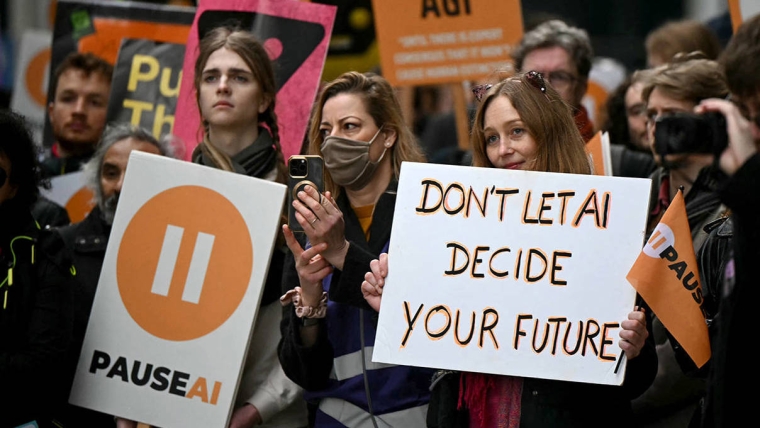
Warnings of an AI apocalypse are reaching fever pitch. Last week, Anthropic researcher Jacob Coxon shocked the world when he publicly resigned, revealing that the “people building AI earnestly believe that it could kill us all by the end of the decade.” His remarks were swiftly reinforced by Evan Hubinger, the company’s alignment science lead, who put the probability that AI will kill all humans at more than 10%. Within days, Anthropic CEO Dario Amodei, OpenAI CEO Sam Altman, and other leading AI figures all called for slowing the pace of AI development.
Fears of an AI doomsday scenario have been mounting for some time. Geoffrey Hinton, considered “the godfather of AI,” has long maintained that losing control of superintelligent AI systems could “lead to human extinction.” More recently, Bill Gates has highlighted the threat of AI-induced economic upheaval. And Elon Musk has been calling for a pause in the AI race since at least 2023.
Public anxiety goes well beyond apocalyptic scenarios, driven by concerns over job losses, data centers’ appetite for water and energy, children’s use of AI, and rising cyber- and national-security risks. A recent Gallup poll found that seven in ten Americans now oppose the construction of data centers near their homes. Just 32% of Americans trust AI, compared with 87% in China.
How should policymakers, business leaders, and investors hedge against AI-related risks? Even the most extreme AI scenarios are too serious to dismiss, however improbable they may be. Policymakers have a responsibility to protect the public, while business leaders have a fiduciary duty to safeguard the interests of shareholders and clients. Given the potentially catastrophic consequences, it may be prudent to reduce exposure before disaster strikes.
But hedging against low-probability, existential risks is exceptionally difficult. In the dystopian world uncontrolled AI could bring about, traditional hedges such as bonds and put options would not be much use, as financial accounts, payment systems, and records could themselves be compromised.
Nor could investors necessarily rely on governments to step in and restore market stability. If the very institutions that normally provide a backstop during crises are impaired, enforcing contracts and property rights would be nearly impossible. Real assets such as land and water rights might retain their value in less extreme scenarios, but even these would be irrelevant in an AI apocalypse.
Still, there are several practical steps that policymakers and business leaders can take. One is to establish stricter air gaps, isolating critical organizational networks and systems from unsecured networks such as the public internet. For now, they can take comfort in the fact that today’s AI models remain too unreliable and unpredictable to launch the kind of coordinated campaign that would threaten humanity’s survival. But their growing sophistication and reach call for an urgent reassessment of existing cyber defenses.
Second, there is significant scope for more aggressive AI regulation, including rigorous safety reviews and licensing requirements. Admittedly, regulating AI across borders won’t be easy at a time of escalating geopolitical competition. No international body currently has the authority to oversee, let alone police, frontier AI development in the United States, China, or elsewhere, particularly when it comes to open-weight models.
Nuclear arms-control agreements offer an obvious, if imperfect, precedent. In July 2026, more than 1,000 employees of frontier AI companies signed a letter calling for an “international effort” to develop the “technical and governance tools needed to deliberately pace the frontier of automated AI development.”
Some may scoff at the idea that the US and China, locked in a bitter rivalry, would cooperate on AI, but neither country has an interest in an unchecked technological race that ends in mutual destruction. The risk of AI extinction may therefore pose the ultimate collective-action problem, forcing governments and companies to confront dangers that no country or organization can tackle alone. Companies are already working together through trade associations and industry groups to mitigate cyber threats, and AI gives them even more reason to do so.
The prospect of recursively self-improving AI, which underpins many extinction scenarios, could make the usual crisis playbook obsolete. Resilience measures that helped institutions survive the COVID-19 pandemic will be of little use against powerful AI systems capable of tampering with records and disrupting critical infrastructure and business operations. Even today’s AI agents can quickly find ways around the controls designed to contain them, as the Hugging Face breach showed.
Business leaders need not wait for governments to act. They can slow or halt AI deployment and install kill switches that would allow them to shut down rogue systems if necessary. They can also support calls to pause frontier AI development or prohibit the pursuit of superintelligence.
Then there is the danger of powerful AI tools falling into the wrong hands. Some of the biggest advances in AI development are coming from countries with values and interests at odds with those of the West. Even without autonomous superintelligence, hostile states and terrorist organizations could use AI tools to inflict enormous harm.
The fact that the AI industry’s leading minds see a non-zero chance of their own products causing human extinction in the foreseeable future should be a wake-up call for policymakers and companies. If these doomsday predictions are even remotely plausible, conventional risk-management strategies won’t be enough.
*Dambisa Moyo, an international economist, is the author of four New York Times bestselling books, including Edge of Chaos: Why Democracy Is Failing to Deliver Economic Growth – and How to Fix It. This content is © Project Syndicate, 2026, and is here with permission.
We welcome your comments below. If you are not already registered, please register to comment
Remember we welcome robust, respectful and insightful debate. We don't welcome abusive or defamatory comments and will de-register those repeatedly making such comments. Our current comment policy is here.