

sign up log in
Want to go ad-free? Find out how, here.

We compare how financial markets have priced the key 10-year bond yields for some countries having social stresses, and benchmarked them with NZ

Bonds / analysis
We compare how financial markets have priced the key 10-year bond yields for some countries having social stresses, and benchmarked them with NZ
riot in France
Image sourced from Shutterstock.com

"France is in flames" is today's narrative, consumed by riots over education, social spending, jobs and affordability issues generally. The Italians have joined in. Spain has similar social ructions.

The financial news has French bond yields jumping on the sharply rising risks of budget sustainability. Other countries have similar fiscal stresses.

The way investors 'price' these risks can be summarised in sovereign bond yields. They are certainly rising fast in France, for example.

But a review of these sovereign 10 year yields over the past 25 years perhaps puts them into a better perspective. Which is what the following tracking shows. And that may surprise some readers.
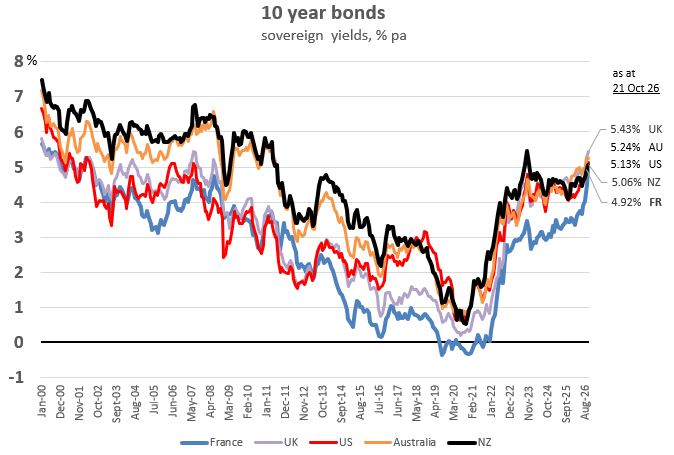
 

We leave it for you to draw implications and 'conclusions'.

We welcome your comments below. If you are not already registered, please register to comment

Remember we welcome robust, respectful and insightful debate. We don't welcome abusive or defamatory comments and will de-register those repeatedly making such comments. Our current comment policy is here.

1 Comments

This is indeed a very interesting graph.

1) For most of the last 27 years New Zealand and Australia have been paying higher yields, implying higher risk than the other countries.

2)  New Zealand bonds haves typically yielded slightly more than Australia, but that is not the case right now.
3) All of the bond yields for the listed countries are now very similar, implying similar perceived risks. 

4) All of the yields are high compared to the recent past but not compared to a longer history.

5) France has recently lost its low yield status relative to the rest of us. It has joined the pack. 

6) Although not directly assessable from the graph, risk is not the only factor that affects yield.


Up
0