

Interest.co.nz is unpacking how AI will change your everyday life - the risks, the opportunities, and what to actually expect. Our series brings you the policymakers, experts and industry leaders from New Zealand and overseas.
By Anna Whyte
Nearly every company Accenture New Zealand talks to has an AI programme underway, says country lead Justin Mowday. But moving from small experiments to enterprise-wide rollout is where most get stuck on skills, on data, and on a workforce split between enthusiasm and worry.
And the anxiety around AI isn't coming from where you'd expect. Boards want it, junior staff are already using it, often without being asked. It's the executives in between.
Mowday says consultancy company Accenture works in "trying to help New Zealand and the businesses within it get future fit."

What companies want from AI
Mowday says many of the tasks businesses have long wanted to fix - the ones that always felt too hard, too slow, too arduous - seem within reach with AI. And not only can it speed up work, it can help companies do things they were not able to previously.
Accenture's insights team conducted a report for Microsoft, analysing 19,000 tasks and 400 occupations. They found 38% of tasks could be enhanced with AI, 14% could be automated, and 24% could be augmented in some way using generative AI.
Mowday said businesses were; "looking in their companies, going, 'I can see that really good AI, or really good automation, or a really good set of agents could do that task, and I could then redeploy that human to a higher value task in the company."
That report estimated generative AI adoption could add up to $102 billion per year to New Zealand's Gross Domestic Product (GDP) by 2038.
"When you extrapolate that out, that's about 275 hours per person that you gain. That's about 15.5% productivity uplift by 2038," he said.
He said almost every company they speak to has a programme underway exploring AI, but then come up against four challenges - data, skills, scale and safety.
"Fundamentally, people have gone, 'that works,' and then they've learnt some other things as well, [that] this is actually a bit harder than what we thought... we need our data in better shape if we're going to do this because this is a data-rich technology."
"Then often we have companies going, 'Oh, where am I going to find enough people with the skills to do this if we want to do this more? That becomes a key challenge," Mowday said.
"Then, how do I do this at scale? Because it's one thing doing some little experiments; it's another thing going, 'Okay, we're going to do this in an enterprise grade, and how do I do it safely, and how do I do it responsibly?'"
Safety and responsibility has to be designed from the beginning he said.
"It's not a layer you put on later. It's right at the inception."
What does it really mean for the workforce?
Mowday thinks the early notion that AI would predominately replace jobs was "probably an unhelpful blunt first place that people went to."
"Look, in some cases, where it's really, rote-sort of jobs, they may well be replaced, and hopefully those people will then go on and do higher value things that they enjoy more."
But Mowday said it is about moving from the idea that rather than replacing jobs, it can make jobs better.
"We're still at a point where we need humans to lead this to actually monitor, control, direct AI and agentic AI."
"What we're seeing is the pendulum swing towards actually this can uplift customer experience... It can increase revenue. I can make this easier for citizens to get what they need out of a government."
Breaking down AI uptake in the company, Mowday said they are seeing boards and chief executives considering AI roll outs as an opportunity to uplift revenue, customer experience and efficiency.
"Then we're seeing perhaps the more junior ranks in a company probably doing a whole lot more than you even know. They have embraced tools. They are off and running. They're using it in their personal life, they're using it in their work life."
But it's the middle group of executives that are generally more worried about it.
"I think that unhelpful start point of 'this threatens my job' is an inhibitor," Mowday said.
"Maybe there is an age factor in there... Younger people tend to adopt new technology pretty readily."
On helping the workforce adopt AI, Mowday said, AI is not a strategy.
"AI is a tool and a technique to achieve your strategy. So you still need a business strategy, and you still need a growth plan, and that still needs to be developed and shared."
"Then, of course you define, what's the role of AI and agentic AI within that? How can that now help? How can it propel us towards that?"
"Then we really advocate for being very transparent and clear with your workforce about where you want to use AI and why, and how those roles and jobs may change, and where we see humans being really really critical still."
The overseas job trends
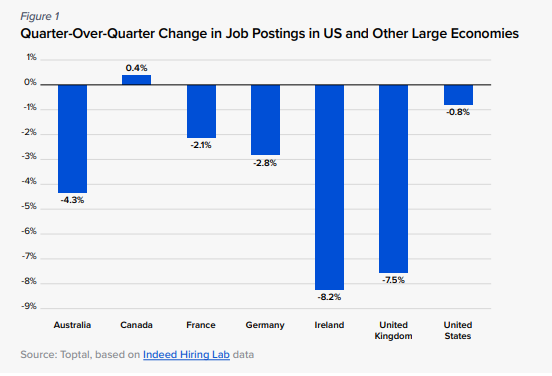
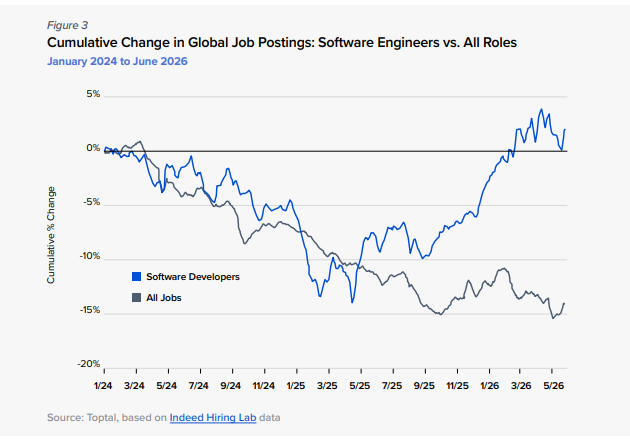
Toptal second quarter data, which looks at job trends in the US and broad global market, found while postings for all professions remained lower than two-years-ago, software engineers, a useful proxy for the broader technology sector, has started to rebound.
The report said this was largely due to organisations investing in software development, cloud infrastructure, and AI-related capabilities.
"What’s more, the rapid adoption of AI is prompting companies to embark on initiatives and investments that they wouldn’t otherwise, thereby increasing the need for technical talent. The data suggests that AI is functioning as a complement to software engineers, rather than a substitute."

We welcome your comments below. If you are not already registered, please register to comment
Remember we welcome robust, respectful and insightful debate. We don't welcome abusive or defamatory comments and will de-register those repeatedly making such comments. Our current comment policy is here.