
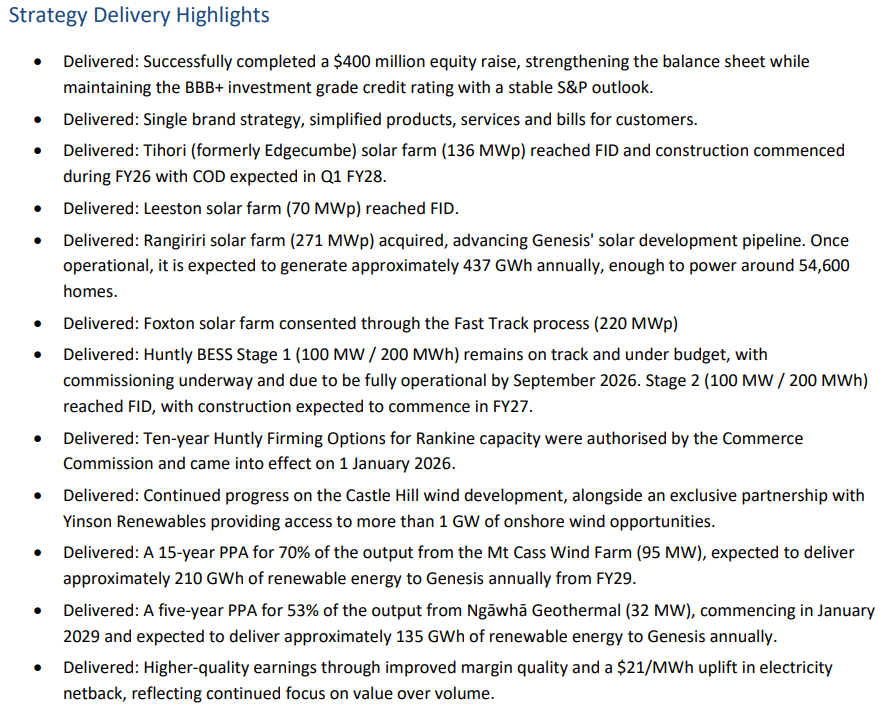
Genesis Energy’s annual net profit fell by 50% due to lower wholesale electricity prices.
The state-controlled company, which sells electricity, reticulated natural gas and LPG, reported its annual results on Thursday. Genesis is one of the country’s largest energy generators and retailers with nearly 500,000 customers.
Net profit after tax (NPAT) halved in the 2026 financial year, down 50% to $85 million, driven by a drop in the wholesale price of electricity. The power company reported a $169 million NPAT for the prior year.
Genesis’ reported operating earnings before interest, tax, depreciation, amortisation and fair value movements, or EBITDAF (the sector’s preferred underlying operating metric), were $518 million, up 14% from $454 million in the 2025 financial period.
Genesis’ operating earnings for the June year were much lower than those from fellow state-controlled competitors Mercury and Meridian, both of which have also released their full-year financial results over the past week. Mercury’s operating earnings for the year ended June reached $1.068 billion while Meridian reported $1.051 billion.
The Government holds a legislated 51% majority shareholding in Genesis, as well as Mercury and Meridian Energy. All three power companies make up the four largest power generators and retailers (gentailers) in NZ, along with Contact Energy. Contact has no government shareholding but is one of the country’s largest listed companies on the NZX.
Genesis said its revenue during the June year, which fell 24% to $2,821 billion, was helped by higher customer sales and the pass-through of transmission and distribution costs – but offset by lower wholesale volumes and prices.
'Solid' gross margin
Genesis said it delivered a “solid” gross margin of $949 million, up 10% from a year earlier and its highest to date, according to Genesis. The margin growth was driven by strong portfolio management, renewable generation and managing fuel position to monetise reduced thermal generation during the 2026 financial year.
Operating free cash flow jumped 24% to $322 million, with Genesis saying this supported continued investment in renewable generation, battery storage and core generation assets during the June year.
Genesis chief executive Malcolm Johns said Genesis was continuing to embed margin quality, cost discipline and strong capital management into “every part” of the business.
“Through our large customer base, growing renewable generation and Huntly's evolving role to firm our increasing solar and wind generation, we are structurally lowering our average cost of generation while strengthening the flexibility we need,” he said.
“We are focused on lowering the total cost of energy for our customers through electrification of transport and heat, which in turn grows demand for electricity, improves New Zealand's energy security and delivers a lower carbon economy.”
Genesis declared a final dividend of 7.58 cents per share (cps), taking the total dividend to 14.88 cents for the 2026 financial year.
In the 2027 financial year, the power company expects normalised operating earnings of $480 million to $520 million, based on normal hydrological conditions, current assumptions for gas availability and plant reliability, and the absence of material adverse events.
“Investment will continue across renewable generation, battery storage and the final year of the company's major technology transformation programme,” Genesis said.
Beyond the current financial period, Genesis said it continues to see a “credible pathway” to operating earnings in the upper $500 million range by the 2028 financial year.
This would be supported by ongoing improvements in margin quality, disciplined cost and capital management, lower operating costs following completion of major technology programmes, new renewable generation and the expanding role of Huntly, the country’s largest thermal power station, in providing flexibility for a more renewable electricity system.
'Under control'
During an analyst call following the results, Genesis was asked about the progress of its IT delivery. Genesis Energy is currently undertaking platform upgrades for a new billing and CRM system, a financial management system and an electricity trading and risk management platform.
Genesis chief financial officer Emma Oettli had called them “complex programmes” earlier on in the call and said that the power company remained on track to complete them by the end of the 2027 financial year within a budget of $145 million.
When questioned about managing cost slippage for the system upgrades, Johns said the costs were currently under control. He described the system replacements as a “heart and lung transplant” for the business.
“The financial management system is now in, the electricity trading and risk management system is well advanced. We're through the first phase of the billing and CRM system,” he said.
“The big migration will occur in the second half of this financial year, and once that's complete, then all three systems will be in place. We would consider it at this point in time to be under our control.”
We welcome your comments below. If you are not already registered, please register to comment
Remember we welcome robust, respectful and insightful debate. We don't welcome abusive or defamatory comments and will de-register those repeatedly making such comments. Our current comment policy is here.