

The Commerce Commission has finalised its decision to cap interchange fees on Mastercard and Visa commercial credit cards, a move it says will save businesses roughly $40 million annually.
The competition watchdog announced a draft decision to cap commercial credit card interchange fees back in June. In its final decision and reasons paper released on Thursday, the Commission says commercial credit card interchange fees remain “above efficient levels” and need to be regulated.
“These fees ultimately flow through to retail prices, where everyone pays for benefits only some people receive, which creates an inefficient system,” Commissioner Bryan Chapple says.
Interest.co.nz is seeking comment from Mastercard and Visa.
The new caps are below:
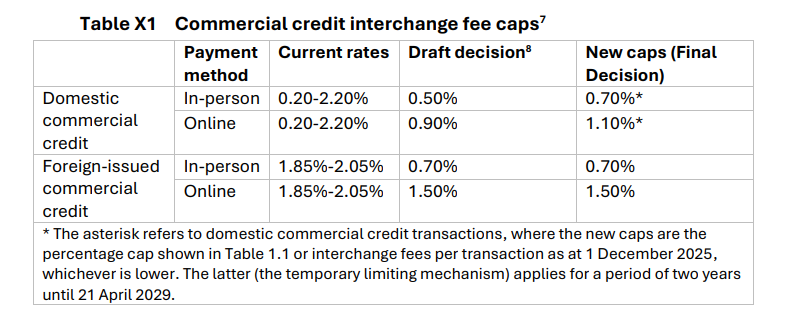
Commercial credit cards make up a small share of transactions but generate a “disproportionately larger share” of interchange fees, according to the Commission, which it says are paid for by businesses through their merchant service fees.
Interchange fees are paid by a business’ ‘acquirer’ – the bank or another payment service provider that enables a business to accept credit and debit card payments – which is then paid to the customer's card issuer for each card transaction on the Mastercard and Visa networks.
Interchange fees do not generate revenue for operators of card payment schemes like Mastercard and Visa, but they still grow the networks of card payment scheme operators and make up the largest component of merchant service fees paid by merchants to their banks.
The final decision and reasons paper found that current weighted average domestic commercial credit card interchange rates in New Zealand remain around 1.40%, which is more than double those on domestic personal credit cards. Domestic commercial credit card interchange fees are also almost double those observed in Australia, which are near 0.8%.
“Businesses are paying too much to accept commercial credit cards,” the paper said.
Improving incentives
The Commission estimates NZ businesses pay approximately $170 million in merchant service fees each year to accept Mastercard and Visa commercial credit card payments, with NZ merchants currently paying $125 million per year in interchange fees alone in order to accept domestic and foreign-issued commercial credit cards.
This represents around 19% of total interchange fees paid, despite commercial credit transactions accounting for only 8% of the total value of transactions.
Chapple says the new cap on commercial credit card fees, combined with the Commission’s earlier cuts to interchange fees on personal cards, should reduce businesses’ costs by around $290 million each year. Of that, the Commission estimates around $40 million a year will come from the new commercial credit card caps.
“Reducing these fees will ensure the costs businesses pay to accept Mastercard and Visa cards are reasonable and improve the incentives for payment issuers, like banks, to consider supporting alternative payment methods,” he says.
One alternative is open banking, which the Commission recently estimated could save businesses about $180 million annually instead of Mastercard and Visa debit transactions. The Commission found open banking services could offer lower costs, faster payouts and additional functionality than traditional card payments or bank transfers.
The new interchange fee caps will come into effect on 22 April 2027. The Commission says businesses should review their merchant service fee arrangements and contact their payment service providers to understand how the changes may affect their costs.
We welcome your comments below. If you are not already registered, please register to comment
Remember we welcome robust, respectful and insightful debate. We don't welcome abusive or defamatory comments and will de-register those repeatedly making such comments. Our current comment policy is here.