
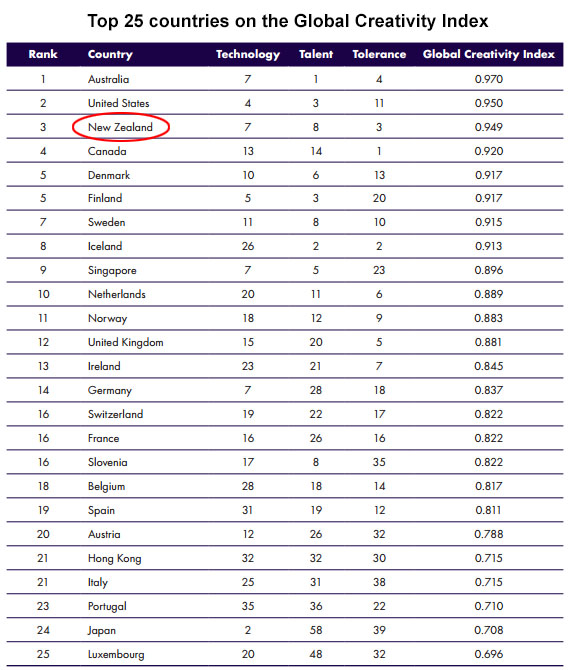
New Zealand has ranked high in a global assessment of creativity. We are now playing with the adults - and winning.
The Canadian study puts us at #3 after Australia and just marginally below the US.
Here is the Introduction to this study:
Capitalism is in the midst of an epochal transformation from its previous industrial model to a new one based on creativity and knowledge.
In place of the natural resources and large-scale industries that powered the growth of industrial capitalism, the growth of creative capitalism turns on knowledge, innovation, and talent.
Adam Smith long ago called attention to the role of human capital as a “fourth factor of production” alongside land, labor, and capital.
Creativity differs in fundamental ways from the traditional, tangible factors of production. It is not a stock of things that can be depleted or worn out, but an infinitely renewable resource that can be continually replenished and deepened.
Innovation and economic progress also stem from diversity and openness to talented people across the board.
Capitalism in the Creative Age is thus organized more around places that attract and mobilize talent and technology. Indeed, place has supplanted the corporation as the key economic and social organizing unit of our time.
Just as the older model of industrial capitalism was organized around major classes—capitalists and the working class—the new model of creative capitalism gave rise to a new set of occupational classes.
The working class, which has declined from its peak of nearly half the workforce to just one in five workers in most advanced nations, has given way to two even larger classes. The creative class, which comprises a third to more than forty percent of the workforce in the advanced nations, includes scientists and technologists; artists, cultural creatives, and media workers, as well knowledge-based professionals in business, education, and health-care. While the varied members of the working class had physical skills as a shared trait, the diverse groups of workers that make up the creative class all draw on their underlying human creativity.
The even larger service class is made up of lower-skill, lower-wage, routine service occupations in fields like health care support, food preparation and service, low-end retail, and office and administrative positions.
The divide between these two main classes lies at the root of growing inequality and class division across advanced and developing nations alike.
Growth and prosperity under creative capitalism turns on a new model we term the 3Ts of economic development—Technology, Talent, and Tolerance.6 Technology is the first T.
It has long been recognized as a key driver of wealth and progress. Karl Marx and later Joseph Schumpeter noted that advances in technology enable capitalism to generate new industries and spur new growth.
In the late 1950s, Robert Solow defined technology’s role as a driving force in economic growth, for which he received the Nobel Prize in economics.
Technology increases productivity, creates wealth, and enables capitalism to constantly reinvent itself.
The GCI includes both the standard measure of R&D effort—the share of GDP devoted to R&D—and the standard measure of innovation, which is based on patents.
Talent is the second T.
Talent, or human capital, stands alongside technology as a primary driver of economic growth.
As far back as the 1950s and 1960s, Peter Drucker and Fritz Malchup identified the role of knowledge workers to economic development. Paul Romer later formalized the role of knowledge and connected it with technology in his theory of endogenous growth.
A large amount of research has shown the close connection between talent and economic progress. Beginning with Jacob Mincer’s classic models of human capital, a wide body of studies has documented the connection between human capital and economic development at both the national and regional levels. A more recent stream of research suggests an alternative measure for human capital based on occupation, or class, to better capture human capital effects in relation to growth and innovation. The GCI includes both educational and occupational measures of talent.
Tolerance is the third T.
Tolerance acts on economic development by helping to establish the broad context for both technological innovation and talent attraction. Places that are open to different kinds of people gain an edge in both attracting talent from across the spectrum and mobilizing new ideas.
Tolerance thus forms an additional source of economic advantage that works alongside technology and talent.
The GCI includes two measures of tolerance—openness to ethnic and religious minorities and openness to gay and lesbian people.
This updated 2015 edition of the Global Creativity Index assesses the creative performance and longer run economic potential of 139 nations across the world. It expands the previous 2011 edition, adding more than 50 additional countries to the analysis.
The report is organized into two major parts. The first part presents the rankings of nations on each of the 3Ts. We then combine these individual scores into our overall ranking on the Global Creativity Index (GCI).
The second part examines the connections between the GCI and broader measures of economic development, competitiveness, and prosperity. The details of our methodology, data sources, and variable definitions can be found in the appendix.
We welcome your comments below. If you are not already registered, please register to comment
Remember we welcome robust, respectful and insightful debate. We don't welcome abusive or defamatory comments and will de-register those repeatedly making such comments. Our current comment policy is here.