
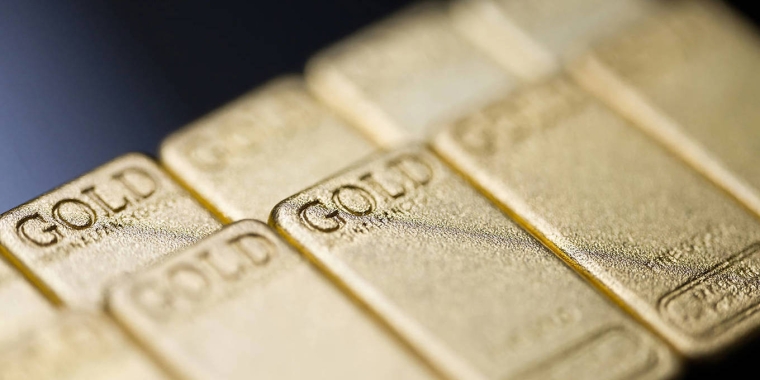
Gold may be a “barbarous relic,” as John Maynard Keynes once observed, but it remains the relic of choice among central banks. Emerging-market central banks have been loading up on gold reserves ever since the 2008 global financial crisis, more than doubling their holdings. Does the anomalous behavior of gold prices since the outbreak of the war with Iran call this strategy into question, or is something else going on?
Gold’s allure derives from its reputation as a safe haven and inflation hedge. Yet in March, following the start of the war, an event that should have supported demand for gold on both grounds, its dollar price fell by 10%. Prices then remained flat in April. Evidently gold is not quite the safe haven and inflation hedge investors thought it was.
Various explanations have been offered for this anomalous behavior. Traders incurring losses on other investments may have sold gold futures and funds to meet margin calls. Higher interest rates, or at least diminished expectations of interest-rate cuts, may have caused investors to shift from gold to bonds. Turkey’s central bank sold gold to obtain the foreign exchange needed to support the country’s currency, the lira. Other central banks may have followed suit.
In any case, this episode is a reminder that gold prices can be volatile. So, should central bankers re-think their investment strategies?
Consider why central banks hold gold. Holding bullion has history on its side, having long been a sign of respectability for central banks. Any global investor will want to include in its portfolio a “commodity play,” an investment correlated with commodity prices. Being long on gold is one way to obtain this exposure, although in a world with commodity and future ETFs there are other instruments offering better combinations of risk and return.
The most important factor, though, is that gold kept at home is free of sanctions risk. Foreign-exchange reserves held as bank deposits and securities abroad are at risk of being immobilised, or even garnished, by a foreign government using sanctions for deterrence purposes, as Russia was reminded following its attack on Ukraine in 2022.
Russia was not unaware of the danger: the share of its foreign reserves held in gold more than doubled from 2014, just prior to its annexation of Crimea, to its full-scale invasion of Ukraine in 2022. It repatriated all of it, vaulting it in St. Petersburg and Moscow.
The People’s Bank of China has been less forthcoming about its gold operations but is thought to have been the single most important central-bank purchaser in recent years. The PBOC is thought to store the vast majority of that gold in Beijing and Shanghai, presumably because it is cognisant of sanctions risk.
My own research with co-authors suggests that the pattern is general: exposure to US financial sanctions significantly increases the share of reserves that emerging and developing economies hold in the form of gold. More generally, the largest central-bank gold purchases in recent years have been by countries that are significantly exposed to geopolitical risk, not just Russia and China but also Poland, India, and—before last March—Turkey.
A further indication of what central banks are thinking is that the share of official gold reserves held in custody at the Federal Reserve Bank of New York has fallen from 30% of the global total in 2005 to barely 20% today. Policymakers in other countries are questioning whether the US is a reliable ally and whether the New York Fed is a reliable custodian. Recent reports link popular pressure for gold repatriation in Germany and Italy to political tensions with the United States and threats to the Fed’s independence. Who would have thought?
But gold vaulted at home can’t be lent, swapped, or posted as collateral, unlike gold vaulted in London and New York. It is clunky when used for payments. In 2019, Venezuela’s government, subject to US sanctions, chartered a Boeing 777 from a Russian company to ferry 7.4 tons of gold to Uganda, where it was refined and resold. Venezuela received $300 million worth of euros to pay for merchandise that would have been unavailable to the country otherwise.
Venezuela did it again in 2020, paying for oil-field equipment and services from Iran, also sanctioned, by hiring a fleet of 747s to transport gold bars. These operations, complex and unwieldy, were exceptions that proved the rule.
In this sense, central-bank purchases and repatriation of gold are a symptom of deglobalisation. They signal the advent of a more geopolitically fragmented world in which cross-border transactions of all kinds are poised to become more difficult and costly.
Barry Eichengreen, Professor of Economics at the University of California, Berkeley, is the author, most recently, of In Defense of Public Debt (Oxford University Press, 2021). Project Syndicate, (c) 2025, published here with permission.
19 Comments
The golden rule
He who has the gold makes the rules
this is concerning, even during the GFC the solutions where fiat based , is this end times for fiat ?
The alternative to fiat?
There is no orderly alternative to USD being the fiat based reserve currency, the assets held in USD ie Treasuries etc, have no other place to actually goto. I suggest they would flow in a Sovereign basis into Sovereign government debt ( at negative rates by then).
Gold is not an alternative, it's an insurance policy that the Sovereign states holding gold have some purchasing power in the post USD based world. A collection of currencies could play a role as an anchor with perhaps commodities as well, but as all these are normally priced in USD you can imagine how chaotic this would be, if you have 10% of your reserves in say GBP what asset class would they sit in? gilts?
money used to flow into USD and JPY in times of crisis, if money flows out of USD in the next crisis, we are in end times. 100 times as much if it goes into physical gold.... which may actually just become non deliverable.
So in effect you are saying fiat cannot end (that does not mean the USD cannot lose its role)...which would make sense as money has always been by fiat.
fiat does not end but assets valued in fiat loose most of their value think loaf of bread and wheelbarrow of money to purchase in Germany, starting you fire with $1fiat bills seems reasonable, one bread is a million $.
who wants to be a tirkish lira millionaire?
", is this end times for fiat"
You have answered your own query
So in effect you are saying fiat cannot end (that does not mean the USD cannot lose its role)...which would make sense as money has always been by fiat.
Of approximately 775 fiat currencies ever created, 600+ have failed - 87% failure rate. According to monetary historians, the average lifespan of a fiat currency is just 27 years, though some major currencies like the British pound and US dollar have endured longer despite significant devaluation. There are currently 180 currencies recognized by the UN.
USD is not the same now as it was when Nixon suspended dollar-gold convertibility in 1971 because the United States had more foreign-held dollars in circulation than it had gold reserves to back them, making the system unsustainable and leaving the country vulnerable to a catastrophic gold run.
https://www.businessinsider.com/the-failure-of-money-2012-9
The point being one fiat currency will be replaced by another fiat currency.
as long as people wish to trade they have two options...barter or fiat.
"There is no orderly alternative to USD being the fiat based reserve currency..... Gold is not an alternative"
Perhaps tokenised Gold, backed by physical Gold is an alternative ?
Sort of but do you trust the physical holder to give you your gold if asked, ie the issues is that central banks are moving gold from swappable vaults to their own countries... tokens do not help physical settlement issues of trust
Tokenized gold already exists Dr Y. Tether has become one of the largest buyers and private holders of gold globally, even outpacing most central banks.
Your stake is secure - as long as you don't get on the wrong side of the govt. Hopefully Iran is a special case...
https://no01.substack.com/p/the-cbdc-we-already-have
Permissionless, censorship-resistant, beyond the reach of any single government.
The whole pitch of crypto, repeated in white papers and conference keynotes for fifteen years, was that this was the exit. The dollar system had become weaponised, the rails could be cut at will, but the chain - the chain was sovereign.
...
As recent as April 22nd, Tron founder Justin Sun declared his blockchain “the most decentralised in the world”.
On April 23rd, the US Treasury called Tether and asked them to freeze $344 million of Iranian funds on Tron. Tether did it in one single smart-contract call. Two wallets, blacklisted at the issuer level, $213 million in one and $131 million in the other.
That money didn’t move or got seized. It instantly became decorative. Visible on the chain, but immobile, a monument to a successful misrepresentation.
"The alternative to fiat?"
Alfa Romeo
Yvil,
You don't think on a big enough scale-Ferrari is my answer.
Out of the frying pan and into the fire
Into the mechanic....or the back of someone?
The price of spot Gold moving as a risk on asset since the war in Iran (dropping in price with uncertainty and rising with good news) has certainly been surprising. I believe there is increasingly a marked difference between "paper" Gold, meaning ETF's and the COMEX manipulated spot price, and the value or "real" physical Gold. This is more visible in the Silver market, where the price of physical Silver being purchased at the Shanghai exchange is now commonly in excess of 10% higher than the paper Silver futures of the COMEX. $77.30 on COMEX and $86.42 in Shanghai = +11.8% premium at the time of writing.
I wouldn't bet on gold at the moment. Too risky. If you do, make it a small % of your overall portfolio.
I believe there is increasingly a marked difference between "paper" Gold, meaning ETF's and the COMEX manipulated spot price, and the value or "real" physical Gold/
Paper gold (and silver) rock if you understand how to work it in your advantage. There are gold derivatives that are arguably better than others - PMGOLD for example.
Even after last night's bloodbath, ETPMAG on the ASX is up 115% past 12 months. Silver CFDs up 135% over same time period.
ETPMAG has been far better than most asset classes, and far better than cash obviously and the beloved Ponzi.
That depends on your investment horizon JC, you seem to be a trader, I'm a long term investor.
We welcome your comments below. If you are not already registered, please register to comment
Remember we welcome robust, respectful and insightful debate. We don't welcome abusive or defamatory comments and will de-register those repeatedly making such comments. Our current comment policy is here.