


Mortgage interest rates and incomes are now the main drivers of changes in housing affordability for first home buyers, as house prices at the bottom of the market go nowhere.
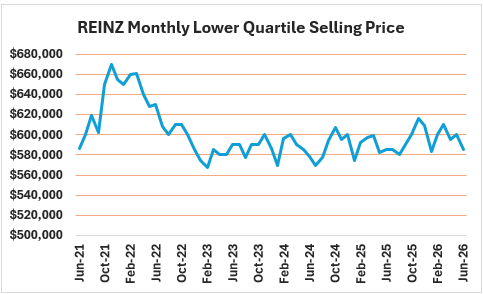
According to the Real Estate Institute of New Zealand (REINZ), the national lower quartile selling price was $585,000 in June this year, back to almost exactly where it was five years ago.
The lower quartile price is the price point at which 25% of selling prices are below and 75% are above, representing the most affordable end of the housing market.
In June 2021 the lower quartile price was $586,000. It then rocketed up to a peak of $670,000 in November 2021 during a debt-fuelled price boom engineered by the Reserve Bank and fuelled by the trading banks, before plunging back to its recent low point of $567,500 in February 2023.
Since then there have been monthly movements up and down, but overall it's gone nowhere for the last three years and is now $1000 less than it was five years ago.
So price movements are not currently a big factor in changes to affordability. Interest rates and incomes are now the main drivers.
The average two year fixed mortgage rate bottomed out in the current cycle at 4.49% in November last year, and has increased in every month since to 5.26% in June this year.
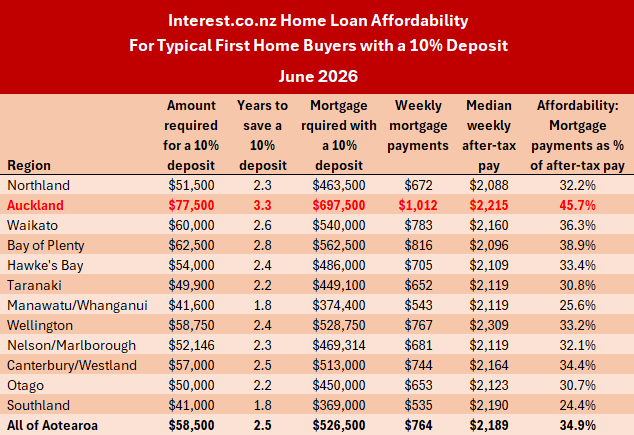
That pushed mortgage payments on a home purchased at the national lower quartile selling price up from around $741 a week to $764, over that period, assuming it was purchased with a 10% deposit. That's an increase of $23 a week.
Interest.co.nz estimates over the same period, the combined after-tax pay of a couple working full time at the median rates of pay for people aged 25-29, would have increased from $2170 a week to $2189. That's up $19 a week.
So the extra $23 a week in mortgage payments since November last year as a results of rising interest rates has been almost balanced out by rising wages.
However, household budgets will also be under pressure from other rising costs, which will be making life more difficult for aspiring first home buyers.
At the national level, mortgage payments on a home purchased at the lower quartile price with a 10% deposit would eat up 35% of a typical first home buying couple's after-tax pay.
That's well within affordable limits with mortgage payments not considered unaffordable until they take up more than 40% of after-tax pay.
The last time they were above 40% was in July 2024, when the average two year fixed rate was 6.50%.
All of this suggests that for the time being, first home buyers may be in something of a sweet spot, even though interest rates are rising.
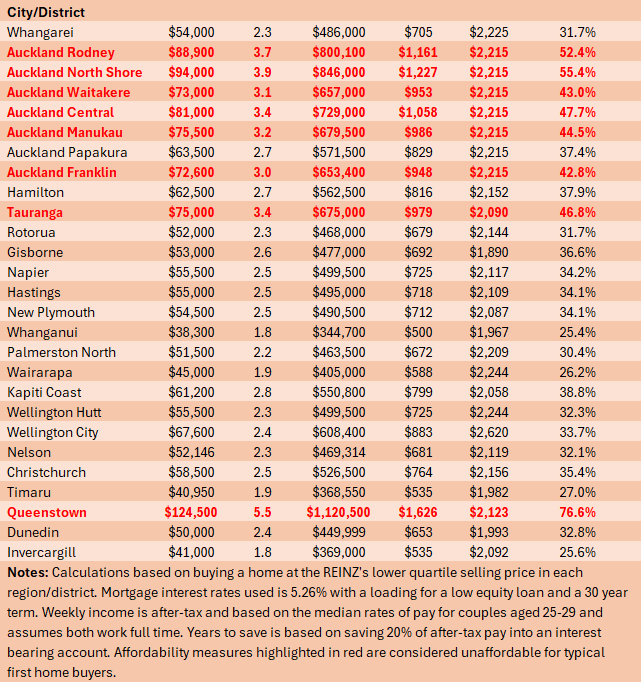
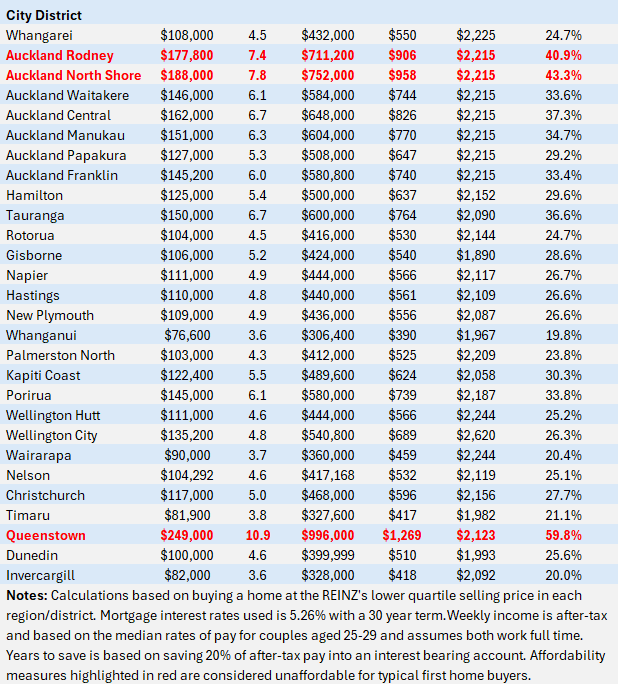
The main exceptions to this are Auckland, Tauranga and Queenstown, with housing remaining at unaffordable levels in those areas for typical first home buyers on average incomes.
The graph below shows the movement in the REINZ's national lower quartile price over the last five years.
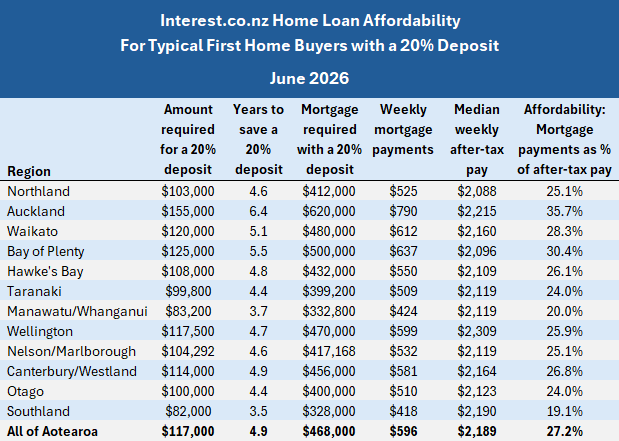
The tables below show the main affordability measures for homes purchased at the REINZ's low quartile price with either a 10% or 20% deposit, in all main urban areas throughout the country.
The comment stream on this article is now closed.

We welcome your comments below. If you are not already registered, please register to comment
Remember we welcome robust, respectful and insightful debate. We don't welcome abusive or defamatory comments and will de-register those repeatedly making such comments. Our current comment policy is here.