

By Sheryl Sutherland*
As you know, the three main asset classes are stocks/equities, fixed income and cash (or cash equivalents. Outside those, in the context of portfolio diversification, people can consider options of gold/metals, EFTS and crypto to be in their own classes too. I won’t be mentioning these, as I consider them to be too high risk for most investors; although gold has had a magnificent run thanks to China – another story.
Supposedly, these different asset classes behave differently during different market environments. The relationship between two asset classes is called asset correlation. For example, shares and bonds are held alongside one another because they are usually negatively correlated, meaning when stocks go down, bonds tend to go up, and vice versa.
However, that theory has been blown out of the water of late. It has been widely accepted that choosing an asset allocation is more important over the long term than the specific selection of securities. That is, choosing what percentage of your portfolio should be in shares and what percentage should be in bonds is important - and impactful. Theory being that uncorrelation between assets offers a diversification benefit that helps lower overall portfolio volatility and risk.
This concept is widely used for those with a low tolerance for risk and/or for those nearing, at, or in retirement.
Your advisor will suggest that you think of asset allocation as the big-picture framework or foundation upon which your portfolio re moving on to the minutiae of selecting specific securities to invest in. We know that we can't consistently time the market or pick individual shares with success. Moreover, they say that staying disciplined with this framework on your investing journey will allow you to more easily reach your financial objectives and will improve the reliability of the expected outcome.
Most people I’ve talked to aren’t familiar with the term ‘asset allocation’, but it is simply a ratio of different asset classes held.
Asset allocation is usually colloquially written about and stated as a ratio of shares to fixed income, e.g. 60/40, meaning 60% shares and 40% bonds. Continuing the example, since bonds tend to be less risky than stocks, the first investor with a short time horizon may have an asset allocation of 10/90 shares/bonds while the second investor may have a much more aggressive allocation of 90/10.
We can extend that description to other assets like gold, for example, written as 70/20/10 shares/bonds/gold, meaning 70% shares, 20% bonds, and 10% gold. These pie graphs give the picture:
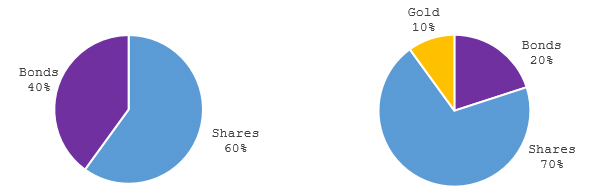
Because of the historical negative correlation between stocks and bonds, and because planners want the security of a ‘safe harbour’ when markets go down, the 60/40 split has become the ‘gold standard’ of advice. A recent article posted by Morningstar points out:
“The dual bear market for both stocks and bonds in 2022 created the perfect storm for the 60/40 portfolio, which had been a popular asset-allocation strategy for the past couple of decades. With broad stock market benchmarks down 19% for the year and bonds down 13%, a 60/40 mix of the two suffered its worst performance since the global financial crisis in 2008.
This disappointing showing was followed by a chorus of pundits heralding the death of the 60/40 portfolio as a viable investment strategy. That didn't happen. In fact, a standard balanced portfolio combining a 60% weighting in the Morningstar US Market Index and a 40% weighting in the Morningstar US Core Bond Index chalked up returns of 18% in 2023.”
After some beautiful graphs, they conclude that there are lessons to be learned in the 60/40 portfolios, fall and redemption for one. It’s not realistic to expect any portfolio strategy to excel in every market environment. Now this is what really interested me, it’s a fairly limp summation.
With the assistance of a summary by Brent Wheeler (admittedly a quant but he can be forgiven, he thinks outside the box) the challenges of the traditional 60/40 split are as follows:
1. High Equity Valuations:
The stock market has experienced significant growth, leading to high valuations. This increases the risk of lower future returns
2. Monetary Policies:
Unprecedented monetary policies. such as low interest rates and quantitative easing, have impacted bond yields and returns
3. Inflation and Interest Rates:
Rising inflation and interest rates have reduced the effectiveness of bonds as a hedge against equity risk
4. Geopolitical Tensions:
Events like the war in Ukraine and tensions between major economies have added uncertainty and volatility to the markets
5. Correlation Between Stocks and Bonds:
The historical negative correlation between stocks and bonds has weakened, reducing the diversification benefits of the 60/40 split
6. Exclusion of Alternative Assets:
The traditional 60/40 portfolio often excludes assets like Treasury Inflation-Protected Securities (TIPS), gold. and commodities. which can provide additional diversification and protection against inflation
Despite these challenges, some experts argue that the 60/40 portfolio is not dead and can still provide balanced returns with proper adjustments and diversification.
The question I have however, is why use bonds at all? If your portfolio is structured for long term investment the risk of equities diminishes at around five years. At that point, the returns on a 5% bond are the same as an equity of 7.5%.
Consider this:
- Equities return somewhere between 6-8% on average.
- Bad years don’t happen that often.
- Even ‘quite bad’ still has you in the money.
Remember Warren Buffett and his portfolio – 90% equities, 10% cash. You can’t argue with the returns he has achieved for his shareholders.
*Sheryl Sutherland is director of The Financial Strategies Group, and author of Girls Just Want to Have Fund$ – Every Women’s Guide to Financial Independence, Money, Money, Money Ain’t it Funny – How to Wire your Brain for Wealth, and co-author of Smart Money – How to structure your New Zealand business or investments and pay less tax. You can contact her here.
We welcome your comments below. If you are not already registered, please register to comment
Remember we welcome robust, respectful and insightful debate. We don't welcome abusive or defamatory comments and will de-register those repeatedly making such comments. Our current comment policy is here.