
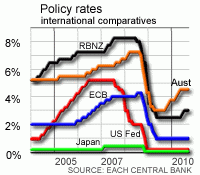
The Reserve Bank of Australia has surprised almost all economists by leaving its official cash rate on hold at 4.5%.
Markets had expected an increase to 4.75% as Australia deals with a cash surge from its biggest mining boom in the last 100 years.
The Australian dollar tumbled a full cent vs the US dollar to 95.75 USc while the New Zealand dollar initially fell to 73.5 USc from 73.7 USc before rebounding to 73.9 USc. The New Zealand dollar, therefore, strengthened significantly against the Australian dollar to 77.0 Ac from 76.3 Ac.
Most economists had expected the Reserve Bank to hike after strong commodity price inflation data and bouyant consumer price inflation. This would have lifted the gap between Australian rates and New Zealand rates to over 1.75%.
However, the RBA did appear to warn that it may have to hike the rate in future.
The Reserve Bank of New Zealand is expected to leave its Official Cash Rate on hold at 3% until the end of the March quarter of next year.
"The current stance of monetary policy is delivering interest rates to borrowers close to their average of the past decade. The Board regards this as appropriate for the time being," Stevens said.
"If economic conditions evolve as the Board currently expects, it is likely that higher interest rates will be required, at some point, to ensure that inflation remains consistent with the medium-term target," he said.
Here is the full statement below from the Reserve Bank of Australia's Governor Glenn Stevens.
At its meeting today, the Board decided to leave the cash rate unchanged at 4.5 per cent. The global economy grew faster than trend over the year to mid 2010, but will probably ease back to about trend pace over the coming year.
Recent information is consistent with a more sustainable, but still strong, pace of growth in China and most of the Asian region.
In Europe and the United States, growth prospects appear to be modest in the near term, a legacy of the financial crisis and its impact on private and public finances.
Financial markets are still characterised by a degree of uncertainty, and are responding both to differences in growth outlooks between regions and evident strains on public finances and banking systems in several smaller countries in Europe.
Most commodity prices have changed little over recent months, and those most important to Australia remain very high.
Information on the Australian economy shows growth around trend over the past year.
Public spending was prominent in driving aggregate demand for several quarters but this impact is now lessening, while the prospects for private demand, and in particular business investment, have been improving. This is to be expected given the large rise in Australia’s terms of trade, which is now boosting national income very substantially.
Asset values are not moving notably in either direction, and overall credit growth is quite subdued at this stage, notwithstanding evidence of some greater willingness to lend.
Inflation has moderated from the excessive pace of 2008. The effects of the rise in tobacco taxes aside, CPI inflation has been running at around 2¾ per cent over the past year.
That looks likely to continue in the near term. The current stance of monetary policy is delivering interest rates to borrowers close to their average of the past decade.
The Board regards this as appropriate for the time being.
If economic conditions evolve as the Board currently expects, it is likely that higher interest rates will be required, at some point, to ensure that inflation remains consistent with the medium-term target.
11 Comments
I don't think the RBA had much choice, they are very worried about the Aus. Ponzi housing market and have to keep the OCR as low as possible to keep the property market from crashing.
An old mate of mine in Australia has invested heavily in property there. He is scornful of suggestions that their housing market is currently the planet's hottest ponzi scheme. According to him, Australia's mining industry "guarantees" that the Aussie market and economy will never falter. He often uses the word "mug" when referring to those who disagree.
Obviously time will be the final arbitrator on this subject. I would suggest that your "old mate's" opinion may be somewhat clouded by his investment position.
Your mate in Aussie is suffering from "delusions of granduer" and he may find the term "mug" he refers to, for others will come back and bite him !
I think the RBA is caught between a rock and a hard place... hike the rate and see the currency run as investors pile into Aust paper... only to see it rush out again in a few months...
The mining boom is surely there, but the rest of Aust is probably like NZ - just managing to bumble along - the RBA had to signal that it wasn't going to play into the currency markets hands and as it were 'feed the greed'...
Taking the wind out of the A$ sails is the right thing to do as it dampens down expectations and means that the Aust economy outside of the mining sector can get on with things...
Also this is good for the NZ$... bit of balance coming back into play
@Andy........worried about the Aus. Ponzi housing market and have to keep the OCR as low as possible to keep the property market from crashing.
Noooo, you dont say............
http://blog.lvrg.org.au/2010/10/40-years-of-housing-bubbles-and.html
LVRG CONFIRMS “THE GREAT AUSTRALIAN REAL ESTATE BUBBLE”
By a number of objective measures Australian property is in a bubble, exposing landowners to the imminent prospect of a once-in-a-century price collapse, the Land Values Research Group confirmed today.
“Sober cautionary voices from within Australia and overseas have been ignored in a frenzied headlong rush to profit from the surge in prices,” LVRG Research Associate Bryan Kavanagh said.
“It is now too late. The profits have been made. Canny investors have already sold up and left the market.
.
The Australian Housing market is insane. Ours is not much better. Their banks are our banks. Any correction in Aus will trigger a correction here.
Who knows maybe they can keep their bubble inflated, maybe. I would suggest it's time in Aus & NZ for being cautious and careful. i.e. a time to pay down and stay out of debt. This is no time to be leveraged.
No one will listen though will they? Blinded by the greed. Hoping and believing that this time it's different? Good luck with that.
Rumour has it that at least two of the banks in Oz were waiting for an increase to hike their mortgage rates by a greater margin (say 45 basis points for a 25 RBA uplift).
Profits that they now make on their ealier profligate lending with hot money are forcing them close to a negative return and so even without the RBA hike they will probably be forced to move mortgages up.
Yesterday was one of those days when you have to thank the modern trading platforms available to the retail investor... these days make the diference between those savy traders and the rest. i had to close so many open trades in such a short time that I ended a bit tired but managed to lock in trades that otherwise would have soured. I felt very complacent being a AUD bull for the past few weeks and I must tell you that I was not feeling to comfortable about it in the past few days. And untill the decision came out I was a AUD bull... Don't ever love a trade... Roger K. got it right this time.
I see Australia soon picking on the Super Prof. Tax because higher OCR is not viable
Wolly you're awfully quiet on this topic?
We welcome your comments below. If you are not already registered, please register to comment
Remember we welcome robust, respectful and insightful debate. We don't welcome abusive or defamatory comments and will de-register those repeatedly making such comments. Our current comment policy is here.