
By Alex Tarrant
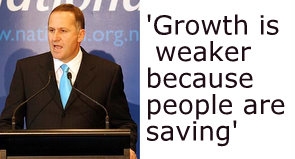
New Zealand's economy would be growing at approximately 6% if New Zealanders were still spending at 2007 levels and not saving, Prime Minister John Key said, citing Reserve Bank data.
Speaking at his post cabinet press conference on Monday afternoon. Key also said that he did not expect the global economy would be hit by a double-dip recession and that he expected interest rates in New Zealand to stay low for "quite a long period of time".
Key was asked that, given Finance Minister Bill English had said people had moved to savings from debt a greater rate than expected, was he hoping people would use quite a bit of their tax cuts to spend at the moment, given the state of the economy?
"It would be good if they make their own choices for what they think is appropriate," Key said.
"All I can tell you is some of the data I’ve seen from the Reserve Bank, If people were spending at the same level they were spending at and not saving, say in 2007 when consumption levels were very high, growth in New Zealand would be approximately 6%
"So the reason that growth is weaker at the moment than we would probably hope is because people are saving."
Key said New Zealanders getting balance sheets in order and getting out of debt as a collective was the right decision.
'No global double-dip recession'
Key was asked whether he was worried about unemployment staying at high levels, given the rebalancing of the economy meant Kiwis weren't spending, and the negative effect this had on unemployment.
“Well we always worry when New Zealanders lose their jobs, and one of the differing features of this recession and then recovery period has been it’s tended to demonstrate jobless growth," Key said.
"That seems to be the case in the United States where unemployment’s sat at 9.6%-9.8% and has been there for much longer than people had anticipated.
"That’s a function of the fact that companies didn’t lay off as many staff as anticipated when the recession was on.
"But because they had fears of a double-dip global recession, they were concerned about overstretching themselves just in case there was another downward cycle.
"My view is that we won’t have a global double-dip recession, and that confidence will be restored over time."
"Unemployment is always a lagging indicator."
'Interest rates low for a long period of time'
Key was asked whether it surprised him that unemployment hadn't improved
"In one sense, we are growing," Key said.
He referred to the government’s statements in the House that New Zealand had grown more in the last nine months than in the last four years.
“But there’s no getting away from the fact that this was a very deep recession, and knocked around capital markets, and international markets have been very concerned about what’s going on," he said.
"You’ve seen quite big swings in policy from very interventionist, highly stimulatory policies now to quite austere policies in countries like the United Kingdom and Italy and Spain and other countries having to cut expenditure."
So there’s nothing more you’re considering to give us stimulus?
Key said the government were always monitoring whether they should consider more stimulus.
"But if you want to put gimmicks to one side, there are three major ways we can stimulate the economy," he said.
"One, Government spends more money, and we’re doing that – we’re spending NZ$13 billion in terms of a deficit. So there’s no question we’re stepping up and running a budget deficit that’s around about 5-6% of GDP.
"Secondly, interest rates are low, and it’s my expectation that they’ll stay low for quite a long period of time. That helps consumers who are paying less for borrowings than they were in the past.
"And the third is we’ve stayed true to our word to cut personal taxes."
'Worried about non-commodity exporters'
With the high New Zealand dollar, Key said he was more worried about exporter sectors that were not commodity linked.
"For the most part we’re actually seeing very strong commodity prices, not just in dairy, but [for] wool, sheep and beef," Key said.
"But obviously the exporter who’s exporting to the United States of America, with no commodity link, is struggling at the moment."
Key said the challenges facing exporters by the high exchange rate was a very difficult situation.
“I saw David Cunliffe in the weekend saying he’s going to urge or make the Reserve Bank intervene. Well he’d be well worth to have a trip to Japan,” Key said.
See full story on Labour's foreign ownership policy and Cunliffe comments on monetary policy here.
“Intervention does not work. At the very best it might take the rough edges off the highs and lows, but it does not work as a policy.”
Key said the government had to take the pressure off exporters in ways that it can.
“Controlling government expenditure takes the pressure off [Reserve Bank Governor] Alan Bollard [to raise interest rates]," he said.
“Making sure that the infrastructure block takes the pressure off our companies.
“Making sure we have free trade agreements - that’s good orthodox economic policy that actually works.
“Gimmicks of economics, for the most part, don’t.”
(Updates with 'worried about non-commodity exporters'.)
We welcome your comments below. If you are not already registered, please register to comment
Remember we welcome robust, respectful and insightful debate. We don't welcome abusive or defamatory comments and will de-register those repeatedly making such comments. Our current comment policy is here.