
By Bernard Hickey
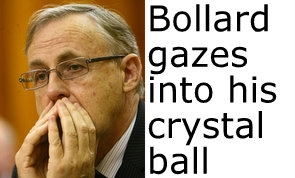
Reserve Bank Governor Alan Bollard has delivered a speech titled "Looking into the Crystal ball" in Christchurch which details 8 risks to a gradual recovery in the New Zealand economy through 2011.
In a wide-ranging speech to the Canterbury Employers' Chamber of Commerce, Bollard said economic forecasting was always difficult and had become more difficult in the wake of the Global Financial Crisis as the behaviours of people and businesses had changed. He compared economists to meterologists.
Speaking a day after the RBNZ left its Official Cash Rate on hold at 3%, Bollard repeated that the central bank would hold interest rates until it was sure the economic recovery was more robust and there were clearer signs of inflationary pressures re-emerging.
Economists expect the Reserve Bank will start increasing the OCR again from June or September and the Reserve Bank has forecast short term interest rates are likely to increase by around 1% over the next two years.
Bollard listed a possible Chinese slowdown, US gloom, commodity price boom and sovereign debt bust as risks for gradual NZ recovery in 2011, although he also said the bank had forecast the Rugby World Cup could boost the New Zealand economy by around NZ$700 million.
He described the GFC as a "deep and damaging event" which had meant the recovery had been "rocky and fragile."
“Even in New Zealand where we have been less affected, recovery has been slow and patchy. In fact 2010 was a disappointing year: we initially saw recovery happening, but the second half went unexpectedly soft (as it did in many OECD countries). During 2011 we expect the recovery to pick up and gradually become more secure," Bollard said.
Bollard detailed 4 international risks for the economy over 2011.
1. US Economic Gloom or Boom
"If this US domestic gloom continues or worsens, it is difficult to see American consumers playing any part in driving world recovery. Further, it could impact equity markets, and start to focus financial markets on the size of US state and Federal debt, he said.
"But just as possible, the US may surprise us with economic strength over 2011. Many US businesses hoarded cash over 2010. But now flow of funds data show non-financial firms started borrowing again in the third quarter of last year, though retaining cash from bond issuance rather than undertaking new investment. It would not be difficult for businesses to ramp up investment quickly, and then demand for labour could increase almost as rapidly as labour was shed going into the crisis," he said.
Under this scenario, US consumers would start to spend again, acting as an engine of growth for trans-Pacific trade.
“In this scenario, the US dollar would presumably appreciate, taking some pressure off the New Zealand dollar and providing an improved opportunity to rebalance our economy towards export growth.”
2. Sovereign debt reaches crisis point
Bollard said the GFC had cruelly exposed some governments with high public debts and sovereign debt problems could worsen further in 2011.
"Managed sovereign defaults could still occur, and these could impact the banking systems of core European countries. Investors continue to re-evaluate the price of sovereign debt in the euro area. Moreover the countries that have implemented austerity plans could find the terrain rougher and the recovery harder than first thought," Bollard said.
"This would imply more spill-over to the wider euro area economy. Some eastern European economies on the periphery could suffer, and countries outside the euro area might not be immune. Renewed fragility in funding markets could have other effects. Slow growth and high debt in Japan, together with its skewed demographic profile, could worry volatile markets, and other Western countries would not be immune from this," he said.
"A scenario of renewed capital market fragility would also make life much tougher for Australian and New Zealand banks, and that would be extremely damaging to our economic recovery."
3. Emerging markets outperform and bubbles burst
Bollard said there was a risk that activity in the BRIC emerging nations (Brazil, Russia, India and China) overheated.
"In the short-run strength in the BRICs is underpinning the global recovery and this could intensify further. If this happens, it will boost New Zealand’s trading prospects. At the same time there is a real risk of over-heating," he said.
"Much of the strong growth in China was driven by the extension of credit through the latter part of the crisis. This helped China to post double digit growth rates for most of the past year. But now there are general signs of over-heating through Asian economies, risking asset bubbles: Chinese asset prices, Hong Kong and Singaporean property, capital inflows into other East Asian economies, inflation in India, and house prices in Australia.
"A worse scenario for New Zealand would see the Asian banks, which until now largely have been insulated from the Global Financial Crisis, affected by deflating asset prices."
Bollard said a material slowing in the Chinese economy appeared a likely scenario as policymakers there applied the brakes to control rising prices.
"This could be very disruptive, risking loan defaults, poor bank balance sheets, capital controls, exchange rate tensions, import protection and a regional slowdown," he said.
"One effect would be to hit industrial commodity prices. A disruption of this magnitude would have another undesirable effect: knocking Australia’s terms of trade, and exposing rising imbalances in that country. New Zealand would lose the advantage of the China/Australia growth locomotive that has helped drive our own export demand over the last twelve months. In such a situation, some of the shock would likely be offset by a lower New Zealand dollar, though this would have to be balanced against higher imported inflation."
4. The Commodity Boom intensifies
Bollard said it was possible the commodity boom could intensify, boosting prices for New Zealand's exports and for key imports such as oil.
"But as oil prices rise, this places pressure on inflation not just in New Zealand, but globally, risking a bursting of the commodity boom just like the 2007-08 event. Indeed if oil prices escalate beyond US$100 for long, growth in much of the world will suffer again," he said.
Bollard then detailed 4 domestic risks or scenarios for the economy in 2011.
1. New Zealanders save but don't spend
Bollard said there was a risk that the cautious approach of New Zealanders over 2010 could herald a structural rather than cyclical change in consumption and savings behaviour.
He even raised the possiblity of another loosening of monetary policy if it caused a marked recession.
"House prices could be forced to drop much further to reach true economic values. This would cast a pall of gloom over the market, with homeowners keeping houses off the market, not re-building, and trying to pay off mortgages faster, saving more, and spending less," he said.
"The construction and retail sectors would suffer as a result. Under this scenario, the Reserve Bank might have to reconsider some further monetary policy stimulus. Such restrained spending would keep domestic demand in check for 2-3 years, constraining growth short-term but building a stronger base for long-term growth."
Bollard even raised the prospect of an exodus of people from New Zealand if consumption was constrained too much.
"The positive side of this risk is that it would accelerate New Zealand’s much discussed rebalancing, reducing the current account deficit, improving competitiveness, reducing exchange rate pressure, relieving pressure on funding markets, and reducing our external vulnerability generally. The negative side is that New Zealanders would have to reduce their consumption compared with pre-GFC years, and that could create an emigration exodus."
2. Financial market fragility
Bollard said another scenario for 2011 was a disruption on global financial markets caused by European sovereign debt that made bond investors much more wary of buying government bonds from indebted small countries, such as New Zealand.
"Funding market fragility would be bad news for our public debt. If participants in fragile sovereign funding markets were to form a view that New Zealand exposure is less attractive, credit rating agencies might re-assess New Zealand sovereign debt, meaning that debt servicing costs could rise," Bollard said.
"If the market were to form the view that the government deficit was increasingly structural and hard to correct, and if the New Zealand Government were forced to consolidate faster, this could generate a contractionary effect on consumption, which would be difficult to counter with monetary policy. And in such an environment, looser fiscal policy would not be a serious option."
3. Construction boom
Bollard said the NZ$5 billion of repairs expected after the Christchurch earthquake could create labour and housing shortages that lifted inflationary expectations.
"In addition the relatively strong inward migration, the limited investment during the last few years, growing demand in the Auckland region, and leaky homes rectification means that the stock of housing could be falling behind demand," Bollard said.
"Rectifying these would put additional pressure on resources, increasing prices already lifted by GST and other taxes/charges. Households might start to ratchet up their expectations about future inflation and in such a case the Reserve Bank could be confronted with the need to increase policy rates to dampen the accelerating inflation outlook," he said.
4. The Rugby World Cup
The Reserve Bank expected the Rugby World Cup could add about NZ$700 million to the economy over the six weeks of the event, which represented about 0.3% of GDP.
A Horwath Asia Pacific Ltd report prepared for Rugby World Cup organisers and updated in 2006 estimated the tournament could add NZ$507 million to NZ GDP.
A Deloitte report prepared for the International Rugby Board in 2008 estimated the tournament would add 201 million pounds to GDP, which is around NZ$420 million at current exchange rates. Deloitte predicted total direct economic activity from the event of 456 million pounds.
"More optimistic assumptions about multiplier effects would suggest a stronger impact, during months which are normally a tourist down-time. Winning the World Cup would also boost general confidence."
Meanwhile, Bollard also said Reserve Bank forecasters had on average predicted the All Blacks would win the World Cup final against the Wallabies by 23.9 to 15.6.
"How likely is it that New Zealand will win? We have asked our expert team of forecasters to answer this question. They have pointed out several solid facts: we have always won the World Cup at home; we will have a Cantabrian leading the team and another directing the back-line."
Here is the powerpoint display that went with it.
(Updated with more detail, links to full speech, full powerpoint, and background with links on Rugby World Cup)
We welcome your comments below. If you are not already registered, please register to comment
Remember we welcome robust, respectful and insightful debate. We don't welcome abusive or defamatory comments and will de-register those repeatedly making such comments. Our current comment policy is here.