
By Amanda Morrall
New Zealand's low wage economy may be attractive to foreign businesses looking to exploit a cheap labour pool, but as John Key and Bill English learned recently it's a sales pitch best made far offshore and well out of earshot of those Kiwis who have to make do with anemic salaries here.
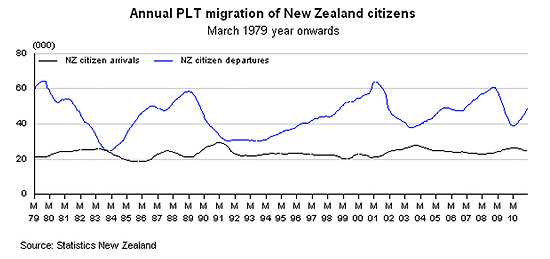
Stagnating wages compounded by unrelenting cost of living increases are tempting otherwise faithful Kiwis, many in a state of perpetual bill shock, to leave home.
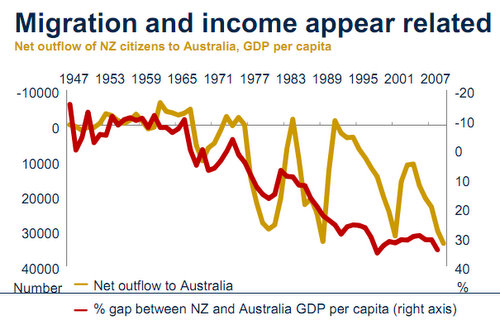
Australia is proving more irresistible than ever with average weekly wages 40% higher than Aotearoa.
(To calculate how you would fare in Australia check out our new calculator.)
National's attempt to mollify restless Kiwis with discounted tax rates is proving ineffectual amid skyrocketing food and petrol increases and 15% GST.
(For further analysis on why personal tax cuts have failed see Bernard Hickey's opinion piece here.)
In February, 3,908 Kiwis made the leap to Australia, bringing to 23,500 the running total of those who have left in the year to February.
(See Gareth Vaughan's article from April 13).
The trend has leading companies in New Zealand surveying the economic landscapes at closer range to determine whether it is possible to woo and retain high skill labour.
Global consultancy firm Mercer says demand for business analytics focused squarely on the problem has surged since the financial crisis.
Mercer's Anthony Shippard, a principal with the research house, said New Zealand businesses want to know if, and how, they can stay competitive as the economic powerhouse across the Tasman continues to flex its muscle.
Shippard said business can no longer afford to bury its head and pretend the growing threat and allure of Australia doesn't exist.
"They're looking at the issue and saying: `Okay, tell me where Australia is at exactly and then we have to take a decision as to whether we can compete with them or not,' but until they know where they stand, they're not making a call either way."
From a purely financial perspective, the outlook isn't so good, concedes Shippard.
According to Mercer's figures, executive salary increases are running around 3.5%, compared to average salary increases of 2.5%.
With consumer prices increases in the 3-4% range, Shippard said salaries are fast being outpaced by inflation, underscoring a pronounced difference between how Australia and New Zealand have weathered the global downturn and financial crisis.
"Australia has shown buoyancy on a global level and the price of the Australian dollar is a testament to that."
"NZ has had a different experience and has struggled a lot, and you can see that in the cost of living with the CPI numbers versus the wage increase. There's a big difference between how people's salaries are increasing versus the cost of living which is going up so dramatically, with dairy products leading the charge."
Costs of living?
Although, both Auckland and Wellington fared well in a recent international study measuring cost of living (click here to see highlights of Mercer's 2010 cost of living survey), placing 149th and 163rd respectively out of 214 cities in five continents in terms of expense.
Shippard said the benchmark U.S. dollar used to measure affordability yielded a somewhat misleading result.
(More more on NZ's ranking see Amanda Morrall's article here).
Auckland prices "extravagant"
"On a dollar for dollar basis, yes it did fare extremely well, but relative to average wage, prices in Auckland are quite extravagant."
If real wages and cost of living make a bad case for New Zealand, Shippard said the analysis would be incomplete without taking into account the more philosophical question of quality of life.
In his opinion, that's where New Zealand's best advantage lay and where business, in its appeal to both executives and rank and file employees, needed to beat its drum.
He admitted the effectiveness of the pitch would depend on personal circumstances and motivating factors.
"I suppose traditionally, the New Zealand market is more sensitive to losing its senior executives at the top end of the tree, and if those people are motivated purely by financial gain, then it's going to be very, very difficult to retain them because the New Zealand market just doesn't pay as much as Australia.
"But if those executives have other factors in mind, such as quality of life, raising a family, education, pollution, crime etc., New Zealand would appeal for the lifestyle."
Does flex time, camararderie make up for pay?
Shippard said businesses trying to tap that sentiment have increasingly been plying non-numeric work advantages as a reason to work and live in New Zealand.
Things like work place flexibility, holidays, professional development, and benefits outside of pay (like creche, parental leave, job-sharing) were among the options available to employers.
Compensation of this kind would naturally appeal more to families than singles, said Shippard.
"I would tend to suggest that if you have no ties then the financial lure of Australia would be stronger than if you had kids established at schools and things than if you were in Australia with kids."
Shippard said it was also important to bear in mind that, despite Australia's proximity, job titles alone did not guarantee a comparable experience in the workplace because of the scale of business in Australia, and the different dynamics that entailed.
39 Comments
As a long time reader I thought I might as well signup to Interest.
The main reason I moved to Sydney (in January) from Auckland was for the earning potential, I’m earning approx 65% more than back in NZ (taking FX rate into account). Plus the opportunity of career progression, being mid 20’s this is important.
I must admit the cost of living (housing/cars/food) is more expensive here – but the higher income definitely makes up for it.
Earning in Aussie $$$ I can afford to buy those overpriced houses in NZ and retire early!
Fast forward 30 years "We've done okay here, Sheila. The kids like staying at the unit on the Gold Coast and we've got a nice place here in Double Bay, good super with Macquarie and a few zacs in the bank. Now... those renters we bought back in Welly? What to do..Well let's cash 'em and bring the money over here, in as it looks like we're in OZ to stay!" ...Hang on....that's what your predesessors did Kiwi@Aussie, back in the 80's...and on...! And they're going to start cashing those renters in, right now, as they have started to turn 65... in 2011.....
You make a pretty compelling agreement for the move, (whether you mean to or not) - Apartment on the Goldie, House in Double Bay (personally I prefer the north shore) - Super at 9%, GST at 10% - Those rentals in Welly would have done alright over 30 years. I can't see any complaints?
Ah, yes. But you didn't get to LAQC them or the like , did you? Because your income is 'offshore' you didn't get to claim your 30% rebate from the NZ taxpayer to help keep them. So you were at a financial disadvantage to the on-shore property chaps. But, yes. It's a compelling case...all bar the renters that never made financial sense, of course :)
GST @10%. Didn't we use to have that here in N.Z.?
Just one example, but things change....
as I've said before I'm looking for opportunities in Aus ,seen one job that fits and will be applying for that. Whether I get it or not is another question. But if I get offered it I'll be off.
Not a big difference to the influx of Polish workers into the UK or Germany when EU labour laws were slackened.
University professors harvesting asparagus in Germany and earning more in a month than they did i a year in Poland, virtually every plumber in the UK from Eastern Europe.
After a while, opportunities opens up in Poland as the economy develops and there's a great sucking noise and there are no plumbers any more and the asparagus pickers are all from Romania and Kosovo.
hat's what happens when the barriers to migration are low, and I'd suggest that nowhere in the world are the migratory barriers lower than between NZ and Australia.
OK, success stories aside (well done all), surely the best way to get a handle on the outflow to Aussie is to actually measure this stuff in a bit more detail?
All you ever seem to see are large numbers - how much work has been put into looking in a bit more detail at he circumstances behind these? Things I'd be interested to know if I was tasked with stemming the flow would be...
What you occupation is
What your career intentions are in Aussie
Are you going temp or perm
Do you have family in NZ
How long have you lived in NZ
Do you have family / friends in Aussie
Do you have any financial ties to NZ (house, funds etc)
You can't fix what you don't understand, so lets get a bit more detail around the drivers.
Interesting timing having just returned from Australia today after a business trip whereby we have decided to relocate our $60m business to Brisbane. Not because of the wage gap, or tax, but because as a nation Australia consists of a positive, go get ' em attitude, have a intelligent regulatory system, and have a population that are comparatively civilized. We are a profitable business, however with compliance costs here ballooning, since the Clark government, a lack of intellectual nous down in wellington calling the shots. We have found over the last 5 years that where once we had some control over our destiny, this is no longer the case. No one wants to risk capital, intellectual capital, and work essentially for the state yet takes all the risk with no reward. New Zealand has lost another very capable bunch of executives, with hundreds proof years (combined) expertise in a highly specialized area. Another 100+ employees will be added to an already burgeoning doll queue. Very sad.
Maybe NZ should simply become part of Australia (if the Aussies would take it at all) - probably the only chance this country has for a functional government.
But mind you, Gillard is pretty clueless, too, from what I hear from Canberra, and who knows what she is going to break next.
Did you catch Gillards speech to the NZ HoR when she was here?...just a stunning speech and delivery too!..and her address to the Australian parliament, regarding CHCH, the day after the Feb 22 earth quake, with only hours to prepare, left me embarrassed of what we elect to represent us...if she is clueless then she has one-hell-of-a speech writer..my 2c
Obama also delivers great speeches, but that does not stop him from being clueless when it comes to daily operations.
Yes, Gillard must have gifted speech writers.
The main point was, however, not Gillard, but rather aiming for NZ becoming part of Australia. Given the lack of competence and probably also simply intelligence among the left-overs of the NZ "elite" it is hard to see that things can genuinely improve for NZ. And by that I dont mean another property bubble, but substantial progress in building an industrial base that deserves the name.
I'm returning from the UK in a few months due to my partners visa expiring. Looking at the NZ job market really doesn't encourage me to want to stay in NZ. The reality is that I'll never earn half of what I earn in the UK doing the same job in NZ. Sad really. Couple that with a dearth of similar opportunities in the NZ and I can see myself making my stay back in NZ short.
Its true that NZ has a nice insular quality of life, but then so do many other places. The UK has rubbish weather but Europe is close by, with all the sights and experiences that has to offer. More than makes up for it.
Once you have made the move to leave as I've done for the past 3 years, its much easier to do it again.
The vast majority of my peers have left NZ, probably never to return.
I'm similar to you. Been in the UK for 18mths now and cannot imagine ever returning to New Zealand to work. I absolutely love NZ, the culture, the people, the landscape; the food & drink make it unquestionably one of the greatest places in the world. However the economic opportunities for people 20-35 are seriously limited and the outlook for growth or improvement is highly unlikely.
I work in Canary Wharf and was initially astonished by the amount of Kiwi accents you hear just walking around. Kiwis would feature as essential members of just about every department in most of the investment banks, accounting firms and funds. This in my mind proves our education system is top-notch and our ingrained commitment to get the job done is one which the POM's and others respect.
I talked about this recently with a number of kiwis over here about returning and almost none will return to NZ. Many will move to Sydney/Melbourne/HK/Singapore but Auckland/Wellington do not offer the positions, would offer 30-50% in pay and further we all agree that paying for the baby boomers retirement in the coming decade won't be pretty for those whom remain. This would be also be similar for many of my high school and university friends whom are in other fields working in South Africa, US, Australia and other nations – they won’t come back.
New Zealand, once was a nation in the top echelon of the OECD rankings, produces some of the brightest people not just in finance but in sciences, medicine and engineering yet most operate offshore and the majority never return - truly sad.
Many of us had some hope for John Key and company changing this and making NZ, a Switzerland of the South Pacific or at least address the true structural issues within the NZ economy. Nothing has happened, he’s just taken a short term approach.
PS. I pay my Student Loan
Rains more in Auckland than in Manchester...
NZ is being woefully mismanaged for decades now, and the current so-called government is topping it all off. No wonder that talented people are leaving. Why would you stay in a country where the major economic activities are milking cows and tourists, and selling each other decrepit houses at the price of mansions.
Can that thrill young, smart people? Nah ...
Better rely on replacing the population with Indians and Chinese who are happy that there are streets and schools and a bit less corruption than at home, and would not make outrageous demands for affordable houses and food, or related luxuries.
Good luck to NZ.
Without a comprehensive, complex production sector – wealth creation cannot be achieved as a nation.
Our government is guilty of not providing enough support – allocating infrastructure needs to NZcompanies to the NZworkforce.
I could not agree more.
I deal with Australian companies and clients regularly and generally find the Aussies a lot more positive and proactive than kiwis. I find a lot of kiwis are cynical with chips on their shoulders. The Aussie women are much nicer too than our lasses fresh off the farm:)
I'm applying for a job in Aus that interests me, hopefully I can nail it., If not, I'll keep looking
Matt, when we emigrated from Europe 20 years ago, one of the differences we noticed, in general Kiwi women are hard working taking a lot of responsibility for families/ jobs, while Kiwi blokes are the trouble of this nation. Guys spend a lot of money enjoying their leisure time, while quite often women are running many more daily jobs.
Matt,
In my experience Aussies are more positive, but far less professional and skilled and for many all they know is the gravy train of big banks and mining companies. Certainly thats the case for a big IT banking project I am working on. 1000+ people on a project that would only require 30 in NZ. A lot of "positive" spin, and little substance. Ditto for their pollies - unlike NZ, they still think a housing bubble is a good thing.
For the short term I'll take the easy money while its there, but Aus has become reliant on being lucky and if the luck runs out god help them (and us as well I guess). I seem to remember the UK being similar when I was over there in the late 90s - I always wondered why their economy was so strong, bluster and hot air gets you quite far in the short term .... ditto Australia. The housing market is just starting to crash in Aus, retail is slumping, unemployment will rise and the rest will follow. Stay in NZ.
Found this the other day, apparently it's the original quote...
"Australia is a lucky country, run by second-rate people who share its luck." - Donald Horne
Not sure how it reflects on us though...
I'm going to have to agree with Jimmy.
I've been in WA for 3 years now, all the growth has come from mining and goverment stimulus ie FHOG. I work in Construction and we would have been stuffed if not for the FHOG.
The 'two speed' economy is obvious and wage inflation unsustainable, with housing starting to crash again this time the government really can't afford to re stimulate housing. Especially not with there promise to return to surplus by 2012 ish. They are looking for cuts anywhere and everwhere, even talk of changes to negative gearing *gasp*
I hope to return to NZ when it all turns to crap over here, sure NZ has its obvious downsides and really doesn't seem like its heading in a positive direction at the moment, but I get the feeling that being closer to family will become important over the next 5 years.
Yes, NZ does need it - but will not get it. If anything, the quality of public services in NZ is in decline, from what I can tell.
Australian public services are singularly efficient because they have smart recruitment practices, there is little corruption and they pay relatively well and provide perks so that good people get attracted into it. It is not quantum physics, you know.
Well I've said it before and I'll say it again. This multigenerational New Zealander considers all those who have left this country and to have been absent from it for more than about 5-7 years and who no longer contribute to the advancement or development of this country as no longer New Zealanders. You've left. Beginning, middle and end of story. You’re a Pom now, or an Aussie or a Yank. It may be an unpopular opinion, but I'm sticking to it. You don't live here anymore. Penny dropped yet?
And I will certainly be doing my best to ensure that those who have spent the bulk of their adult working life outside of New Zealand, should they wish to return to it once retired will not benefit at the expense of the long suffering New Zealand tax payer for their superannuation or health care.
You guys throw your lot in with wherever you are now, ok, and good luck to you.
DB : I spent 16 years in South Australia , way out in Sturts Stoney Desert ........... And during the rugby season I never once , not once , baracked for the Wallabies ! ......... I'm a Kiwi , and the AB's are my team .
......... There's alot of us who have left the country , but are genuinely sad that we felt compelled to do so .
Hmm I wonder about the differences in age between outgoing new zealanders and the incoming foreigners taking their place... would be interesting to find out what the average and median age of people coming into NZ is vs those leaving.
Are the recent immigrants having the effect of aging NZ's population faster as more younger and less tied down new zealanders leave for aussie? How many young people are moving to NZ?
I have a sneeking suspicion that our population is ageing faster due to current immigration/emigration.. how will this effect the retirement of the baby boomers, and also will we reach a point where entitlements for the elderly become such a burden on the working class that its like a tipping point and people start bailing out en masse?
I am currently on holiday in Surfers and it is obvious things are not great here. High unemployment, house prices under stress, retail poor and when you go to eat out up to 50% off the menu prices signs everywhere. Talking to the Aussies they are moaning about the high cost of living in areas of food, petrol, insurances and power costs.
You need good wages to live well here. If you are coming over bring plenty of cash. you will need it.
You need good income and investments to live well anywhere :-)
There has to be something deeply wrong when we somehow convince ourselves the government is "investing" when it gives money to the America's Cup.
In a sane and successful society surely this would be way outside the government's role.
This is just not right.
I agree with you there Westminster. Its just that it makes dependency junkies of us all.
Business is supposed to be the strong and vibrant part of our culture, what puts bread on the table. Fierce, strong, independent, those sort of qualities. Dependency breeds weakness, dependence and resentment.
Sorry if my last comment was self referral. The point was that compared to Aussie we encourage our business leaders to be dependent on government help. This is akin to grown up boys still living with their mum rather than leaving home and establishing their own household. In short the difference between a dependent and whiny teenager and a grown man.
I understand the benefits to tourism and the potential business spin off particularly in Auckland for those operating in this niche industry but the Government picking winners (similar to the R&D comments above) is troubling. NZ may see itself as an egalitarian society but the America's Cup is an elitist sport globally and if there is not an adequate corporate appetite to support a Team NZ campaign then a Government subsidy of this value can surely be put to better use.
the money usually goes to the self promoters, not necessarily are all sucessful high potential businesses.
Ministers underperforming mismanaging our economy and the resulting consequences are paid by taxpayers. I would simply sack a few – certainly Brownlee and Joyce.
Everyone talks about the wage gap --sure that has to be part of it , but most of the young people I talk to who are moving or are thinking of moving the biggest thing is the lack of opportunity in New Zealand. Young graduates often cannot get jobs irrespective of the money on offer. We have a family member recently graduated in IT but cannot get anywhere because employers are asking for at least 1 to 2 years commercial experience , so you can guess where he is going. I think NZ employers are their own worst enemies in some cases -- if they are too lazy to recruit their own staff and so use recruit agencies who in most cases don't respond to applications , what do they think young people are going to think.?
I agree with you re-recruitment cabinets and really wonder what they get paid for. Obviously for filtering the applicants but every experience we've had with them has been a joke (ie, they don't even do that and seem useless at making anything happen).
And I can also see where you're coming from re-the difficulty of finding a first job for a new graduate. Although we now contract independantly (in IT, and have over 12 years' experience each), we keep an eye on the offers around and I have noticed that most say "new graduates need not apply" or similar (and was wondering what new graduates were expected to do to gain experience with such policies).
It's a bit sad really. When I graduated in France in 1997 I had 7 interviews for my first job and got 6 offers. The director of a large company even flew down from Paris to try and convince me to accept his offer rather than someone else's after I had turned him down, and my only experience was an 8-months training course! On the bright side, once your family member gets a first job (and I have no doubt he will), you can be quite sure that he will have a good career to look forward to. Good luck to him/her.
agree it is lack of opportunity, my first degree was in IT and I was one of first three to graduate in my year at a particular university, right ahead of the curve, none of us gained employment at the time in NZ. I'm the only one that has come back and contributed to NZ post graduation after setting up businesses overseas.
Kunst, you seem to have a venetta against Joyce, which is pretty tiresome. He's actually not a poor performing member of the government, except in your opinion. I understand that John Key rates him, but what would John Key know compared with you? Suppose you really think you could be the PM as you would be miles better.
We welcome your comments below. If you are not already registered, please register to comment
Remember we welcome robust, respectful and insightful debate. We don't welcome abusive or defamatory comments and will de-register those repeatedly making such comments. Our current comment policy is here.