

Here's my Top 10 links from around the Internet at 12 pm today in association with NZ Mint.
As always, we welcome your additions in the comments below or via email tobernard.hickey@interest.co.nz.
See all previous Top 10s here.
My must watch today is number 10 from Jon Stewart. You will laugh and yell at the screen over the ludicrous nuttiness of America's elite all at the same time.

1.'We're in the euro -- get us the hell out of here' - The Telegraph reports that 51% of Germans surveyed in a Bild am Sontag poll want out of the euro-zone.
When even the Germans want out of the euro-zone that's a good thing -- and a bad thing.
For the euro-zone to survive it needs the Germans to hold their noses and stump up enormous amounts of their cash (or more importantly guarantees to pay out if necessary) or to allow the European Central Bank to print cash Weimar-style to make the debt go away.
When they clearly don't want to do either that's a problem for the future of the euro-zone. (Unless of course Germany's leaders either hoodwink or ignore their voters).
The other way to view it is this makes an early euro-zone breakup more likely, which would 'clear the system' to allow it to start again. The pain could be sharp, but at least relatively short. The exit of Germany from the euro-zone first would be the easiest, fastest and cheapest solution. That may explain why German two year bund yields are now negative. Investors want to be in Germany itself when its currency is revalued higher back into deutsch marks.
Some people are saying it could take 10-20 years of grinding pain for the euro-zone to survive along the current path of supply-side deflation and adjustment without breakup.
The Emnid poll for the Bild am Sonntag mass circulation weekly showed 51pc of Germans believed Europe's top economy would be better outside the 17-country eurozone. Twenty-nine percent said it would be worse off, AFP reports.
The survey also showed that 71pc of Germans wanted Greece to leave the euro if it did not live up to its austerity promises.
Economy Minister Philipp Roesler told Bild am Sonntag there were "considerable doubts whether Greece is living up to its reform promises."
"The implementation (of the reforms) is faltering. There is still no functioning tax office. Also, almost nothing has happened in terms of the promised privatisation of public assets," Mr Roesler told the paper.
2. Iron ore prices crashing - This is obviously important for Australia, which in turn means it's important for New Zealand.
Here's FTAlphaville on the latest action on iron ore and how it's now fallen below the US$120/tonne marginal cost threshold, beyond which it doesn't make sense to add new production. This is the sort of thing behind BHP's decision this week to delay its US$33 billion Olympic Dam expansion, albeit for copper/gold/uranium.
It looks like spot iron ore prices are indeed catching up (or down) with (Shanghai steel) rebar, and that’s taken iron ore below the critical $120/tonne mark.
Why is $120 important? Because of the cost curve. This comes up a lot in the world of iron ore, so it might be worth revisiting what that means.
The “cost curve” just refers to the price level at which each producer can and will continue to produce. Above their price level they’ll profit and below it, they’ll tend to cut or stop producing. Of course this is a very broad generalisation and lots of things can get in the way but that’s believed to be the general structure of the market today.

3. No pressure - Ambrose Evans Pritchard writes at The Telegraph that ECB President Mario Draghi is the only player in Europe who can prevent financial catastrophe by printing money in a wholesale way to buy Spanish and Italian bonds.
The only issue that matters at this late stage is whether Germany is willing to let the ECB step up to its responsibility as a global central bank after two years of ideological posturing and take all risk of sovereign default in Spain and Italy off the table - which it can do easily enough once it stops playing politics and obeys the “financial stability” clause (Article 127) of the Lisbon Treaty.
That is to say, whether Latin states are willing to mobilize their majority power on the ECB’s council to force a change in policy over German protest, or lamely let themselves be picked off one by one in serial disasters like the death of the Gold Standard in 1931.
Failure to halt a full-blown debt debacle in Spain and Italy at this delicate juncture - with China, India and Brazil by now in the grip of a broken credit cycle and the US on the cusp of fresh recession even before the “fiscal cliff” hits - would tip the entire global system into a downward spin, triggering the sort of feedback loop that caused such havoc in late 2008.

4. Keep an eye on the Cliff - Senior US political figures tell Reuters in this piece that a political solution to America's 'fiscal cliff' at the end of the year will not be possible before the Presidential elections on November 6.
That means a lame duck Congress will have to fix things within a few weeks... It could be a bumpy end to the year.

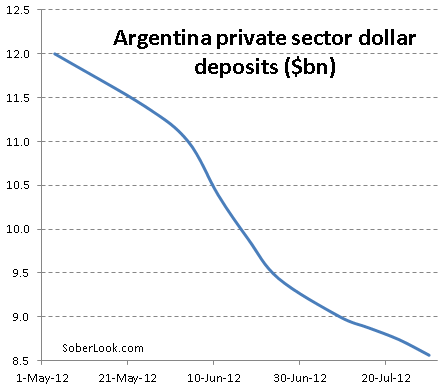
5. Capital flight - Argentinians run for the exit. Argentina has a history of shutting its banks and revaluing currencies, so it's no surprise claims from the government that the same won't happen again aren't being believed.
The All Blacks go there for a test on September 29. They should be careful to take any spare US dollars home with them.
They conclude that unnaturally low interest rates (ie below the rates required to keep inflation at a particular level) do indeed fuel housing bubbles.
Sigh.
The last time New Zealand's Official Cash Rate was held unchanged for a long period was in 2007 when it was held at 7.25%. Eventually the Reserve Bank worked out this was too low when the housing market went ballistic. It raised it to 8.25% in short order, but by then the damage was done.
Now we have had the OCR at 2.5% since March 2011 and the Reserve Bank's own forecasts suggest it will stay there until mid 2013. The SNB suggests alternative counter cyclical measures. That would be LVR limits.
So why are we surprised the housing market is taking off again?
Sigh.
Our results indicate that there is a strong link between low interest rates and housing bubbles. This impact is especially strong when interest rates are “too low for too long”. We argue that, by ensuring that rates do not deviate too far from Taylorimplied rates, central banks could lean against house price fluctuations without considering house price developments directly. If this is not possible, e.g. because a single monetary policy is confronted with a very heterogenous economic development within the currency area, alternative counter cyclical measures have to be considered.

7. 'Obama is the anti-Romney' - Robert Reich is a caustic critic from the left of Barack Obama. Here's his view on Obama's re-election strategy and what he could do about the economy, but is not.
The President could propose a new WPA, modeled after the Depression-era jobs program that hired hundreds of thousands of jobless Americans to rebuild the nation’s infrastructure, or a new Civilian Conservation Corps.
He could suggest permanently exempting the first $25,000 of income from payroll taxes, and making up the lost revenues by eliminating the ceiling on income subject to it. He could propose resurrecting the Glass-Steagall Act and breaking up the big banks, so Wall Street doesn’t cause another financial collapse.
But you won’t hear any of this, or anything else of this magnitude, because the White House doesn’t want to take any risks. Polls give Obama a slight edge in the critical eight or so battleground states, so, the thinking goes in the Obama camp, why say anything that might give Romney and the GOP a target? Besides, polls also show Romney isn’t well-liked by the electorate. So Obama has decided to campaign as the anti-Romney.

8. Violent environmental protest in China - Reuters reports there were riots in Qidong over the weekend that forced the local government there to abandon plans for an industrial waste pipeline for a Japanese-owned factory. Now an official paper is calling for political reforms to stop the violence spreading. Keep an eye on this.
Chinese officials cancelled an industrial waste pipeline project on Saturday after the violence in the city of Qidong, the latest in a string of pollution protests across the country.
Similar scenes of violence sparked by environmental fears played out earlier this month in the town of Shifang, in Sichuan province, highlighting the social tensions China faces as it approaches a leadership transition this year. Authorities are especially worried about maintaining social stability as they balance economic growth and the fallout from environmental pollution.
"An irrational decision-making process is the main reason why the Shifang and Qidong governments experienced mass incidents," the normally hawkish Global Times said.
In a development likely to cause concern in Beijing, some demonstrators in Qidong said they were inspired by the events in Shifang, where the protests were widely seen as having forced the local government to cancel a refinery project.
The spread of a "Shifang-Qidong Model" of violent protest would damage social stability "and present an unprecedented challenge to China's future development", the Global Times warned. "Now is a good opportunity with these classic cases of Shifang and Qidong to undertake serious reforms within the system," it said.

9. Home made highlights - There's a fair amount of grumpiness around in America about NBC deciding not to televise live the Olympic victory of 17 year old swimmer Missy Franklin. The WSJ does its best in this video to recreate the mood. Good cheap television. HT Gareth.
10. Totally Jon Stewart points out how a typographical error stopped the enactment of regulatory reform of banking...seriously. And makes a complete mess of Sandy Weill.
(Updated to replace Paradox of Choice video that was in David's Top 10 yesterday. My apologies.)
We welcome your comments below. If you are not already registered, please register to comment
Remember we welcome robust, respectful and insightful debate. We don't welcome abusive or defamatory comments and will de-register those repeatedly making such comments. Our current comment policy is here.