
By Alex Tarrant
Returns reported for the supposed NZ$450 million Ross Asset Management 'investment fund' were likely exaggerated and possibly fictitious, while withdrawals by investors over the last five years appear to have been funded by contributions made by other investors, receivers PwC say, in language that hints at a Ponzi scheme.
More than NZ$60 million was withdrawn from the fund than was contributed over the last five years, meaning the Ross Group lacked adequate liquidity to meet further withdrawal requests from its 900-odd investors, the receivers said in a report released on Thursday.
Withdrawals during the period appeared "to have largely been funded by pooled funds which include the contributions made by other investors coupled with the sale of investments." Meanwhile, almost NZ$30 million in management fees had been paid out since 2000, the report showed.
The receivers also said "unrealistic" historical returns reported by the investment fund for more than a decade were likely exaggerated and possibly fictitious, as they try to ascertain whether investments claimed by manager David Ross on behalf of investors actually exist.
The receivers said they had found no evidence so far of the vast majority of the fund's purported overseas holdings; they had so far identified only NZ$10.2 million of actual holdings. They noted an absence of robust systems and processes.
None of the Ross Group entities were audited, the receivers said.
Frozen
Wellington-based Ross Asset Management’s assets, and a number of related companies, were frozen by the Financial Markets Authority on November 2 after the FMA received complaints from investors unable to withdraw funds several months after requesting them.
The FMA had executed a search warrant from October 31 to November 2 on the offices and home of the fund’s manager, David Ross, after Ross was unable to “satisfy serious concerns” raised by the FMA during initial inquiries.
PwC, who were appointed receivers of the fund and related companies on November 6, released a report on Thursday highlighting their initial inquiries into the fund’s purported investments and financial position.
The report, prepared by John Fisk and David Bridgman of PwC, with the assistance of First NZ Capital, explained that Ross Asset Management’s records showed purported investments of NZ$449.6 million, held on behalf of more than 900 investors across 1,720 accounts, the FMA said on Thursday.
“This figure represents the portfolio values reported by Ross Asset Management to investors, not their actual capital contributions, or the current value of those contributions. The latter figures are yet to be determined,” the FMA said.
“The receivers and managers’ focus over the first five days of their appointment has been to identify and secure investment assets. After searching the custody accounts identified by Mr Ross and through wider searches in international investment markets, they have so far located investments of only NZ$10.2 million. The search continues.”
Accordingly, there was a significant gap in the identified market value of the Group’s investments as against the amounts reported in investors’ portfolios, Fisk and Bridgman said.
“The analysis of the Receivers and Managers to date indicates it is likely the historical returns advised to investors are exaggerated and may possibly be fictitious,” they said.
“Therefore, the actual cash loss that may eventually be suffered by the remaining investors will differ from the amounts currently showing as the “value” in individual investors’ portfolios.”
“In our opinion, the Investment Fund managed by the Ross Group is insolvent, as it cannot repay the value of the portfolios reported to investors as they become due in the ordinary course of business. We firmly believe a recovery strategy needs to be immediately addressed to maximise investor interests," Fisk and Bridgman said.
"Therefore, we have recommended the Ross Group entities be placed in liquidation because this will help with the realisation of assets for the benefit of investors.”
Read the full PwC report here.
No auditors
David Ross, who is currently hospitalised, was the sole director of all entities under investigation and appeared to have sole responsibility for all funds management, research and investment decisions, supported by two administrative assistants who advised they had no significant decision making authority, the receivers said.
"Mr Ross also appears to have been the sole party who liaised with investors to attract new contributions and to inform them of the decisions he had made regarding their investment portfolios," Fisk and Bridgman said.
"We would ordinarily expect, given the quantum of investors and funds involved, that a more robust governance, management and organisational structure would have existed (e.g. an investment committee to assist with investment decisions) together with more sophisticated information systems," they said.
"None of the Ross Group entities were audited and we would have expected that the Ross Group would have been audited."
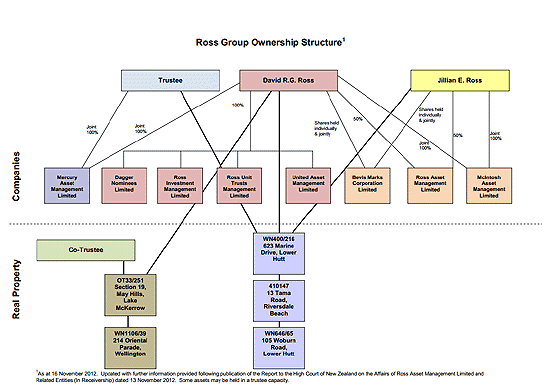
In some instances Ross' shareholdings in the entities were held jointly either with his brother, Gregory J Ross or his wife, Jillian E Ross.
"We have not yet been able to meet with David Ross as he is currently hospitalised. However, we have had contact with Gregory Ross, Jillian Ross and their legal advisors, all of whom have provided some assistance with our inquiries," the receivers said.
Unrealistic returns
Based on the Group’s own records there had been significant net cash outflows to investors in the last five years to the extent that in the receivers’ opinion the Group had lacked adequate liquidity to meet further withdrawals by investors.
“Funds withdrawn by investors over the last 5 years have exceeded funds contributed by more than NZ$60 million,” Fisk and Bridgman said.
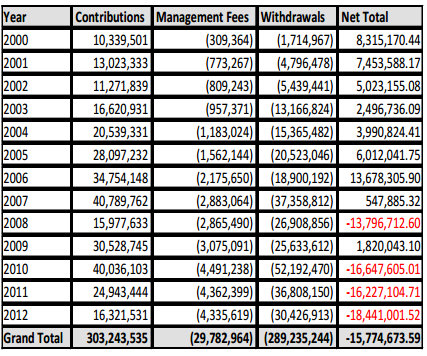
“What this table [above] does not show are any movements pre 2000 (which we understand did occur) or contributions that investors may have made by transferring in share portfolios they may previously have held in their own names,” they said.
“It also does not show any movements in the trading position of the investors’ portfolios as a consequence of these portfolios having appreciated in value.
“However, given that the current portfolio value is supposedly still in the order of NZ$449.6 million, there remains an unaccounted contribution and / or growth factor of NZ$465.374 million (i.e. NZ$449.6 million plus NZ$15.774 million).
“This means that the pre-2000 net contributions would need to be significant and / or the aggregate portfolio investment return would have to have averaged at least 25%p.a. compounding for the 12 year period, which in the circumstances, we believe is unrealistic,” they said.
Where did the money go?
Analysis of the Group’s database to date purportedly showed the market value of share investments of NZ$449.6 million spread across the following markets:
- Australia: NZ$152,393,272
- New Zealand: NZ$3,763,012
- Canada: NZ$136,123,067
- United States: NZ$156,390,350
- Other: NZ$943,332
Concern; Low-value, high risk stocks
The majority of shares purportedly owned by the Ross Group on behalf of investors were recorded as held in the name of Bevis Marks Corporation Limited, the receivers said.
“The total value of shares which the Group's records show as being held by Bevis Marks is NZ$437.6 million, however, to date we have not been able to verify any material portion of these investments with external sources and there is a lack of supporting evidence in the Group’s records in respect of these investments,” Fisk and Bridgman said.
“So far we have identified actual holdings in the Ross Group, including those held in related party names and investor names through our verification processes, having a current market valuation of only NZ$10.214 million,” they said.
“It is important to note that we are still continuing with numerous enquiries of overseas share brokers and registries to further ascertain shares held within the Group and the value of those holdings.
“However it is of considerable concern that whilst the Group’s internal records show shareholdings with a value of NZ$449.6 million we have only been able to verify NZ$10.214 million. We have also identified cash held in various NZ and overseas bank accounts which we estimate as being no more than NZ$0.2 million.
“It should also be noted that the market value of a number of the remaining investments we have identified are lower than the original cost prices recorded in various portfolios of the Ross Group,” Fisk and Bridgman said.
“Furthermore, we have evidenced from recent contract notes of the Group, trading losses on a number of shares, many of which appear to be low value and high risk stocks,” they said.
'No evidence of holdings'
In trying to find evidence of the purported NZ$450 million holdings, the receivers said securities data (excluding cash) was extracted from the Access Database operated by the Ross Group. The data showed the name of each security and the volume stated to be held by each investor along with the purported location and market valuation.
"The database has not been maintained since circa September 2012, so any recent securities transactions have not been recorded and we have not reviewed any reconciliations (if they were performed) pre September 2012," the receivers said.
Further work was being performed with Ross Group’s IT administrator to build a more complete data set (i.e. cash and securities).
"From the database as at the date of receivership it was established that NZ$449.6 million of securities was purported to be held in investor portfolios with various brokers and registries. Of this, as noted above, NZ$437.6 million was stated to be held with Bevis Marks which had purported holdings of NZ$145.9 million in Australian securities, NZ$135.1 million in Canadian securities, NZ$156.1 million in US securities and NZ$0.4 million of UK/Euro/NZ securities," Fisk and Bridgman said.
"If these holdings are correct, Bevis Marks purported holdings in some securities would be amongst the 20 largest holders of those securities (Roc Oil, Catamaran Corp, and Santos Limited). No evidence of these holdings specifically linked to Bevis Marks has been found in publicly available securities registers," they said.
If the holdings were valid, they must be held through broker / financial institution nominee companies through relationships with the Ross Group.
"We have not identified any such holdings at this point," Fisk and Bridgman said.
Hand-written notes
A review of one investor portfolio indicated that contracts with Bevis Marks were referenced with “DRGR” or “David Ross” to denote the (original) largely hand-written instructions of Mr Ross to his administration staff to reflect transactions in the database that he directed, whereas contract notes from brokers were generally referenced with contract note numbers (as received from the counter party broker and input to the database by the relevant staff member).
"On this particular portfolio, realised gains and losses for non-Bevis Marks trades averaged $11k in losses from 36 trades and $11k in gains from 44 trades for a net return of $83k for years 2000-2012. Realised gains and losses for Bevis Marks trades averaged $17k in losses from 44 trades and $31k in gains from 90 trades for a net return of $2.06m from 2001-12," the receivers said.
"Accordingly for this investor at least, the vast majority of the net returns were purportedly made through Bevis Marks."
Further analysis of the Access Database records was continuing.
Absence of robust systems & processes
"At the time of writing, assets identified by the Advisors total NZ$10.214 million of which NZ$1.376 million is stock held direct in Ross Group entity names at share registries. NZ$2.753 million are assets in Ross Group investor account names at brokers and held direct at the registry, and NZ$0.409 million relates to accounts and stock in the name of related parties. The balance of NZ$5.676 million is stock / balances held in Ross Group entity names (including Ace, Vivian and Ross Units Trusts Limited) at identified brokers," the receivers said.
"This reconciliation of investments will continue to be updated on a regular basis by the Advisors as further registry checking is completed and any new relevant information comes to light," they said.
"However, it is apparent...that from the work done to date, there is a significant gap between the total reported value attributed to investors’ portfolios at 30 September 2012 of NZ$449.6 million and the assets identified by the Advisors to date.
"In the absence of robust systems and processes, including a full set of adequate records, the use of multiple broker account relationships (including some accounts held in Ross Group investor names and controlled by Ross Group) along with the combination of securities held in broker nominee companies and other stock held direct at registries (for both Ross Group entities and some Ross Group investors) is difficult to administer and control," the receivers said.
"It also makes it reasonably difficult for any independent reviewer to readily reconcile an overall position of what securities are held, where they are held and the transaction history," Fisk and Bridgman said.
"The fact that no records exist at the business address of the Ross Group, other than on the Access Database to reflect the apparent directions of Mr Ross to his staff in relation to Bevis Marks depository and other entries on Ross Group investor portfolios for the purported primary security depository, is highly unusual," they said.
"The method of data entry of Bevis Marks entries to the Access Database without any independent verification records held by the business in the form of broker transaction statements / portfolio valuations, broker contract notes or registry records provides the opportunity for misrepresentation of records due to the lack of controls.
"On 8 November 2012 we received confirmation from Mr Ross via his brother, Mr Greg Ross, that all records relating to Bevis Marks were held on the computer systems at the Ross Group’s offices in Wellington. Such records have not revealed, at this stage, any significant third party confirmation of where assets are held," Fisk and Bridgman said.
(UPDATE: PWC have revised their Ross Group Ownership Structure diagram. The following is the updated structure.)
See the release from PwC below:
PwC Partners John Fisk and David Bridgman as Receivers and Managers to Ross Asset Management Limited and related entities, have provided a report to both the High Court in Wellington and the Financial Markets Authority (FMA). The submission of the report is in accordance with the orders of the High Court dated Tuesday 6 November 2012. The Court has now ordered the report to be released so investors are fully informed.
Mr Fisk says, “The report outlines our appointment and the actions undertaken to date. It also includes recommendations as to the likely next steps and future for the Ross Group.”
Since being appointed, work has been undertaken to verify the Ross Group’s assets in New Zealand and overseas, while also analysing the Group’s records to determine the position of the investors’ portfolios.
To date, the Receivers and Managers have identified 1,720 individual investor accounts holding purported investments of NZ$449.6 million. However, the Receivers and Managers and their expert advisors have only been able to identify $10.214 million of investments held.Accordingly, there is a significant gap in the identified market value of the Group’s investments as against the amounts reported in investors’ portfolios. The analysis of the Receivers and Managers to date indicates it is likely the historical returns advised to investors are exaggerated and may possibly be fictitious.
Therefore, the actual cash loss that may eventually be suffered by the remaining investors will differ from the amounts currently showing as the “value” in individual investors’ portfolios.
Also, through their work, the Receivers and Managers have identified a further three entities within the Ross Group which they recommended should be considered part of the receivership.
Mr Fisk says, “In our opinion, the Investment Fund managed by the Ross Group is insolvent, as it cannot repay the value of the portfolios reported to investors as they become due in the ordinary course of business. We firmly believe a recovery strategy needs to be immediately addressed to maximise investor interests. Therefore, we have recommended the Ross Group entities be placed in liquidation because this will help with the realisation of assets for the benefit of investors.
“We are fully aware the situation is distressing for investors and it is our aim to provide as much certainty as quickly as possible. Should investors or other stakeholders have any queries, please contact us via our website, facsimile, or postal address, or dedicated telephone message,” concludes Mr Fisk.
A summary of the Receivers and Managers report will be distributed to investors and the full report is available on the PwC website http://www.pwc.co.nz/RossAssetManagement.
The details are:
· Postal
Ross Asset Management Limited (In Receivership) and related entities PricewaterhouseCoopers
PO Box 243
Wellington
· Facsimile: +64 (0)4 462 7492
· A dedicated page on the PwC website can be found at http://www.pwc.co.nz/RossAssetManagement . It will be updated when relevant and appropriate.
· In addition, a dedicated telephone message line +64 (0)4 462 7040 has been established for any investors or creditors who have an enquiry relating to Ross Asset Management Limited (In Receivership) and related entities.PwC Partners Mr John Fisk and Mr David Bridgman were appointed Receivers and Managers to Ross Asset Management Limited and related entities, pursuant to FMA application under the Financial Advisers Act.
Ross Asset Management Limited and related entities include (In Receivership) (the “Ross Group”) comprise of:
· Ross Asset Management Limited (In Receivership)
· Bevis Marks Corporation Limited (In Receivership)
· Dagger Nominees Limited (In Receivership)
· McIntosh Asset Management Limited (In Receivership)
· Mercury Asset Management Limited (In Receivership)
· Ross Investment Management Limited (In Receivership)
· Ross Unit Trusts Management Limited (In Receivership)
· United Asset Management Limited (In Receivership)
· Chapman Ross Trust (In Receivership)
· Woburn Ross Trust (In Receivership)
· Mr David Robert Gilmour Ross (In Receivership).
The additional three entities mentioned in the news release include:
· Ace Investments Limited or Ace Investment Trust Limited or Ace Investment Trust
· Vivian Investments Limited
· Ross Units Trusts Limited.
See the release from the Financial Markets Authority below:
The investigation into the affairs of David Ross of Ross Asset Management Ltd and related entities has moved forward today with the release of the receivers’ report.
The investigation commenced on 25 October when the Financial Markets Authority received complaints from investors who had been unable to withdraw funds, several months after requesting them.
Following initial inquiries FMA moved immediately to obtain information from Mr Ross. When he was not able to satisfy serious concerns, FMA executed a search warrant from 31 October – 2 November on the offices and home of David Ross, and on 2 November obtained a freeze of Mr Ross’s assets and assets of entities located in New Zealand. Receivers PwC and brokers First NZ Capital were appointed on FMA’s application on 6 November and required by the Court to submit a report within five working days.
The report, prepared by John Fisk and David Bridgman of PwC, with the assistance of brokers from First NZ Capital, explains that Ross Asset Management’s records show purported investments of $449.6 million, held on behalf of more than 900 investors across 1720 accounts. This figure represents the portfolio values reported by Ross Asset Management to investors, not their actual capital contributions, or the current value of those contributions. The latter figures are yet to be determined.
The receivers and managers’ focus over the first five days of their appointment has been to identify and secure investment assets. After searching the custody accounts identified by Mr Ross and through wider searches in international investment markets, they have so far located investments of only $10.2 million. The search continues.
FMA CEO Sean Hughes said today that while he welcomed the greater clarity the report brings on the affairs of Ross Asset Management, it clearly makes for difficult reading for the 900 plus investors with funds under management.
“The events of the past two weeks demonstrate that FMA will take swift action in response to investor complaints and we would encourage people to come forward if they have concerns about the security of their investment. They should be confident that we will listen and act where appropriate,” Mr Hughes said.
“We understand Mr Ross has been in this business for over a decade. The adviser regime is still relatively new, as are the powers under which FMA operates, but it is heartening to see the speed with which FMA were able to conduct an inquiry, preserve assets and appoint a manager and receiver. Our end goal is the best possible outcome for the investor, although we realise that in this instance it would appear that the remaining assets are limited.”
“New Zealand has nearly 2000 Authorised Financial Advisers, most of whom are behaving professionally, working to comply with the new financial adviser laws and seeking to serve their clients well. We are continuing to work with both advisers and investors to ensure both parties understand what information needs to be made available. For investors in particular it’s about understanding what questions to ask and having the confidence to ask them. They need to understand the nature of their investments and who is holding them, and maintain an appropriately diversified portfolio.”
FMA has been posting regular updates for investors on its website, in addition to email contact with those who had identified themselves to the regulator.
FMA is working with other agencies, including SFO in relation to the serious issues the report identifies.
A copy of PwC’s report can be found at http://www.pwc.co.nz/
RossAssetManagement .
We welcome your comments below. If you are not already registered, please register to comment
Remember we welcome robust, respectful and insightful debate. We don't welcome abusive or defamatory comments and will de-register those repeatedly making such comments. Our current comment policy is here.