
By Bernard Hickey
The Green Party has proposed the Government offer low interest loans to home-owners to buy solar panels, a move National described as "more magic money."
Green Co-Leader Russel Norman unveiled its Solar Homes policy on Sunday in a speech to the Green Party's 2014 campaign conference in Auckland.
The policy of lending up to NZ$15,000 per home to be repaid through rates over 15 years at the Government's own interest rate for borrowing (currently 4.1%) aimed to increase solar panel installations by 30,000 over three years and create 1,000 jobs. The policy is for a maximum of NZ$300 million of such loans.
Norman said the typical system would leave a household NZ$100 better off per year and allow them to sell any surplus back into the grid.
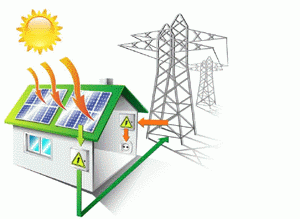
The policy document said a typical NZ$10,000, 3 kilowatts (kW) solar array would generate about 3,500 kilowatt hours (kWh) of electricity per year, producing NZ$1,000 of electricity a year at current prices and would cost NZ$900 a year over 15 years to pay off through the low interest low. It would also avoid the equivalent creation of 5 tonnes of greenhouse gas emissions.
"Solar Homes lets Kiwis take the power back, and break free from the big energy companies. This policy is about energy freedom. Availability of finance is seen as one of the key barriers to the uptake of solar in New Zealand. Solar Homes aims to remove this barrier," Norman said.
Norman said there were no government subsidies involved and the loans would be "cost neutral" to the Government.
"Solar is a smart choice for those wanting to reduce their power costs. It's also one of the greenest forms of electricity generation out there," he said.
Political reaction
Energy Minister Simon Bridges said the "Green Party's belief in their ability to make money magically appear seems to have no limits."
He said any lower interest rate than normal involved a government subsidy. "And if it makes the cost of solar power cheaper for families than existing power options it also must involve a subsidy," he said.
"Everyone wants something cheaper but someone has to pay. Solar is about three times more expensive than grid-scale generation from wind, hydro or geothermal power stations. If solar power was to be made more affordable other taxpayers and power users would have to pay for it," Bridges said.
"There is certainly a place for solar in New Zealand, but given the abundance of lower cost renewable alternatives, it can't be a priority to subsidise solar power or change the rules to suit a specific technology," he said.
Labour Leader David Cunliffe was reported as saying the policy looked sensible and Labour would consider it.
Prime Minister John Key and Economic Development Minister Steven Joyce also later said the Green plan had to involve a degree of Government subsidy.
Norman rejected their comments that the use of the low Government interest rate was a subsidy.
"It’s not: the interest rate on the Solar Homes loan covers the cost to the government of borrowing the money. There is no net operating cost to the Crown. Either Mr Key and Mr Joyce have failed basic fiscal accounting or they are deliberately trying to mislead the public," Norman said.
“If National wants an example of a subsidy, they should look at the $33m ‘buy now, pay later’ scheme that they provided to private investors in Meridian or the NZ$46m a year that they give to the oil and gas industry," he said.
“The truth of the matter is that Mr Key is just interested in defending the big electricity companies’ massive profits and their stranglehold on generation. Mr Key’s more interested in dividends for power company investors than he is in affordable, clean options for families to generate their own power."
EECA paper
The Energy Efficiency and Conservation Authority (EECA), which would have to administer the loans with councils, has also been advised that solar panels on homes don't make economic sense for either the home owners or the nation.
An internal paper presented to the EECA board last year concluded that although it may be viable in future, it was currently a "net cost from a national and consumer viewpoint."
"There are many better energy related investments and behaviours that consumers and businesses can undertake to achieve cost savings or greenhouse gas reductions," the paper advised.
English on subsidies
"The general public don't get the opportunity to borrow at the government rate. Only the government does, and if you offer that opportunity to people you are subsidising their debt," English told reporters.
"We are country already with high levels of debt and subsidising debt is not a good idea. It'll be solar panels this week, then it will be electric cars, then it'll be growing herbs. Who knows where it will get to. It's a subsidy," English said.
He was then asked about the NZ$30 million grant from the Government to Rio Tinto to ensure the continued operation of Tiwai Pt in Southland.
(Updated with board paper presented last year to EECA, comments from Bill English)
We welcome your comments below. If you are not already registered, please register to comment
Remember we welcome robust, respectful and insightful debate. We don't welcome abusive or defamatory comments and will de-register those repeatedly making such comments. Our current comment policy is here.