
Content supplied by Motu*
New Zealand ranks low compared to other developed countries when it comes to productivity.
The most recent research from Motu Economic and Public Policy Research Trust looks at whether New Zealand firms in large cities are more productive than those in smaller urban areas.
“After accounting for the fact that highly productive industries are over-represented in Auckland, Auckland firms produce 13.5 percent more goods and services with the same labour than firms in other urban areas, and 11.3 percent more than firms in rural areas,” said Dave Maré, Senior Fellow at Motu.
This measurement is known as labour productivity and it varies between urban areas. For example, Wellington firms have relatively high average labour productivity, with levels that are 4.2 percent lower than Auckland. For other urban areas, the gap ranges from 9.4 percent to 20.1 percent.
“Auckland firms produce 2 to 6 percent more with the same inputs than firms in other urban areas,” said Dr Maré. “Wellington is an exception in this ‘multi-factor productivity’ measurement, with Wellington firms having multi-factor productivity that is 2.7 percent higher than that of comparable Auckland firms.”
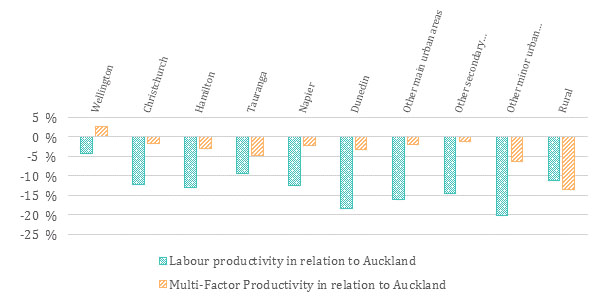
The reasons for Auckland firms’ productivity premium include that Auckland firms disproportionately employ workers who would be more productive anywhere.
“Reflecting the higher average skills of workers in Auckland, firms there pay 12.1 percent more per employee than do firms in other urban areas. Labour prices are only slightly lower in Wellington,” said Dr Maré.
In exporting industries there is a smaller productivity difference between Auckland and other urban firms.
“However, the auxiliary finance and insurance sector in Auckland is 41 percent more productive than in other urban areas in New Zealand. Information media services and non-metallic mineral product manufacturing firms are also more than 30 percent more productive in Auckland than in other urban areas,” said Dr Maré.
The research was compiled using information on 80,000 firms per year over 12 years (2001-1012), which account for over 60 percent of national output in the selected industries, and around 75 percent of employment.
The independent report Urban Productivity Estimation with Heterogeneous Prices and Labour by David C Maré was funded by the New Zealand Productivity Hub, under the Productivity Partnership programme, and also by Te Punaha Matatini, a Centre of Research Excellence hosted by the University of Auckland, whose mission is to develop methods and tools for transforming complex data into knowledge.
| Labour productivity in relation to Auckland |
Multi-Factor Productivity in relation to Auckland |
|
| Wellington | -4.2% | +2.7% |
| Christchurch | -12.1% | -1.8% |
| Hamilton | -13.1% | -2.9% |
| Tauranga | -9.4% | -4.8% |
| Napier | -12.4% | -2.2% |
| Dunedin | -18.3% | -3.2% |
| Other main urban areas | -16.0% | -2.0% |
| Other secondary urban areas | -14.6% | -1.2% |
| Other minor urban areas | -20.1% | -6.4% |
| Rural | -11.3% | -13.5% |
Motu Economic and Public Policy Research is an independent research institute operating as a charitable trust.
It is the top-ranked economics organisation in New Zealand, according to the Research Papers in Economics (RePEc) website, which ranks all economists and economic research organisations in the world based on the quantity and quality of their research publications. According to RePEc, Motu has five of the top 25 individual researchers in New Zealand.
We welcome your comments below. If you are not already registered, please register to comment
Remember we welcome robust, respectful and insightful debate. We don't welcome abusive or defamatory comments and will de-register those repeatedly making such comments. Our current comment policy is here.