
By Bernard Hickey
Prime Minister John Key has said a Capital Gains Tax is one of the 'third rails' of politics in New Zealand and anyone who touches it will be instantly killed in political terms.
This week Labour touched that rail and only got an invigorating tingle rather than the shock of their lives.
This is good because it shows New Zealanders can look beyond the initial headlines to the underlying need for structural reform that reduces the tax subsidies for property investment.
The debate is welcome, but Labour could have done much better.
Labour should be trumpeting how such a tax would shift investment into more productive export industries and create higher value-adding and higher wage jobs to keep young New Zealanders here.
Instead it has watered down that message by proposing a Capital Gains Tax that is full of exemptions and then used the revenues to shuffle tax from the very rich to the poorest.
A Capital Gains Tax is a good way to change the incentives for investors and reduce our appetite for foreign debt-funded domestic consumption. But it would be even better if it raised significant amounts of tax and was difficult to avoid. The exemptions for the family home, for residences in family trusts, for Maori land, collectables and gambling winnings will be welcomed with open arms by budding tax accountants and lawyers all over the land. See Cactus Kate's views on the exemptions here.
These will be high paid jobs, but they're not the sort we want.
A land tax would have been much more efficient, simple and lucrative. The idea put forward to the Tax Working Group in late 2009 by Motu economist Arthur Grimes for a 0.5% land tax with a NZ$50,000 per hectare tax free threshold and the ability to defer payment until sale would have raised around NZ$2 billion a year. Labour's CGT would initially raise just NZ$18 million in its first year and take 10 years to get to NZ$2.3 billion a year.
A CGT also does nothing to rectify the intergenerational wealth transfer created by the doubling of house prices in the property boom from 2002 to 2007. That created more NZ$300 billion in wealth for a generation of property owners and means the generations to follow will have to take on massive debts to afford a family home, particularly in Auckland. The property boom has effectively shifted wealth in the form of future debt repayments by the young into equity gains now for the old.
A CGT that is not retrospective effectively locks that shift in place and actually punishes future generations for any capital gains they make. The exemptions for small businesses also means those baby boomer business owners wanting to sell to younger generations will get to keep those capital gains tax free.
But the biggest problem with Labour's tax package is not the tax. It's a lack of spending cuts or any real and new reduction in foreign debt. Labour's deficit and debt track is little different to National's and any gains from the CGT and the 39c tax rate are being redistributed to low income earners rather than being used to repay debt.
Labour makes a lot of noise about 'owning the future', but hasn't addressed the need to reduce borrowing.
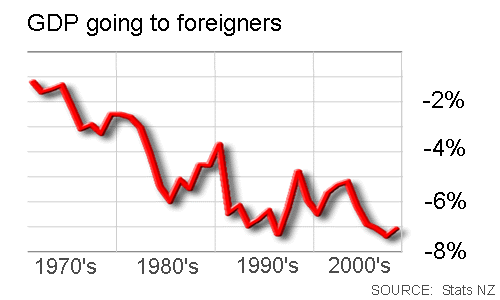
That is the major reason why New Zealanders are getting poorer directly through interest payments to foreign creditors. High borrowing by our government and property owners also makes us poorer in the long run through a ruinously high currency that hollows out the value-added jobs needed to keep our younger generations here. See more here in this piece on the Foreign Drain.
Labour needed to press harder on that third rail to get a bigger jolt.
(Updated with David Cunliffe double shot interview)
62 Comments
FYI from an emailer:
Hey Bernard - always enjoy your articles - refreshingly direct for someone like myself in Gen X and staring at some very large issues in the future.
What's your thoughts on a baby boomer tax before they all start retiring? My thoughts, and my generation who have had to pay large amounts more on everything, feel that since the Baby Boomers are responsible over the last 30 years for the environmental decline (lack of maintenance), ruining the financial investment options, impending health sector cost explosion, real estate bubbles and general political mis-management on both sides of the spectrum for savings and long term national economic security, We think they should actually pay to off-set some of this damage that they have caused - maybe a 1-2% tax to at least offset some of the future consequences. I think most of them that can, would help out, being that they have 'sheep mentality' by design....the message just needs to get out there. That's where you come in I guess.....you are the lone voice helping Gen X and Gen Y until we can get someone in power......but by then it'll be too late and generation debt (X) will be in charge of generation bankrupt. I hear the argument of wealth transference all the time but this generation is going to want to live forever...they cant accept a world without them.....there goes the inheritance as they cash in their assets for 'quality of life'! Ruin everything and expect all the goodies as well.....hardly seems fair. Happy to help somehow if I can get the message out there....possibly a forum / lobby group with some sympathetic Boomers and practical ideas generated from Gen X and Gen Y.......there are some brainy people out there, they aren't anywhere near parliament, they are just too busy paying off personal debt and treading water - but given half a chance would welcome a constructive platform to generate ideas for our future. Letters and blogs are just 'vents' we need a 'policy think tank' for the 'generational issues' we are about to encounter so that when we do get a politician who can see past his / her mates we can action fast. Regards DominicDominic,
Yes. I think a land tax would make a nice intergenerational wealth transfer.
I'll leave the politics to others.
cheers
Bernard
I made the comment a few days ago to the effect that who says the intergenerational theft will go undetected or unpunished.
It can't and it won't.
Best thing the baby boomers can do is decide the terms now, or it will be decided for them.
Babyboomers have spent most of their wealth pandering to every whim of generation x,y and below. Now generation x, y and below will inherit all their parents wealth without having to work for it and they are still whinging! Babyboomers worked hard, scrimped and saved for what they have now and have only really now started to spend their money. Generation x,y and below want to have what their parents have straight away instead of starting in a little flat on the wrong side of town with no furniture or appliances and a secondhand bed. My heart bleeds for them.
I am curious to know about this mysterious wealth that the next generations will inherit?
Is that the countries $230Billion of debt? More than our total money supply? Techically we have no wealth.
What about the government they have built, that currently has to borrow $300million per week with not obvious way of paying it back.
We have gradually slipped down the OECD rankings in my lifetime.
Oh yeah the country is been improved immensely on the BB's watch.
Really? absolute b*llocks is all I can say....BBs wealth is an illusion, try looking at the wealth in terms of outstanding debt and what money there is as IOUs for future energy...its an empty wallet....And BBs seem intent on spending their "gains" made while they pillages oil and resources that are now peaking and going into decline. Then as well as that in the next two to three decades they expect X and Y to pay for their healthcare....while paying off an educational debt BBs got for free...while having to cope with less energy year after year....and with the resulting high structural un-employment
"My heart bleeds for them." someohow I dont think so....
regards
WOW that a new one. A BB tax. Come on Bernard - what are your thoughts on a Baby Boomer Tax
Have just interviewed a Canadian student 21 yo. Discussed this very topic. They were surprised at the theme. Asked how much the average Canadian would have spent in the 10 years (between age 16 and age 25) on mobile phones, credit cards, travel, iPods, iPhones, iPads, latest model cars, restaurants, alcohol, drugs, going bankrupt at 20, etc etc etc .. conservative estimate was more .. much more than $50,000
The parents of BBs lived through the Great Depression and learned or had to learn frugality. Do you know what that is. BBs did not have the vast array of possibilities that genX and genY currently have for instant gratification. The baby boomers had to save for what they bought. GenX and genY put it on cedit cards. X and Y seem much less able to delay gratification and to work and save for what they desire.
If genXs and genYs totalled the amount of money they spend or have spent on all the non-essential toys listed above they would see where their money is going. Rather than criticise BBs for what they have worked and saved to achieve Xs & Ys should learn what every toddler needs to learn, which is to delay gratification and to do like the BBs: work and save.
We offered to accomodate the interviewee student for the duration of their stay. But we dont have Wi-Fi broadband connection. The iPhone4 requires wi-fi connection. Said student declined the offer and has gone out and is spending $200 per week on accomodation which has wi-fi connection. That's the importance of gadgets. Just one of the gadgets will thus cost $1200 for a 6 weeks stay.
And now they want a BB tax so they can spend more and sooner.
On one level I can agree with you.
But at the end of the day the fiat currency we enjoy was implemented well before I hit the school yards.
It is the BB's framework we are working with.
Perhaps a Financial Transaction Tax would be a better option than the Labour proposal
This is an article on Make Finance Work website and makes a whole lot more sense.
'1,000 economists have written to the G20 and Bill Gates to call for a financial transaction tax:
Dear G20 Finance Ministers and Bill Gates,
We write to you as the call for a Financial Transaction Tax is now gathering global momentum, and the French government has made it a key priority for their G20 presidency.
This tax is an idea that has come of age. The financial crisis has shown us the dangers of unregulated finance, and the link between the financial sector and society has been broken. It is time to fix this link and for the financial sector to give something back to society.
Even at very low rates of 0.05% or less, this tax could raise hundreds of billions of dollars annually and calm excessive speculation. The UK already levies a tax on share transactions of 0.5%, or ten times this rate, without unduly impacting on the competitiveness of the City of London.
This money is urgently needed to raise revenue for global and domestic public goods such as health, education and water, and to tackle the challenge of climate change.
Given the automation of payments, this tax is technically feasible. It is morally right.
We call on you to implement the FTT as a matter of urgency.'
I partially agree with the idea of a FTT. If it were limitted to foreign currency transactions it would strongly clip the wings of the hudge international currency speculation in NZ$. I read that at one stage these money flows were significantly greater than our nomal trade flows. This speculation pushes our currency arround and makes it next to impossible for Exporting NZ industries. These speculators work on small magins so 0.5% in and 0.5% out should stop it completely. (The exact figure would have to be optimised.) Any money collected could be redistributed to NZ tax payers in a way that compensates for the negative side effects
It's time for a leader to go Ceaușescu on us:
FOREIGN DEBT
Ceaușescu's political independence from the Soviet Union and his protest against the invasion of Czechoslovakia in 1968 drew the interest of Western powers, who briefly believed he was an anti-Soviet maverick and hoped to create a schism in the Warsaw Pact by funding him. Ceaușescu did not realise that the funding was not always favorable. Ceaușescu was able to borrow heavily (more than $13 billion) from the West to finance economic development programs, but these loans ultimately devastated the country's finances. In an attempt to correct this, Ceaușescu decided to repay Romania's foreign debts. He organised a referendum and managed to change the constitution, adding a clause that barred Romania from taking foreign loans in the future. The referendum yielded a nearly unanimous "yes" vote.
In the 1980s, Ceaușescu ordered the export of much of the country's agricultural and industrial production in order to repay its debts. The resulting domestic shortages made the everyday life of Romanians a fight for survival as food rationing was introduced and heating, gas and electricity black-outs became the rule. During the 1980s, there was a steady decrease in the living standard, especially the availability and quality of food and general goods in stores. During this time, Ceaușescu shut down all radio stations outside of the capital, and limited television to one channel broadcasting only two hours a day. The official explanation was that the country was paying its debts and people accepted the suffering, believing it to be for a short time only and for the ultimate good.
The debt was fully paid in summer 1989, shortly before Ceaușescu was overthrown, but heavy exports continued until the revolution in December.
If only Kiwis weren't a bunch of spoilt cowardly brats.
"how about starting a business, taking loans that are very lowly geared and getting some high skills to sell?"
And when is that ever going to happen? New Zealand is the nation teaching the world how best to stifle initiative and crush innovation. It's the nation doing its best to ensure that its citizens remain uneducated and low skilled, and that the few who somehow manage to gain an education and skills worth having are forced to flee.
Starting a business? Look outside, there are 4 million people queuing up to tell you why your idea is stupid and will never work. Want a loan? Well, unless it's for a house, forget about it. Skills? You mean like milking cows, playing sports, hotting up cars, or binge drinking? Those are the only "skills" considered acceptable in New Zealand, thanks very much.
The number one claim of Kiwisaver apologists is that Kiwis have to be FORCED to save, because they cannot and will not do it on their own. So what makes you think Kiwis are capable of doing any other sensible things?
No, it will take a strongman to force austerity on the country until our ludicrous debts are repaid. Your fellow citizens won't do it voluntarily: they still want to keep on borrowing and spending as if money grows on trees.
Starting a business with a zero interest never-never loan from family is wonderful, but most people aren't so fortunate as yourself.
So do you give back at all Marty? Or are you just a taker?
See what you can learn from this.
http://www.humanmetrics.com/cgi-win/jtypes1.htm
Then perhaps this: http://tip.psychology.org/guilford.html
Just because you have certain attributes doesn't mean that everyone does. It is how you treat others that really defines who you are.
Well yes it has worked, but is unlikely to continue to work if it involves borrowing money or using resources that are finite.
But what really counts is that not everyone thinks the way you do. Hopefully the links will open your mind a bit on that. The hard work one in particular is a fallacy.
Actually, hard work makes Martyh a telles of porkies. He's on record here as saying his business doesn't need physics.
What he doesn't realise is that everything he does - drives to/from work, switches on an appliance, uses a computer - uses energy. He is using it at the equivalent rate (if he's an average kiwi) of having 300 slaves at his permanent disposal. If he was in the 'States, that would be closer to 1000 slaves.
Those folk have no idea what powerdown will do to that. To hold station, sans fossil energy, they'd have to work 300 times harder.
Mind you, you have to define 'work'.
10 gets you 1 he vanishes as of November. As will Willie Foo Foo (working for families - if I was drawing a long bow, I say Tat Loo). (Note his pen name is one up on Marty G from the Standard....just a coincidence, of course. One supposes they don't have to log this as an election cost....
Slavery is how many elite families made there net worth grow...and well thats another chapter in a different volume marty...like opium dealing! Your owners also enjoy a good war or two...
Cue Bono?
Actually I think we all benefit from slavery in the real sense. Chinese wages come to mind.
It's all a bit like discussing the difference between first-class and steerage as the bow slips under water, but.
True but rapidly becoming irrelevant :)
Aye PDK agree
;-)
PDK, you say "Actually, hard work makes Martyh a telles of porkies. He's on record here as saying his business doesn't need physics. What he doesn't realise is that everything he does - drives to/from work, switches on an appliance, uses a computer - uses energy."
What are you suggesting Marty/we do please? Marty says "Most successful people I know do not go for full-time salary work. They boom and bust. They take risks etc." I agree - that's what my husband and I have been doing (boom, no bust yet!) and things are working out well. Not only personnally (in terms of income, family time etc) but also in terms of actually doing productive stuff which hopefully helps the NZ economy (in a very small way obviously, but better than being on welfare, which with nearly 5 kids I could very well choose instead of working).
So should we tell our customers that we have decided to fold up our business and lie in bed all day instead (that will consume less energy I'm sure)? That we are not taking on any more of those software projects developing high-tech products that are all destined to the export market (eg currently, one destined to the French market, another commissioned to us by a foreign govt and another aimed at Australia/US)?
I understand what you are saying re growth not being sustainable, energy running out, exponential maths etc (you repeat it often enough!!) but my question again is...so what should I do right now? Never turn my computer on again, plant a veggie/fruit garden (which we do anyway btw) and go back to living autonomously and in a 17th-century like manner? If I did so, in what way would it actually help anything/anyone (I'm just 1 of 7 billions people after all)? I'm genuinely interested.
Elley I think an honest appraisal of your business in terms of energy would be paramount. How much does it use to produce and distribute. Does it contribute to energy use or does it reduce energy consumption. I think what is key is that you do this before you are forced to.
An equal question is to your motivations towards other humans on this planet. Do you seek to help them or profit from them?
The question is how can you excercise your obvious intellect to something that is beneficial. I doubt for you that subsistence living would be satisfactory or desireable. Instead have a subsistence mentality but use your abilities to develop sustainable technologies.
Scarfie, I'd say our business doesn't consume much energy in that software devt requires very little overhead. We work from home & just use 2 computers (have more but usually only 2 running at any one time) which we probably would use anyway even if we weren't working except it'd be to surf the net instead, + a few pieces of hardware (eg scope, routers etc). That's about it really. We probably do not use much extra energy compared with being at home and not working. The house was recently built with energy in mind (passive solar design, wetback, insulated slab, solar panels).
Does the business help reduce energy consumption? - I suppose not. Although one of the projects we work on is the devt of solar inverters, so I suppose that might count as a brownie point :) The idea is to make a living so basically the projects we take on are dependant on what we get offered (ie, we don't create products ourselves at this point, although will probably get into this once the kids are older, but only contract our development services to NZ companies that want to develop products but don't have the skills to do so).
As for "my motivations towards other humans on this planet" and do I "seek to help them or profit from them". Hmmm, that's profound. I do what I do because I can (studied for it) and my motivation for using my skills is simply to be able to take care of my family & myself, ie not rely on govt welfare or others' charity. That said, I am involved with charities myself and helping others less fortunate has been important to me since I was a little kid so I wouldn't say that my goal is to profit from others. In a few words, I'm just an average person trying to do well with my life (ie, have a happy family life and enough income to avoid financial stress and have a normal standard of living). Nothing deeper than this I'm afraid.
The trouble is your 'normal' is about to be changed by a new paradigm. I think you can sense it. The risk by carrying on being self centred is that you relegate yourself to the level of the soldier that commits atrocities because they were 'just obeying orders'. Even neutrality lends tacit approval to those doing the damage.
Keep thinking, we have been conned for so long that it isn't an easy road out.
The upside is that guys lots of others are resistance because they believe they are going to have to give something up. The reality is that we are spiritually dead and that by following other paths it can lead to a more fulfilling existence.
The four ingredients to longevity. Diet, excercise, spirituality and meditation(not transciendental!).
"The trouble is your 'normal' is about to be changed" - OK, and assuming you are right my question was, should we hide in bed under a blanket while we wait (for things to change / the apocalypse)? I just don't think doing that would help at all.
Hey careful Elley ! PDK and Co arent used to common sense arguments,we are supposed to swallow their self righteous nonsense e.g " I can run my house on the power of one lightbulb -so there " As for admitting to have nearly 5 kids - thats really putting coal on the fire !
Re-5 kids, yeah I know. Totally expecting to be called irresponsible and asked to get rid of a few (fat chance of that happening though)!
Elley - it's a good question, one I've wrestled with for years.
Will answer it tonight (making the most of the daylight outside aty the mo, pre southerly)
May be too much for here, in which case I'll do it on the blog and redirect.
Or maybe BH will take it as an opinion piece.... :)
Gonz - unfortunately, sanctimonious won't save us - but after years of trying to engage the arrogant and the ignorant, I admit to a short fuse. Been there too often.
Thanks, looking forward to reading it.
Sorry to see you go, marty, but I can understand the reasoning behind it. Hopefully the websites participants have provided you with a good insight into the problems that New Zealand faces and why the country has declined down the OECD to the extent that it has. I know it does for me. Sadly I don't see that changing for a very very long time.
Bridges are made for burning. :)
The huge inequality of income that now exists in New Zealand has to be addressed. In a small way a CGT will do that if only because Labour has coupled that with the first $5000.00 being exempt from income tax. However I cannot see how it will address our overseas borrowings when CGT is not going to be implemented until 2013. If Labour were serious about reducing New Zealand's overseas borrowing then it would have to increase even more the Banks' capital requirements, restrict the amount of borrowing for a house to say 70 percent and restrict the amount of foreign ownership of New Zealand assets and the repatriation of profits. It is New Zealand's private debt that is horrific not its Government debt. And who does the borrowing - the Banks. Best of all if the exchange rate were managed and reduced from these ridiculous highs the manufacturing base would start up again as would our export industries. But all we will hear will be from people who moan about the increase in petrol etc and how they will have to leave New Zealand. It will take another major depression before people start to think and realize a Government is there to govern, to manage an economy. The free market cannot do it. The words free market are just another phrase for anarchy.
"the huge inequality of income that now exists in New Zealand needs to be addressed"
Oh yeah, and by penalising those that are the net income generating part of the workforce and subsidizing the net recipients of government spending, you reckon we are going to get there?
That will just retard the wealth generation, and increase spending recipients simultaneously, accelerating the decline. Not in NZ's best interests.
-b
banksterbasher, you obviously haven't studied hard.
The more disposable income the poor and middle class have the better wealthy people do because poor people spend all of their money generally as they earn it.
The money goes from the poor to the wealthy people who own the businesses that supply the needed goods in every day commerce.
The owners are taxed at a higher rate.
Their income is redistributed.
And the welfare circle continues.
With the poor feeding the rich.
The notion that wealthy people are better at spending your money is ridiculous.
In fact thanks to interest, there is less money in the system then debt, so it has become impossible for NZ to be debt free.
You better believe it.
Collectively all countries can not run trade balances against each other at the same time. Its like a game of musical chairs.
He is right Marty. The stats are available on this site and from RBNZ.
Whats worse is that 75% of our debt is against residential property, a further 8% personal.
Default is the only option, it is just a matter of when.
As it is for the western world in general, Scarfie.
http://www.babylontoday.com/national_debt_clock.htm
The first graph looks suspiciously like the classic exponential curve, trending to the vertical.
They never go much further than that.
Haha. That was a great link of yours in the weekend re stealth inflation, definitely bookmarked:)
Perhaps the 98% is the M0 to M3 ratio I was alluding to above 1:63
Patricia "I cannot see how it will address our overseas borrowings"
Our overseas borrowing is a direct result of our current account deficit. We have been buying more than we have been selling for forty years, the differance is made up by going deeper into debt and selling off our precious assets. Even though we now have record terms of trade in our favour the current account is still going deeper into the red at double or triple the rate of GDP growth. We are bleeding to death as interest payments and profits to the foreign owners of our infrastructure and businesses flow offshore.
John Key thinks we can help address the problem by selling even more of our few remaining assets. He hasn't got a clue in other words.
I agree. If our record terms of trade can't do the trick nothing can unless there is a massive change in how the economy is run. And I can't see the voters voting for that. I still can't see how a CGT will help our overseas borrowing problem, that is help us repay it when it doesn't even start until 2013. As I understand it most of the borrowings relate to the interest payments due as well as just rolling over existing loans. I think it is all out of our hands now. The financial markets of the world will decide. All I can suggest is get the vege garden in!!
Does it go far enough ?? Of course not ...Will any political party go far enough ?
Of course not....John Key is not incorrect about the third rail...that's why Phil Goff only touched it lightly and then shrink back ...
What will happen to NZ in the future ??Very much like a small town in Malaysia I know of..
It's populated only with very young (age zero to 12) and very old (age 50 and above) and survive on economic transfer from the middle section who have left it to seek better life and wages elsewhere....
The Gen X and Y will seek revenge in the future by 1. drastically reducing health and welfare on their BB parents and grandparents and 2. reducing security on their BB parents and grandparents assets...burglary and robbery of older people will be the order of the day.
This will happen within the next 20 years if not earlier and will be touted as "market solution"....we don't have the money because it's all in their houses and we don't collect enough taxes because everybody has left......
FYI from a reader via email:
Hi Bernard
Re Ones Home:
We are hearing a lot in the media all the time about NZers investing in housing, and how it locks capital up as none productive.
We have to live some where, so what is a figure or percentage of a persons wealth/income that they can or should have invested in there home or a property.
Investment Houses/ Rentals
The poor also have to live some where, if an investor does’t know what export sector to invest in, what other investment / wealth creation systems are out there?
Please send your thoughts at a time that suits.
Kind Regards
Paul
Paul
Many thanks.
I don't think there's a set level of investment that 'should' be invested in housing.
You're right there aren't the choices there at the moment. It's a chicken and the egg problem.
cheers
Bernard
Haha, it is a fantastic question isn't it Bernard.
FYI from a reader via email:
Hi Bernard
Good to see you hammering both parties on their failure to address the issue of debt and deficit spending in your recent article in the Herald.
Both parties have an election strategy of 'borrow and hope for the best', which is really no strategy at all. It's self serving and disingenuous.
They need to be restrained at the ballot box. I'd love to see debt rather than taxation become the election issue. Depending upon what happens in Europe and the USA, it may well do. If not for this election, then certainly for the next.
kind regards
Brendan
Maybe he is on dial up.....
Won't a CGT actually make the balance of payments worse?
I heard on the radio that a CGT is likely to:
1) Decrease the value of property.
2) Increase rents (to maintain the rate of return).
3) Increase rates of home ownership as renters buy.
Now, since owner occupiers are allowed to carry larger debt loads than the rental property owners, won't that result in an increase in the amount of debt per house?
1) Decrease....yes, quite possibly, which is the idea when the property market is over-valued.
2) If property is cheaper to buy and you get the same rent, and rent is at the max level ppl will pay, yes you get more of a return. PIs are always trying to get the max rent they can, sure they can ask for more, but renters move out..
3) Possibly, and this is bad how? the reason lots of ppl rent is because tey cant afford a mortgage, so reducing houses significanlty in value allows them thre own home.....I cant see anything bad in this.
Owner occupiers v PIs....its expected that the biggest effect will be point 1) so even if this is true ie there is such an effect you suggest, its swamped by the effect of 1). On top of that farmers in particular apparantly load up with debt every year to avoid paying yearly tax...so they claim max WFF, free healthcare as they are so broke and add to the overseas borrowing, all not good / fair things....
Also right now in effect PIs etc pay less tax day to day, for instance I know a work mate is paying 16% PAYE instead of 33% as he has a tax "loss" in a house...but when he retires he cashes out tax free.....What the CGT does is stop/limit that cash out for free at the end....at least 15% tax will be paid...
regards
I think that the 0.5% land tax on land over $50,000 might help generate some tax from speculating land bankers who choke up the free market for residential land, and thereby discourage this behaviour. (making significantly more land available would be far more effective. Why not do both)
It should not effect the average farm at a value of $17,000 per HA
It will affect high yielding horticultural farms but should not be that significant because they are high yielding.
What happens to the significant amount of land valued less than $17,000 /Ha that is in the hands of foreign people who make no other contribution to our ecconomy. We pay the taxes that in some ways they enjoy the benefits as property owners. How do we address this.
Average home owners and companies - just another tax.
Can anybody think of any other good chages of behaviour that may result?
FYI I have updated with my Double Shot Interview with David Cunliffe this afternoon.
Good interview, Bernard. It has thrown some more light on Labour's CGT proposal.
I think Labour is making a good start . Now the electorate has something of a choice.
Great interview Bernard...you raised some good questions...structural deficit, WFF, student loans etc...good on Labour for suggesting a CGT, but I don't believe they will make any progress with spending cuts...perhaps progress with election bribes.
A few thoughts on this capital gains tax:
Speculators & traders will be rubbing their hands, particularly those who's capital profits push them into the highest tax bracket (probably well over in some cases). Their tax rate will approximately halve.
I can see a huge unintended consequence here. Rather than "pushing money into productive areas" I can see it possibly having the opposite effect where speculation increases, because of above.
Also, creative tax accountants will find ways to call income capital gains to take advantage of the lower tax rate.
To call it a "fair tax" the family home & maori land should be included.
Iain,
No politician will ever say this, because if you do you'll get kicked out of the club.
Yes and we are the worse for it, especially us in ChCh:
Housing on the state - opinion - the-press | Stuff.co.nz
http://www.stuff.co.nz/the-press/opinion/5260027/Housing-on-the-state
"If we could build all those houses back then with Reserve Bank finance at 1
per cent interest, why can't we do the same now to rebuild our city?
We still have the Reserve Bank, which could issue credit at 1 per cent as it
did when it provided the money to build houses for Key's mother and more
than 33,000 other needy families.
Perhaps we need more common-sense sheilas and blokes managing New Zealand's
economy as they did with success in the 1930s and fewer over-educated
"experts".
You can envisage that if Key & NACT have tried to manipulate fear of CGT with likeness to an electric third rail, they would probably liken this to an electric Pandora's Box.
How long before you get back to your roots, Labour?
Iain - you've done a good job in this regard. Yep, there is more to do and there have been some good people working on solutions. It's just a matter of time before we get that electric Pandora's Box open and the winged Tasers therein fly out and zap the crap out of the bullshitters who continue to treat the majority of us like mushrooms.
Cheers, Les.
Before the details of labour's proposed CGT came out, I was thinking maybe I'ld vote Labour. But once the details are out and I see all those exemptions and the raising of personal income tax, I think maybe National might be the lesser evil.
I feel like being between a rock and a hard place.
MMP means the govt is hobbled from making bold decisions IMHO. A case study is in pre-MMP system the then LABOUR Party Finance MinisterRoger Douglas' financial reforms in 1980s, most of which have largely not been reversed by successive govts. If JK or BE had the real majority they could get NZ sorted but now they need to consult with Treaty Partners, ACT,United noFuture et al . Boot out MMP asap or nothing changes
Cunliffe is just a typical example of the Labour shorterm memory. Davidhow about you and your stupid party ADMIT you COMPLETELY thucked up 9 years of economic mayhem based ENTIRELY on debt and YOU & YOUR PARTY did NOTHING to correct ANY of it that WHOLE TIME!
National just followed suit like the "plan B" morons they are
David Cunliffe answers Bernard's question here:
CHAT: David Cunliffe answers your questions - Business - NZ Herald News
http://www.nzherald.co.nz/business/news/article.cfm?c_id=3&objectid=10739443
Another important question is, what does the difference between NACT and Labour's surplus track look like once debt is paid down and what policies further support each track?
Noting that NACT believe TINA in regard to monetary policy, while Labour will alter the Act and give RBNZ more tools and targets to support the wider real economy - NACT won't.
After debt is paid down NACT will more than likely want to repeat the kind of (trickle anywhere but down) tax-cuts that have meant they see a need to sell down assets, so what does that imply for remaining assets?
We welcome your comments below. If you are not already registered, please register to comment
Remember we welcome robust, respectful and insightful debate. We don't welcome abusive or defamatory comments and will de-register those repeatedly making such comments. Our current comment policy is here.