

Here's my Top 10 links from around the Internet at 3 pm in association with NZ Mint.
I welcome your additions in the comments below or via email to bernard.hickey@interest.co.nz.
I'll pop the extras into the comment stream. See all previous Top 10s here.
Did I say buckle up last Friday...

1. What QE III might look like - Ed Harrison at Credit Writedowns refers to a section in Ben Bernanke's now (in)famous Helicopters speech from 2002 when considering what QE III might look like.
Bernanke could set long term interest rate caps.
Sound familiar?
This is all about financial repression pure and simple. See my opinion piece here.
How long do savers put up with it?
Do they have a choice?
The levels of US Treasury yields (0.25% for 2 year debt...) suggest fear of outright losses outweighs the fear of inflation adjusted losses.
Who'd be a saver in this environment?
Here's Bernanke from the 2002 speech:
. A more direct method, which I personally prefer, would be for the Fed to begin announcing explicit ceilings for yields on longer-maturity Treasury debt (say, bonds maturing within the next two years). The Fed could enforce these interest-rate ceilings by committing to make unlimited purchases of securities up to two years from maturity at prices consistent with the targeted yields.
If this program were successful, not only would yields on medium-term Treasury securities fall, but (because of links operating through expectations of future interest rates) yields on longer-term public and private debt (such as mortgages) would likely fall as well.

2. A rag tag bag of China short sellers - Some former colleagues of mine at Reuters, including Mark Bendeich, report on a bunch of short sellers of Chinese stocks listed on US and other markets.
They are a rag-tag bunch, often working from home or tiny offices scattered round the world, from rural Texas to Beverly Hills and a suburb near Australia's Bondi Beach.
Some have never even been to China; most don't speak or read Chinese. And yet in the past nine months, this small group of "short sellers" has published research exposing accounting fraud at a series of Chinese companies listed in the United States and Canada, and made as yet unproven allegations against a whole bunch more.
As a result they have scuttled a once hot sub-sector of the American capital markets.

3. 'S&P not credible' - The fury being unleashed on Standard and Poor's in America is something to behold.
Here's Paul Krugman at the New York Times:
Let’s start with S.& P.’s lack of credibility. If there’s a single word that best describes the rating agency’s decision to downgrade America, it’s chutzpah — traditionally defined by the example of the young man who kills his parents, then pleads for mercy because he’s an orphan.
America’s large budget deficit is, after all, primarily the result of the economic slump that followed the 2008 financial crisis. And S.& P., along with its sister rating agencies, played a major role in causing that crisis, by giving AAA ratings to mortgage-backed assets that have since turned into toxic waste.
Nor did the bad judgment stop there. Notoriously, S.& P. gave Lehman Brothers, whose collapse triggered a global panic, an A rating right up to the month of its demise. And how did the rating agency react after this A-rated firm went bankrupt? By issuing a report denying that it had done anything wrong.

4. 'S&P not popular' - And it's not just the Americans who want to beat up the ref. Police in Italy have raided the offices of Standard and Poor's and Moody's.
As stock and bond markets across the world tumbled on fears about Italyand Spain, it emerged that police acting on orders from prosecutors had raided the Milan offices of rating agencies Moody's and Standard & Poor's as part of continuing investigations into their role in the recent financial turmoil.
Carlo Maria Capistro – chief prosecutor of Trani, a small Adriatic port – told Reuters that his office was checking to see whether the rating agencies "respect regulations as they carry out their work"

5. 'Bankers got away with it' - Former Investment banker William Cohan writes at Bloomberg (so we're not talking some bolshie leftie on a dodgy blog) that the moral rot on Wall St has to be ended.
What will it take for Americans to finally get the message that much ofWall Street, in its current form, is a corrupt enterprise in need of a top-to-bottom overhaul, a task that the year-old Dodd-Frank law, for all its verbosity, barely attempts?
There is ample evidence in the detritus left behind by the ebb tide of the worst financial crisis since the Great Depression. There are the thorough -- and thoroughly damning -- reports (along with thousands of pages of accompanying internal Wall Street documents) produced by the Financial Crisis Inquiry Commission and the Senate’s Permanent Subcommittee on Investigations.
Each examination revealed layer upon layer of behavior that should make us seethe with anger. These include the decision to manufacture and sell mortgage-backed securities that were stuffed with loans of questionable value, plus the worthless AAA ratings placed on them by ratings services paid by Wall Street to do so. Also the business model that encouraged bankers and traders to take asynchronous risk with other peoples’ money with the knowledge that by the time things went wrong, billions of bonus dollars would be paid out, and no effort would be made to hold anyone accountable.

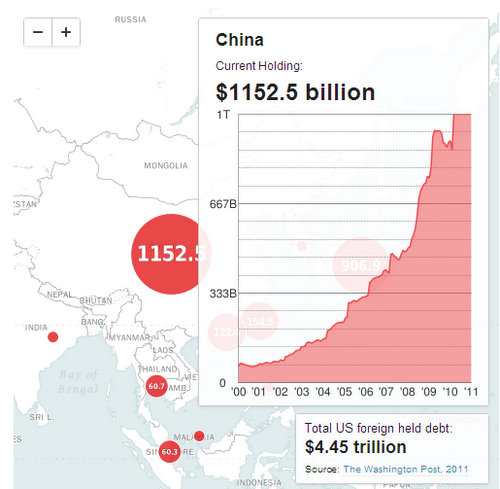
6. Where the US debt is - Check out this excellent interactive graphic showing where the US debt is.
Mousing over the large dot on China shows that Chinese lending to the United States has gone from $59 billion ten years ago to more than $1.15 trillion today, or one quarter of the total foreign owned debt of $4.45 trillion.
7. What the Chinese said - Here's the now (in) famous Xinhua editorial from the weekend (ie the voice of the Chinese government) on the US debt crisis where it said America needed to break its addiction to debt.
There's an element of hypocrisy in all of this. China's lending to America was the enabler for its consumption boom of the naughty noughties.
The other side of this coin is that China has to break its addiction to American consumption of Chinese exports and build consumption within its own borders. Instead it is choosing to bridge the gap left by missing American export demand by building bridges to nowhere, ghost cities and high speed rail systems that break.
Here's the voice of the great creditor (and credit creator):
To cure its addiction to debts, the United States has to reestablish the common sense principle that one should live within its means.The U.S. government has to come to terms with the painful fact that the good old days when it could just borrow its way out of messes of its own making are finally gone.
It should also stop its old practice of letting its domestic electoral politics take the global economy hostage and rely on the deep pockets of major surplus countries to make up for its perennial deficits.
A little self-discipline would not be too uncomfortable for the United States, the world's largest economy and issuer of international reserve currency, to bear.

8. Why the ECB's bond buying is doomed in one chart - Zerohedge points to a chart showing how the European Central Bank's buying of PIGS bonds didn't work to reduce interest rates...yet somehow it's supposed to work in a bond market (Italy's) that is many magnitudes bigger.

9. Australian housing stress growing - Smartcompany.com.au reports that 85 building and construction firms in Australia have gone under in the last month.
Over the past fortnight, Safi Brothers Constructions, Port Melbourne Building Supplies, Coastline Bricklaying and Blue Hills Bricklaying have entered administration. Others to have collapsed of late include plumbers, plasterers and landscape gardeners.
Registered company liquidator, Cliff Sanderson of Dissolve Pty Ltd, says while the building sector always features pretty heavily in the collapse lists, the numbers have increased over the past three to five months.
The reasons, according to Sanderson, are the relatively recent downturn and increased aggression from the Australian Taxation Office.

10. Totally Jon Stewart and his team of pundits (and one mime artist) on the Debt Ceiling deal
16 Comments
FYI from Troy via email
Washington can argue with S&P about a couple trillion dollars till their blue in the face but this is the scope of the real problem. I keep warring people that the REAl debt is much much larger. Big surprise, now the Keynesians are coming out of the woodwork telling us that the bailouts weren’t large enough and that is why the US economy is still in dire straits.
http://www.npr.org/2011/08/06/139027615/a-national-debt-of-14-trillion-try-211-trillion
Excellent programme on Sunday with Andrew Patterson on Radio Live.
Satyajit Das a highlight
http://www.radiolive.co.nz/US-economy-special/tabid/506/articleID/22258/Default.aspx
We’ve put up the whole programme, so here are the timings for those who want to fast forward:
0.00 Intro
3:05 Bernard Hickey
13.25 William Buechler (US based fund manager, Buechler Capital Asset Management)
19.18 Simon Botherway (GM, ANZ Wealth Management)
29.25 Satyajit Das (Sydney based financial and banking analyst and author of the forthcoming book Extreme Money)
In regards to Satyajit Das talking about cutting Greece and others from the EU... here is a video of a speech suggesting just that... ( and it really is the only solution ).
http://www.youtube.com/watch?v=zLoliIpR-X0&list=FLjsOCpm-c3VU&index=2
What is disturbing , is not the content of the speech, ... but the complete and utter lack of reaction or response from the audience.... This guy should have been given a standing ovation..!!!!!!
Seems like the politicans are ignorant... excepting the speaker.
And gold hits US$1700/oz
http://www.zerohedge.com/news/one-ounce-non-money-tradition-1700
Bernard- any involvement of New Zealand trading with gold -with focus to balance finances- rebuilding the economy ?
Ambrose sets the scene beautifully here
http://www.telegraph.co.uk/finance/comment/ambroseevans_pritchard/86874…
This time we face the risk of double-dip recession without shock absorbers. Interest rates are already at or near zero in much of the OECD club. Fiscal deficits are stretched to the limits of safety.
Far from loosening, the US is on track to tighten by 2pc of GDP next year, and Europe by 1pc to 2pc, into the slowdown.China has already pushed credit to 200pc of GDP. It cannot repeat the trick.
The Anglo-Saxons can print more money, but the gains in asset prices for the rich are offset by losses from fuel and food inflation for the poor. This is a destructive trade-off.
The decision to throw everything we had at the crisis after Lehman-AIG was a legitimate gamble at the time, given the near certainty of depression if shock therapy had been tried – as in 1931.
It is too early to say the policy has failed, and failure is a false term when leaders confront cruel choices. Yet last week's drama has brought home the truth that suffocating debt has not gone away; it has merely hopped on to the shoulders of sovereign states, threatening just as much damage.
Even Germany's most ardent pro-Europeans seem to have given up trying to find a solution. They are building an alibi for EMU break-up instead.
This is a dangerous moment for the world. It is still possible that the growth scare of recent months will prove a false alarm.
Yet the Bank for International Settlements is surely right that we are pushing ever closer to the limits of a model that relies on artificial stimulus to keep stealing extra prosperity from the future. There is ever less to steal.
And Nouriel Roubini says avoiding a global recession may become mission impossible:
http://www.ft.com/cms/s/0/f443f640-c115-11e0-b8c2-00144feabdc0.html#ixzz1UPKqPBst
Hopes for quantitative easing will be constrained by inflation that is well above target levels across the west. The Federal Reserve will probably start a third round of QE, but it will be too little too late. Last year’s $600bn QE2 (along with $1,000bn of tax cuts and transfers) produced a growth bump of barely 3 per cent, for one quarter. QE3 will be much smaller, and will do much less.
Nor will exports help. All advanced nations need a weaker currency, but they cannot all have it together – if one is weaker another has to be stronger. This is a zero sum game which risks only the resumption of currency wars. Early skirmishes are beginning as Japan and Switzerland try to weaken their exchange rates. Others will soon follow.
So can we avoid another severe recession? It might simply be mission impossible. The best bet is for those countries that have not lost market access – the US, UK, Japan, and Germany – to introduce new short-term fiscal stimulus while committing to medium-term fiscal austerity. The US downgrade will hasten demands for fiscal reduction, but America in particular should commit to look for significant cuts in the medium term, not an immediate fiscal drag that will worsen growth and deficits.
FYI from Alan via email from Michael West at The Age:
Unlike Japan, which buried its economic problems and never prospered as before, America's resilience had always relied on its capacity for boom and bust, for fast regeneration. Instead, this time, it opted for corporate welfare. The moral hazard of this humungous stimulus though could only ever put off the inevitable reckoning that now appears to be upon us.
It may be yet too early to make the call. But this bloodbath on world markets has left the emperor entirely nude. It is quite conceivable, especially as Washington has always danced to Wall Street's tune, that the plan now, if any, is just to keep printing money till paper currency and therefore $US-denominated debt is rendered worthless.
Now then, what's the plan? There seem to be two choices on the policy menu.
One, the deflation option: let market forces take over, let the defaults begin and provide a social safety net.
Two, the inflation option: keep splashing the cash to reduce the debts to zero. Kick the can down the road. This is clearly the Wall Street option. The proxies in Washington will duly deliver more stimulus, stimulus the public can ill afford, stimulus which could bring another Weimar Republic with its hyperinflation, but stimulus which will diminish the size of the debt.
3. 4, and 7 can be summed-up as 'blame shifting'. Often a symptom of denial.
E-P nails the symptom, but not the cause.
And that graph in 6 is a classic - who would put money on its continuance?
Fascinating debt graph #6
The KSA hasn't lent the US a cent. They are not stupid!
We need a few like Nigel Farage on the NZ political scene.
OMG - I disagree, we need a lot like Nigel Farage in NZ.
Not a bad effort on the tele tonigh Bernard, although I am embarassed to say I was watching the one eyed monster.
Was it just me or was Mark Weldon looking a bit ragged? Is he feeling the strain or on drugs?
I don't know. But what I do know is that he needs to do something about his appallingly stained yellow teeth. Yuk! I'm afraid to say but a person in his position in this day and age simply cannot go around with a set of chops that would give a clapped out old slapper on the rum, a run for her money. It doesn’t look professional.
Well tooth rot is a sign of 'P' use.
..aha ! ...... no wonder me brudder had all his rotten teeth pulled out , he was forever playing with his " p " ........
...... and they told me all that " p " playing would cause him to go blind ! ....... ah feck , where's me Gummy specs ?
We welcome your comments below. If you are not already registered, please register to comment
Remember we welcome robust, respectful and insightful debate. We don't welcome abusive or defamatory comments and will de-register those repeatedly making such comments. Our current comment policy is here.