

Here's my Top 10 links from around the Internet at 7.30 pm in association with NZ Mint.
I welcome your additions in the comments below or via email tobernard.hickey@interest.co.nz.
I'll pop the extras into the comment stream. See all previous Top 10s here.
Jon Stewart and Joe Nocera think deeply about private equity and capitalism at #10.

1. 'Unconventional bridges to nowhere' - This week bond yields in previously distressed European government bond markets fell substantially.
The overwhelming noise is that the European crisis is over, or at least under control for now.
This is because the European Central Bank lent cash-strapped banks almost €500 billion euros just before Christmas and they quickly turned around and invested that money in government bonds, picking up a nice carry trade profit along the way.
America's stock market has started the year with its biggest rally since 1987.
Everyone can breathe a sigh of relief, says Mr Market.
So it's refreshing to read this assessment via Project Syndicate from Mohamed El Irian, the CEO of the world's biggest bond fund PIMCO.
It is today's must read. He says all this central bank lending to banks, which has more than doubled to 20-30% of GDP inside the last year is unsustainable and doesn't fix the basic problems of a lack of credit to those who need it and a lack of economic growth and jobs.
I have bolded the key line. Here's a sample:
From every angle, the extremity of this state of affairs – in which those with access to credit do not need it, and those who do cannot get it – is highly problematic. If left unattended, it leads to a gradual, and then accelerated, renewed deleveraging of the economic system, with the highest first-round costs – a longer unemployment and growth crisis – borne disproportionately by those least able to suffer them. In the next round, as the system slowly implodes, even those with healthy balance sheets would be impacted, accelerating their disengagement from a deleveraging world economy.
All of this slows social mobility, tears already-stretched safety nets, worsens inequality, and accentuates genuine concerns about the functioning and sustainability of today’s global economic system.
Effectively, the central banks have been unconventional bridges to nowhere, owing mainly to their imperfect tools and other government agencies’ inability or unwillingness to act. At some point – and we are nearing it – bridges to nowhere become a standalone risk: they can topple over. Rather than just pumping liquidity into clogged pipes, countries can and should do more to build a more effective network of compensating conduits.
It is high time to move on five fronts, simultaneously:
· Countries such as Spain and the US need to be more forceful in unblocking the housing sector by making overdue decisions on burden sharing, refinancing, and conversion of idle and foreclosed housing stock.
· Countries with excessive debt, such as Greece and Portugal, need to impose sizeable “haircuts” on creditors in order to have a reasonable chance to restore medium-term debt sustainability and growth.
· In several Western countries, public-private partnerships should be formed to finance urgently needed infrastructure investment.
· Regulators should stop bickering about the future configuration of key financial institutions, and instead set a clearer multi-year vision that is also consistent across borders.
· Finally, governments should inform their electorates explicitly and comprehensively that a few contracts written during the inadvisable “great age” of leverage, debt, and credit entitlements cannot be met, and must be rewritten in a transparent way that strikes a balance between generations, labor and capital, and recipients and taxpayers.
Such policies would allow healthy balance sheets around the world, both public and private, to engage in a pro-growth and pro-jobs process.
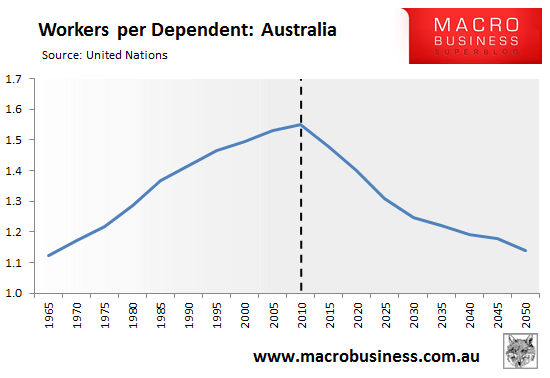
2. Australia's demographic problem - Leith van Onselen at Macrobusiness has done a good job looking at the stats on hours worked per head of the working age population in Australia. He finds it has been rising for much of the last 30 years, therefore boosting economic output and incomes. It has been expressed in a higher workforce participation rate.
But what happens when the number of workers starts to drop as they retire and those left working have to support a larger number of retirees? Economic output may drop and you'd have to think that tax rates (or public debt) have to rise to compensate.
Here's Leith:
One underlying reason for the upwards trend in the participation rate is that Australia’s population has, for the past three decades, reaped a demographic dividend from the large baby boomer cohort – those born between 1946 and 1964 and currently representing one quarter of Australia’s population. This group entered the workforce in in the 1970s and 1980s, resulting is a large increase in the ratio of workers to non-workers.
the ratio of workers to dependents peaked in 2010, but is now projected to decline each and every year going forward as the baby boomers enter retirement [the first of the baby boomers reached 65 in 2011]. This suggests that Australia’s participation rate should start trending downwards, which should reduce the average number of hours worked per head of population; although the likely impact on hours worked relative to the working age population is less clear.
3. A Chinese property crash by the end of the year? - Bloomberg reports with lots of juicy detail that China's previously booming housing market is creaking under the weight of unsold homes and property developers are struggling with finance.
Here's more:
Developers are looking for ways to preserve record sales last year as the impact of purchase limits and tighter mortgage requirements imposed by the government spreads. China’s home transactions will fall 10 percent this year, according to Daiwa Securities Capital Markets, while UBS AG says the curbs may boost supply to the highest in a decade.
“If the government doesn’t relax the enforcement on the house purchase restrictions and mortgages by the summer, then we could have a crash in the housing market by the end of the year,” said Andy Rothman, CLSA Asia-Pacific Markets’ China macro strategist in an interview in Shanghai.
Developers may be facing one of their toughest years in 2012, said Chen Li, head of China equity strategy at UBS. Their cash flow may be “exhausted to zero” by the end of the year as some companies struggle to get financing for projects, said Chen.
“The worst time will be the end of the first quarter or the second quarter because some non-listed developers will be forced to cut prices to get capital quickly,” said Eva Lee, a property analyst at UBS.

4. Plutonomy and Democracy don't mix - This is Bill Moyers, a former press secretary to US President Lyndon Johnson and long time commentator, signing off with an editorial on America's rich and powerful. It's 18 months old but is still worth a watch.
And here's the Citigroup research report on Plutonomy from 2006 that he refers to in the video.
Again, neither of these people are communists or anarchists trying to overthrow the 'system'. They are inside the system and are simply revolted or revelling in it.
5. The Chinese won - Here's the Economist with an excellent piece on the victory of state-directed capitalism.
OVER the past 15 years striking corporate headquarters have transformed the great cities of the emerging world. China Central Television’s building resembles a giant alien marching across Beijing’s skyline; the 88-storey Petronas Towers, home to Malaysia’s oil company, soar above Kuala Lumpur; the gleaming office of VTB, a banking powerhouse, sits at the heart of Moscow’s new financial district. These are all monuments to the rise of a new kind of hybrid corporation, backed by the state but behaving like a private-sector multinational.
State-directed capitalism is not a new idea: witness the East India Company. But as our special report this week points out, it has undergone a dramatic revival. In the 1990s most state-owned companies were little more than government departments in emerging markets; the assumption was that, as the economy matured, the government would close or privatise them. Yet they show no signs of relinquishing the commanding heights, whether in major industries (the world’s ten biggest oil-and-gas firms, measured by reserves, are all state-owned) or major markets (state-backed companies account for 80% of the value of China’s stockmarket and 62% of Russia’s). And they are on the offensive. Look at almost any new industry and a giant is emerging: China Mobile, for example, has 600m customers. State-backed firms accounted for a third of the emerging world’s foreign direct investment in 2003-10.
With the West in a funk and emerging markets flourishing, the Chinese no longer see state-directed firms as a way-station on the road to liberal capitalism; rather, they see it as a sustainable model. They think they have redesigned capitalism to make it work better, and a growing number of emerging-world leaders agree with them.
6. 'Aussie house prices may fall 60%' - This is entertaining. A few Aussies will be choking on the prawns over this one.
News.com.au reports US real estate analyst Jordan Wirsz saying Australian house prices could fall 60%.
He predicts that a flood of properties will begin to hit the market in Australia from next year as investors scramble to bail out, leading to a property crash of magnitude the country has not seen before.
“Right now is not a time to be buying real estate in Australia," Mr Wirsz said. "The market has slowed substantially but residential prices are likely to fall up to 60 per cent, possibly even more, within five years."
The outlook is even grimmer for land investments, which Mr Wirsz said are more speculative and will plummet by as much as 80 and 90 per cent in value.

7. Grecian spiral - Ambrose Evans Pritchard looks at Portugal's problems and concludes it is diving into a Grecian death spiral.
The ECB's LTRO carry trade may have stabilised the banking system, but most of Europe is sliding into an austerity driven recession or worse that can't be solved by money printing to roll over toxic government bonds.
Here's Ambrose reporting:
Jurgen Michels, Europe economist at Citigroup, said Portugal's economy will contract by a further 5.8pc this year and by 3.7pc in 2013, a far sharper decline than official forecasts. The peak-to-trough collapse would be 13pc, a full-fledged depression.
"As this gets worse it is going to be extremely difficult to go ahead with more austerity measures: political contagion will start to come through," he said.
8. The curious link between Africa's CFA and the Euro - I hadn't realised there was a currency in Francophone West Africa that was connected to the Euro.
Christian Science Monitor looks at what might happen in Africa if the euro fell over.
Fourteen countries use one of two euro-pegged CFA (commonly pronounced “say-fah”) francs as their legal tender. Comprised of eight agrarian West African nations and six resource-rich central African countries, the combined monetary zone stretches from Senegal on Africa’s western coast to the Central African Republic (CAR) at the heart of the continent.
If the euro collapses, the CFA zone wouldn’t tie itself to a resurrected French franc but likely peg to a basket of currencies. Low-growth Europe is no longer the prominent destination for CFA goods, rendering the euro peg less and less important. In 1995, approximately 49 percent of exports from the central African CFA countries were bound for Europe. By 2010, that number had dropped to an estimated 32 percent.
China’s rise as an export destination is most responsible for the turn away from Europe. It has an insatiable demand for natural resources, which makes African countries attractive trading partners. The growing strength of the Chinese renmimbi against the euro hasn’t hurt either.
9. Home grown money - CNN Money reports on a growing number of community currencies in America and plans by state governments to start minting their own coins as currencies.
While there were only about 20 active community currencies in the United States in 2009, there has been a recent resurgence, with at least a dozen communities developing their own currencies in the past couple of years, estimates Loren Gatch, a professor of political science at the University of Central Oklahoma who researches these alternative currencies. In addition, currencies that have been around for years have seen a spike in interest, with membership doubling in some cases.
Now, even state governments are exploring the option. Lawmakers in more than 10 states, including Virginia, Georgia, South Carolina, Idaho and Tennessee, have been circulating proposals to introduce alternative currencies -- many of which would be issued in the form of gold or silver coins.

10. Totally relevant video of Jon Stewart talking with business journalist Joe Nocera about the nature of private equity and lowly taxed capital gains. The whole interview is well worth watching.
The thing below on Mitt Romney paying 15% tax is a hoot.
The capital gains tax rate in America is 15%. At least they have one. There's no capital gains tax here.
We welcome your comments below. If you are not already registered, please register to comment
Remember we welcome robust, respectful and insightful debate. We don't welcome abusive or defamatory comments and will de-register those repeatedly making such comments. Our current comment policy is here.