

Here's my Top 10 links from around the Internet at 2 pm in association with NZ Mint.
I welcome your additions in the comments below or via email tobernard.hickey@interest.co.nz.
I'll pop the extras into the comment stream. See all previous Top 10s here.
My must read today is #8, in which I agree that money printing is a good idea and public local currency debt doesn't matter...ka boom.

1. Europe remains in a dangerous state- Former IMF economist Simon Johnson has written a detailed analysis questioning the current complacency about Europe in the wake of the ECB's massive money printing and lending to European banks just before Christmas.
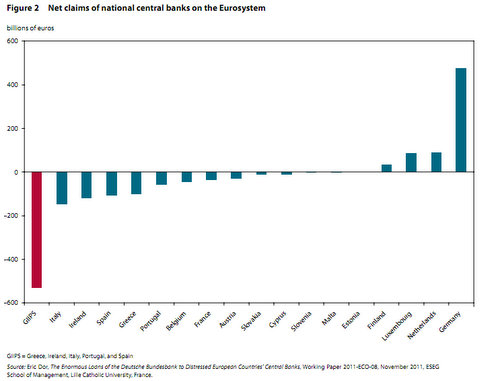
Johnson points to capital flight within Europe from banks in the PIIGS, (or the GIIPS) as he calls them, to banks in Germany.
His warnings about austerity-driven debt spirals are not new and he is not alone.
John Key has come back from holiday in a relaxed mood.
He needs to read this paper.
Europe’s peripheral banks are suffering large deposit losses as capital moves to safer nations. Figure 2 shows the enormous capital flight that is occurring through the banking sector across the euro area. These Target2 balances show a cumulative transfer of €440 billion from peripheral nations to Germany from early 2009 to October 2011. Were it not for these implicit bailouts through the payments system, the euro area would have already collapsed.
At the least, we expect several more sovereign defaults and multiple further crises to plague Europe in the next several years. There is simply too much debt, and adjustment programs are too slow to prevent it. But this prediction implies that the long-term social costs, including unemployment and recessions rather than growth, attributable to this currency union are serious. Sometimes it is easier to make these adjustments through flexible exchange rates, and we certainly would have seen more rapid recovery if peripheral nations had the leeway to use exchange rates.
When we combine multiple years of stagnation with leveraged financial institutions and nervous financial markets, a rapid shift from low-level crisis to collapse is very plausible. European leaders could take measures to reduce this risk (through further actions on sovereign debt restructurings, more aggressive economic adjustment, and increased bailout funds). However, so far, there is little political will to take these necessary measures. Europe’s economy remains, therefore, in a dangerous state.
2. And then Key needs to listen to the head of the IMF - Christine Lagarde warned overnight (via the BBC) that Europe faced a 1930s moment.
In a BBC interview, Ms Lagarde said now was the time to act in order to avoid a 1930s-style depression. She said: "Looking at it from this perspective, 2012 must be a year of healing. But as Hippocrates put it long ago: 'Healing is a matter of time, but it is sometimes also a matter of opportunity.'
"And today, it has to be an opportunity of our own making. Otherwise, we could easily slide into a 1930s moment. A moment where trust and co-operation break down and countries turn inward. A moment, ultimately, leading to a downward spiral that could engulf the entire world."
3. Here comes a massive money-print on leap year day - Bloomberg reports the European Central Bank is set to lend at least another €500 billion to European banks on February 29.
I wonder if the Germans know this is money printing via the back door. It's just cash for trash. The collateral rules are watered down and much of it is government guaranteed, which is all very circular in a Ponzi-schemey sort of way.
“February’s second three-year Long Term Refinancing Operation looks set to be extremely large,” Credit Suisse Group AG analysts led by William Porter wrote in a report to clients. “The last LTRO has removed any stigma, making managements who do not exploit the value on offer arguably careless at best.”
The ECB is flooding the banking system with cheap money in a bid to avert a credit crunch after the market for unsecured bank debt seized up and funding from U.S. money markets dries up. Politicians, including French President Nicolas Sarkozy, are pushing the banks to use the loans, which carry an interest rate of 1 percent, to buy higher-yielding southern European sovereign debt, thereby forcing down borrowing costs in the region.
4. 'Look out below' - Fortune's Editor at Large Shawn Tully reports that China's housing market is set for a hard landing, citing University of Chicago's Booth School of Business, Robert Aliber.
John Key is not worried. Tully's piece is well worth a read:
Aliber got his first clue that the craze spelled disaster from a former student living in Beijing. The young Chicago alumnus told Aliber that he'd just moved into an apartment building with several hundred units, and was the only one living there. Investors had bought all the other apartments that hadn't sold.
Later that year, Aliber visited the office of an upscale developer in Beijing, who was getting $600,000 for 1100 square foot units with bare walls. The folks doing the purchasing were earning between $20,000 and $30,000. Given those modest incomes, it was obvious that the buyers weren't purchasing an affordable new residence, but speculating in real estate, either to live there for awhile then flip the unit, or simply leave it vacant while seeking a buyer willing to hand them quick windfall.
What amazed Aliber was the chasm between the prices of the apartments and the rents they fetched. A typical $600,000 unit brought a landlord less than $1000 a month in rent after expenses (assuming no mortgage). It wasn't the rental yields that attracted investors, it was the huge price appreciation, averaging from 20% to 30% from 2008 until last year.
So how far do China's prices need to fall so that the cost of owning is reasonably close to the level of rents? Aliber reckons that the rental yield on apartments will eventually go from less than 2% to 5%, or even a bit higher.
The rental yield is simply the annual rent divided by the market price, just as the yield on a bond is the fixed interest payment divided by the price of the bond that day. In the U.S., the rental yield averages around 6%, meaning the multiple of prices to rents is around 17. The adjustment to a 5% rental yield in China would push prices down by 60%.
5. The subsidy for private equity - William Cohan comments at Bloomberg that American private equity investors, who pay 15% capital gains tax, are getting a big public subsidy from regular taxpayers who pay 35% on their income tax. It's all very topical given Mitt Romney's past life as head of Bain & Co and his vast wealth, which he hasn't been that keen to disclose tax records on.
Cohan has a point about the public subsidy.. A really big one.
Just imagine how much bigger his point would be if he was talking about an economy with no capital gains tax. Like New Zealand's. The same argument applies for debt funded private equity and property investment here.
The real reason the tax loophole for private equity mavens must be closed once and for all is that American taxpayers subsidize the private-equity industry -- and its outsize paychecks -- and simple fairness demands that they don’t also get an additional break in the form of lower tax rates.
Mitt Romney, the co-founder of Bain Capital LLC and the leading contender for the Republican presidential nomination, got blindingly rich because of this taxpayer subsidy, and it isn’t right that he and his cohort can also pay taxes at a 20- percentage-point discount compared with the rest of us.
Here is how the subsidy works: The Internal Revenue Service allows for the tax-deductibility of interest expense on corporate debt. Since corporate debt is the mother’s milk of a leveraged buyout, there would be no private-equity/LBO industry without this huge tax benefit. Indeed, anyone who has used an Excel spreadsheet to model a leveraged-buyout -- you know who you are! -- knows that the magic of the entire industry depends almost solely on the interest-expense provision in the tax code.
By loading up a company with debt and then deducting the resulting interest expense, tax payments are generally wiped out, allowing the remaining “free cash flow” to be used to pay down the debt taken on to buy the company in the first place. Given that tax revenue is necessary for the government to function, this means the rest of us provide a subsidy that allows the private-equity firms to thrive.

6. China's demographic Tsunami - Bloomberg's Frederik Balfour and Alfred Cang report on how unprepared China is for nearly half a billion people who expected to retire by 2050.
The latest government census shows 178 million Chinese were over 60 in 2009. That figure could reach 437 million -- one third of the population -- by 2050, the United Nations forecasts. While the elderly were looked after in the past by their children, urbanization and the nation’s one-child policy have eroded the tradition of family care.
“It’s a demographic tsunami,” says Joseph J. Christian, a fellow at the Asia Center at the Harvard Kennedy School, and former DLA Piper partner in Hong Kong, who specializes in senior housing issues in China. “The whole multigenerational housing model has disappeared.”
Japan’s Shadow
China’s challenge is similar to that faced by Japan in the 1990s, with one essential difference: China will grow old before it gets rich. With tens of millions of parents left to fend for themselves, the government set up a National Committee on Aging to try to devise a comprehensive strategy to ensure their health and comfort.

7. Training your replacements - The next wave of globalisation is going to hit service sectors in developed economies that have previously been immune to outsourcing to the likes of China or India.
First the manufacturing sectors in America, New Zealand and Australia (Toyota laid off 350 workers there yesterday) were gutted. Now the services sectors face being cleaned out.
The first batttleground we are seeing across the Tasman is in financial services. The media there is up in arms about layoffs in banking as some of the big banks outsource IT services and accounting to India.
This could come here too. It has already happened in chunks of Telecommunications (tried ringing Telecom's Philippino O18 staff lately?) and will eventually spread to the likes of IT, banking, medical services, media, insurance and legal services. The growth of the Internet is accelerating this shift.
Here's Brisbane's Sunday Courier Mail reporting on some disgruntled Westpac employees there who were sacked and then asked to train their Indian replacements.
The Sunday Mail can reveal that before sacked staff leave they are being made to train Indian workers on temporary visas at the bank's Sydney CBD offices.
Westpac staffer of 15 years, Russell Siachico, said of one trainee: "She has been shadowing me, sitting next to me and I have to teach her how to do my day-to-day job.
"Basically sitting next to me like a sponge, sucking in as much information as possible. It's devastating.''
After the so-called "knowledge transfer'', the overseas workers will return to India to teach their colleagues, who are paid far less than Westpac's Australian employees.

8. 'Debt doesn't matter' - Robert Skidelsky, Economics Professor and member of the House of Lords in Britain, writes at Project Syndicate that governments in the developed world should not worry about debt issued in their own currencies because their central banks can always print more money to make it go away...
Here's the argument, which I don't necessarily disagree with. I'm beggining to think that a good dose of money printing (and the direct buying of government bonds) may be the only sane way out of the austerity-driven foreign debt spiral that many countries are diving into.
Skidelsky says the current mantra of government debt reduction simply drives an austerity spiral with ever higher interest rates, ever higher debt/GDP ratios and ever lower employment and economic growth. He cites five fallacies of the government debt reduction mantra.
First, governments, unlike private individuals, do not have to “repay” their debts. A government of a country with its own central bank and its own currency can simply continue to borrow by printing the money which is lent to it. This is not true of countries in the eurozone. But their governments do not have to repay their debts, either. If their (foreign) creditors put too much pressure on them, they simply default. Default is bad. But life after default goes on much as before.Second, deliberately cutting the deficit is not the best way for a government to balance its books. Deficit reduction in a depressed economy is the road not to recovery, but to contraction, because it means cutting the national income on which the government’s revenues depend. This will make it harder, not easier, for it to cut the deficit. The British government already must borrow £112 billion ($172 billion) more than it had planned when it announced its deficit-reduction plan in June 2010.
Third, the national debt is not a net burden on future generations. Even if it gives rise to future tax liabilities (and some of it will), these will be transfers from taxpayers to bond holders. This may have disagreeable distributional consequences. But trying to reduce it now will be a net burden on future generations: income will be lowered immediately, profits will fall, pension funds will be diminished, investment projects will be canceled or postponed, and houses, hospitals, and schools will not be built. Future generations will be worse off, having been deprived of assets that they might otherwise have had.
Fourth, there is no connection between the size of national debt and the price that a government must pay to finance it. The interest rates that Japan, the United States, the UK, and Germany pay on their national debt are equally low, despite vast differences in their debt levels and fiscal policies.
Finally, low borrowing costs for governments do not automatically reduce the cost of capital for the private sector. After all, corporate borrowers do not borrow at the “risk-free” yield of, say, US Treasury bonds, and evidence shows that monetary expansion can push down the interest rate on government debt, but have hardly any effect on new bank lending to firms or households. In fact, the causality is the reverse: the reason why government interest rates in the UK and elsewhere are so low is that interest rates for private-sector loans are so high.
As with “the specter of Communism” that haunted Europe in Karl Marx’s famous manifesto, so today “[a]ll the powers of old Europe have entered into a holy alliance to exorcise” the specter of national debt. But statesmen who aim to liquidate the debt should recall another famous specter – the specter of revolution.
9. China's game of cat and mouse in the shadows - Nick Edwards (an old colleague of mine) and Zhou Xin report at Reuters on how Chinese banking regulators are trying to chase down and control the finance company equivalents in China.
It seems the shady characters are often one step ahead of the regulators. Financial repression (artificially suppressed official interest rates) also have a habit of forcing money underground and creating bubbles around the fringes. Sound familiar?
Twas ever thus.
The full story is well worth a read. Here's a sample:
Beijing's bans are a way of life for financiers constantly looking for the loopholes in China's tightly-controlled credit markets.
"Trust firms really know how to live with harsh regulation -- when one thing is banned, they can quickly find a new thing and make it big before regulators notice it," Li Yang, the chief analyst for Use Trust, a trust-focused consultancy in Chinese city of Nanchang, told Reuters.
Trust firms raise private capital fund vehicles, typically from high net worth individuals, working hand-in-hand with banks to find investors and distribute products. Their emergence has been particularly appealing to China's big state-backed lenders who can use trust products to put deposits to work off-balance sheet, bending rather than breaking the rules on strict lending limits laid down by Beijing.
The seemingly-permanent shortage of official bank loans for the small firms that generate around 80 percent of the jobs in China, as well as negative real interest rates on bank deposits, has generated soaring demand for trust products. Annual yields of 9 percent versus bank deposit rates of 3.5 percent and inflation that averaged 5.4 percent in 2011 have tempted a wide range of investors, even those who struggle to meet minimum investment rules of millions of yuan, designed to keep the general public out of the often risky enterprises.
Regulators fear a return to the experience of the late 1980s, when at the industry's peak China had more than 1,000 trust firms and a host of investment-fed asset bubbles, moral hazards and systemic risks that ultimately led to, at the time, the biggest bankruptcy in Chinese history.
10. Totally Stephen Colbert making fun of Super PACs, the slush funds being used to buy elections in America.
We welcome your comments below. If you are not already registered, please register to comment
Remember we welcome robust, respectful and insightful debate. We don't welcome abusive or defamatory comments and will de-register those repeatedly making such comments. Our current comment policy is here.