

Here's my Top 10 links from around the Internet at 4 pm in association with NZ Mint.
I welcome your additions in the comments below or via email tobernard.hickey@interest.co.nz.
I'll pop the extras into the comment stream. See all previous Top 10s here.
My must read today is #1. Carmen Reinhart is right on the money. It's not different this time.

1. The Great Financial Repression - Carmen Reinhart, one of the co-authors of the excellent book 'This Time is Different', has been writing about 'Financial Repression' for some time.
She has written another excellent piece at Bloomberg.
Financial repression was the tactic used in the 1940s and 1950s to make huge US war debts 'go away'.
Essentially, central banks held interest rates lower than inflation to ensure GDP grew faster than debt.
They also forced pension funds and banks to buy and hold government bonds.
It's another way of saying savers were made to 'pay' for a slow motion (hope no one notices) debt restructure.
This is what's happening again, Reinhart points out this also results in increased controls on capital flows. Hope the RBNZ is watching.
Concerned about potential overheating, rising inflationary pressures and the related competitiveness issues, emerging- market economies may continue to welcome changes in the regulatory landscape that keep financial flows at home. Indeed, this trend is already well under way. This concern means advanced and emerging-market economies are finding common cause in increased regulation and/or restrictions on international financial flows and, more broadly, the return to more tightly regulated domestic financial environments.
This scenario entails both a process of financial deglobalization (the reappearance of home bias in finance) and the re-emergence of more heavily regulated domestic financial markets.
This line sums it all up (and the chart below is sobering).
Unlike income, consumption or sales taxes, the “repression” tax rate is determined by factors such as financial regulations and inflation performance, which are opaque -- if not invisible -- to the highly politicized realm of fiscal policy. Given that deficit reduction usually involves highly unpopular spending cuts and/or tax increases, the “stealthier” financial-repression tax may be a more politically palatable alternative.

2. The guv'nor attacks the banks - The Telegraph reports the Governor of the Bank of England, Mervyn King, has publicly attacked British banks as deserving the public anger now directed at them.
Accusing the banks of double standards, he said families and customers were lectured on living within their means by financial institutions that needed public money from bailouts when the financial crisis hit.
Sir Mervyn, who earns £305,000 a year, said anger against the banks was “very real and wholly understandable” and dismissed attacks by banks that he had failed to offer enough support during the crisis. “I think it is because they found it very, very difficult to face up to the failure of their banking model,” he told The Times. “That model needs to be restructured. My duty was to the United Kingdom economy as a whole and not just to one part of it.
“Market discipline can’t apply to everyone except banks.”

3. Watch the politics - Reuters reports on growing protests against Hungary's government, which is the most indebted in Eastern Europe and faces a bailout showdown with the European Union and the IMF.
Election results, protests, goverment overthrows and politics generally will be the key turning points as the Global Financial Crisis rumbles on.
Critics say the government has weakened the system of checks and balances, such as the Constitutional Court, and expanded its powers in areas like the judiciary and media regulation.
The ruling party also pushed through a new constitution with scant consultation with opposition parties, while its unorthodox economic policies shook market confidence and contributed to the weakness of the country's forint currency.
Konya's list of grievances included a flat-tax system that he said was unfair because it cut taxes for the rich while it did not benefit the poor; as well as the sanctity of private property and legal security, which he said were lacking.
4. 'A monetary tsunami' - The currency wars now raging across the planet are most intense in Brazil, which has recently slashed its interest rates to try to stop its currency from rising.
Now even Goldman Sachs is saying the Real currency is as much as 20% over-valued, Bloomberg reports.
President Dilma Rousseff last week pledged to take all necessary measures to shield the economy from a “monetary tsunami” caused by what she said were efforts by Europe and the U.S. to “artificially devalue” their currencies.
Investors and exporters have poured $15.5 billion into Brazil since the beginning of the year, contributing to gains in the currency, compared with an outflow of $3 billion in the fourth quarter of 2011, according to the central bank’s website.
5. 'Show us the money' - SMH's Matt O'Sullivan reports on the lengths that Flight Centre's Australian operation went to through 2005 to 2009 to ensure its fares were not undercut by fares sold by airlines' own websites.
In an email in May 2009, Mr Turner wrote to Singapore Airlines' Australian boss seeking ''an agreement that we will not be undercut on the web''. The emails from Mr Turner and another Flight Centre manager are in a statement of claim lodged by the Australian Competition and Consumer Commission in the Federal Court in Brisbane.
The regulator has used the emails to support its case that Flight Centre sought to illegally fix prices by attempting to collude with Singapore Airlines, Malaysian Airlines and Emirates between 2005 and 2009.
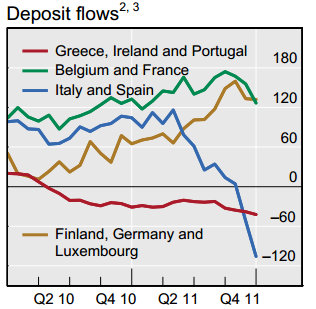
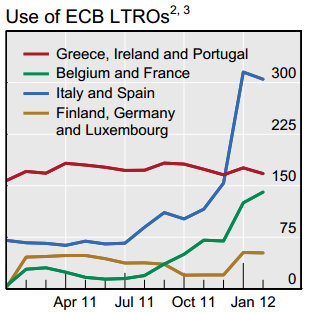
6.What's happening inside Europe's banking system - The European Central Bank's two big money dumps (Long Term Refinancing Operations) in the last three months have calmed down financial markets, but only for a while.
Money is being withdrawn from Portugese, Irish, Portugese, Italian, Spanish and Greek banks (red and blue lines in first chart below) at an astonishing rate. The only reason they aren't dead is they borrowed heavily in the LTROs (red and blue lines in the second chart below). And, we are led to believe, the Feb 29 LTRO was the last one.
This is far from over.
Here's the BIS's data and a couple of charts on the issue of European bank funding and deleveraging.
7. Corporate spying by China - WSJ reports on how the FBI is discovering that many episodes of corporate espionage are sponsored by Chinese government owned companies. The article cites a case involving Pangang trying to get hold of a rare titanium oxide development process created by Dupont 50 years ago.
China regularly denies that its government or state-owned companies engage in concerted efforts at corporate espionage. On a broader level, China aims at gathering already-discovered technical know-how to build global competitors through legitimate means such as joint ventures. More controversially, China has been insisting that foreign companies hand over technology as the price of market access. Within China, many foreign companies are so concerned about intellectual-property theft that they avoid bringing in their cutting-edge technology and manufacturing processes.
8. More China vs US vs EU trade tensions - The New York Times reports on flaring trade tensions between the world's three biggest trading partners.
Five separate issues — involving auto parts, cars, solar panels, anti-subsidy laws and rare earth metals — are all likely to see action by American officials, European officials or both, starting as soon as this week.
On Tuesday, in fact, the United States, the European Union and Japan plan to file a formal “request for consultations” with China at the World Trade Organization about restrictions on exports of rare earth metals. President Obama will personally announce the move, a senior administration official said.Such a request is the first step in a process that will lead to a full-fledged legal case at the W.T.O. by early summer unless China unexpectedly agrees to the West’s demands to ease the export of rare earths — materials vital to various sophisticated technologies.
9. New South Wales slowing - Leith van Onselen from Macrobusiness looks at the latest Australian housing finance data and finds a slowdown going on in New South Wales, particularly among first home buyers.
10. Totally Jon Stewart on Benjamin Netanyahu and his nuclear duck.

We welcome your comments below. If you are not already registered, please register to comment
Remember we welcome robust, respectful and insightful debate. We don't welcome abusive or defamatory comments and will de-register those repeatedly making such comments. Our current comment policy is here.