

Here's my Top 10 links from around the Internet at 8 pm in association with NZ Mint.
I welcome your additions in the comments below or via email to bernard.hickey@interest.co.nz.
I'll pop the extras into the comment stream. See all previous Top 10s here.
My must read today is #2. It's often hard to see behind the veil in China. The Bo Xilai sacking is big, big news. The FT nails it. Sorry I missed Thursday. I was traveling to Whangarei.

1. What Chinese people are saying about Bo Xilai's sacking - The biggest political event in the world in the last week was the sacking of Chinese 'princeling' (child of one of Mao Zedong's main men) Bo Xilai.
Bo was in line to joing the top 9-person politburo at the head of China's government, which is undergoing a once in a decade changing of the guard. This is more important to New Zealand than the increasingly silly US Presidential race being breathlessly reported by our media at the moment.
Bo had created a real stir as the Mayor of China's massive western city Chongqing, where he cracked down on property developers and other mobsters.
He invoked Mao's memory often and seemed to be a bit of a leftie, which is saying something in China's Communist Party.
He was a populist who seemed to be more about helping the little guy than the property moguls and party big wigs. Now he has been squashed.
Some may recall he fell out with his main henchman Wang Lijun, who then tried to do a runner to the US embassy. He was handed back to the Chinese authorites, who then gave him some 'vacation style treatment.' Yesterday Bo was sacked as Mayor of Chongqing. Everyone in China is talking about this. It would be like John Key sacking Stephen Joyce after a huge row in cabinet.
Here's what people are saying inside China's now very active Internet (1.2 million tweets and counting):
Many netizens have rushed to defend Bo for his governing record. As @雪佳-要改变 wrote, “If you are not a true Chongqing’er, you have no way to understand Bo’s status in Chongqing citizens’ hearts. Outsiders only know about ‘singing red’ and Mao poetry readings, but Bo Xilai oversaw the fastest development in Chongqing over the last few years.”
Some netizens wondered whether organized crime will make a comeback since Bo is known for his law and order campaigns. As @余丰慧 wrote, “Bo is out, and the happiest are the mobsters; they will be drinking and partying all night in celebration!”
Indeed, many online comments evince an “us versus them” mentality, which may help explain why Bo was viewed as such a divisive figure which China’s central leadership ultimately chose to boot out. @最初的Triangle wrote, “I like you!” and @zht828 defended him, writing, “At least Bo Xilai was a clear-cut character, one who dared to speak and dared to do things, one who dared to undertake [responsibility].”

2. Here's what Bo Xilai was about - The FT has done an excellent job reporting on what Bo was up to.
Bo had a slogan called 'sing red and smash black'.
The FT reported on March 4 on how one developer got on the wrong side of Bo. It's not pretty.
On his and Mr Wang’s orders, the police and military targeted tens of thousands of wealthy businessmen accused of involvement in “organised crime”, extracting confessions that led to hefty prison terms and death sentences for more than a dozen “masterminds”. The anti-mafia campaign, which mostly targeted the wealthy elite, was hugely popular among ordinary people.
Today, both the model and Mr Bo’s chances of making it to the pinnacle of power are in doubt as the party and the public start to question exactly what this experiment entailed.
From an undisclosed location outside China, Li Jun is more direct: “The Chongqing model is nothing but a new red terror in which Bo Xilai and Wang Lijun trampled on the law and human rights, attacked their political enemies and took whatever they wanted in order to enhance their power.”
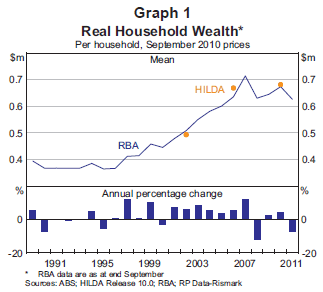
3. Not so lucky - Leith van Onselen picks up at Macrobusiness on Reserve Bank of Australia figures showing Australian household wealth is now back at 2006 levels.
4.We're on the right end of this chart - I used to work at Fairfax in New Zealand on the executive team trying to work out how to deal with this historic shift in readers and advertisers from print to online.
In the end I decided I would be better off working in an online-only shop like Interest.co.nz that kept its operating costs low and focused 24 hours a day on doing the best we can be online.
Here's why. This chart shows which are the fastest growing (in employment terms) and fastest shrinking industries in America. Newspapers are falling fastest. Internet and online publishers are growing fastest.
Phew.
Here's the Atlantic on this shift.
The most important story in this graph isn't the trajectory of the bubbles, but their relative size, which represents the number of jobs in each industry. The industries that added the most jobs, according to the analysis, were "internet, hospitals & healthcare, health, wellness & fitness, and oil & energy." The housing bubble industries -- notably, banking and construction -- and demand-sensitive sectors like retail, warehousing, and restaurants, had the worst losses.

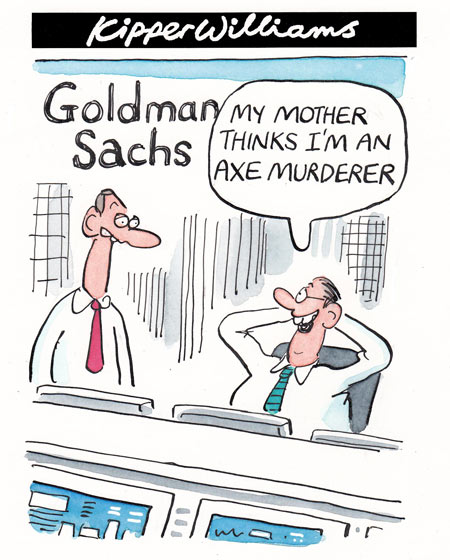
5. The fallout goes on - Greg Smith's epic and very public rant against his (soon to be ex) colleagues and bosses at Goldman Sachs is now the stuff of legend.
It is now known as the 'Muppets' rant because he describes how colleagues called clients 'Muppets' that were there to be ripped off.
Here's another former Goldman Managing Director (although Managing Directors seem quite common in investment banks) Nomi Prins talking about Goldman and Smith's rant: HT Zerohedge
I applaud Smith's decision to bring the nature of Goldman's profit-making strategies to the forefront of the global population's discourse, as so many others have been doing through books, investigative journalism, and the Occupy movements over the past decade since my book, Other People's Money, was written after I resigned from Goldman. It would be great if Smith's illuminations would serve as the turning point around which serious examination and re-regulation of the banking system framework would transpire.
The inherent conflict of interest that firms such as Goldman possess through enjoying the multiple roles of 'market-maker,' 'securities creator' and 'client-advisor' foster an environment rife with systemic risk. The trading revenue portion of Goldman's profits, as well as its derivatives vs. assets ratio, is the highest amongst the American bank holding companies. And yet, in the fall of 2008, the Federal Reserve approved Goldman Sachs (along with Morgan Stanley) to alter its moniker from investment bank to bank holding company, thereby allowing it to gain access to federal subsidies and potential ongoing support.

"I thought it was spot on," Goldman told Business Insider in an exclusive interview.
Now a semi-retired financial professional currently residing in Colorado Springs, Goldman said the culture had changed "for the worse" since the days when his family maintained direct control over the company. On the 'predatory' behavior of Wall Street, Goldman added: "It's certainly something friends of mine have discussed ad infinitum."

7 But they're all the same - Ben Walsh, a Reuters journalist who once worked at Goldman Sachs as an analyst, points out in this piece that Smith should have known Goldman Sachs was just another money-grubbing bank and shouldn't have believed its hype.
Smith never seems to have understood that the very powerful and very wealthy people he counted as colleagues might be less than what they said they were. Now, 12 years, three promotions, two recessions and one financial crisis later, Smith is devastated when he realizes that the place he used to work is nothing like what the “Human Capital Management” manual said it would be. It’s only now that he realizes that the three ways to become a leader at Goldman Sachs revolve around making money? That is not a tough conclusion to come to. And certainly not one that takes 12 years.
Not only did Greg Smith take every banality Goldman Sachs offered him at face value for far longer than he should be willing to admit but he also seems to believe that there actually is such a thing as a virtuous past lodged inside the history of banking. When were these good times Smith wishes would return? Who were the gentlemen partners running investment banks by strictly adhering to the Latin mottos on their family crests? They never existed. Overly self-interested behavior by banks at the expense of their clients is as old as modern banking itself.
To believe that the culture of Goldman Sachs, or any other bank, is about “so much more” than making money misses a point that’s right in front of you. It’s not about more than making money. It’s about making money, full stop.
The rhetoric about teamwork, integrity, humility and client focus? Those are the gauzy drapes that conceal and decorate the view.
8. Vampire squid revisited - I highlighted this now seminal piece of financial journalism back when it was published in April 2010.
This opening paragraph is an epic of its kind:
The first thing you need to know about Goldman Sachs is that it's everywhere. The world's most powerful investment bank is a great vampire squid wrapped around the face of humanity, relentlessly jamming its blood funnel into anything that smells like money. In fact, the history of the recent financial crisis, which doubles as a history of the rapid decline and fall of the suddenly swindled dry American empire, reads like a Who's Who of Goldman Sachs graduates.

We welcome your comments below. If you are not already registered, please register to comment
Remember we welcome robust, respectful and insightful debate. We don't welcome abusive or defamatory comments and will de-register those repeatedly making such comments. Our current comment policy is here.