

Here's my Top 10 links from around the Internet at 4 pm in association with NZ Mint.
I welcome your additions in the comments below or via email tobernard.hickey@interest.co.nz.
I'll pop the extras into the comment stream. See all previous Top 10s here.
My must read today is #9 on why liquidity traps and independent central banks are incompatible.

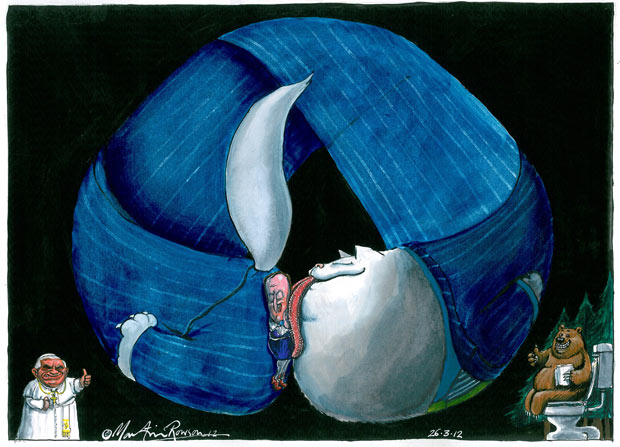
1. Well lookee here - The extraordinary story about the sacking of Chongqing Mayor Bo Xilai just gets more amazing the closer everyone looks.
It turns out a shadowy former British intelligence officer appears to have been murdered and Bo Xilai may be involved.
The latest revelations are deeply unsettling and suggest a struggle for power is going on right now within the upper echelons of the Chinese communist party in Beijing.
Remember in recent days we've had whispers of coups, house arrests and shots being fired.
Now some sort of ex James Bond Mr Fixit for Bo Xilai has been poisoned in mysterious circumstances.
It doesn't get any better than this.
Here's the Wall St Journal on the story:
The revelation adds a layer of intrigue to the scandal, which increasingly appears to mix the worlds of international diplomacy and corporate sleuthing with China's shadowy domestic security apparatus and opaque politics.
Mr. Heywood's death is one of the events in the drama surrounding the fall of the Communist Party chief in Chongqing, Bo Xilai, whose dismissal this month has thrown Chinese politics into turmoil.
The Wall Street Journal reported Sunday that suspicions about Mr. Heywood's death were raised by Wang Lijun, the former Chongqing police chief who triggered the political drama when he sought refuge from Mr. Bo in the U.S. Consulate in Chengdu on Feb. 6. Mr. Wang claimed to have fallen out with Mr. Bo after discussing with him his belief that Mr. Heywood was poisoned, according to people familiar with the matter. He also claimed Mr. Heywood had been involved in a business dispute involving Mr. Bo's wife, Gu Kailai, according to one of those people.
2. Productivity decline to come? - Bank of America is wondering if the retirement of the Baby Boomers in the coming years will lead to a second round deterioration in productivity as they are replaced by younger, less experienced workers.
It seemed productivity slumped when the baby boomers first joined the workforce in the 1970s.
Here's BusinessInsider citing BoA on the research:
By 1969, Baby Boomers made up the entire youth labor force and the entrance of these new workers into the labor market was at least partly responsible for the decline in productivity witnessed during the 1970s, in our view. Now that these workers have built up a lifetime of skills and are planning to exit, albeit with some delay, they will be replaced with younger, less productive workers

3. How China is helping Iran's sensors - Reuters reports on how China's ZTE is helping Iran censor the Internet. All very topical in the wake of Australia's banning of Huawei from bidding for its broadband projects. New Zealand hasn't banned Huawei, or ZTE for that matter.
Also interestingly, days after this report ZTE said it was pulling out of Iran, but not before it became clear ZTE had violated sanctions on re-exporting American-made technology to Iran.
A Chinese telecommunications equipment company has sold Iran's largest telecom firm a powerful surveillance system capable of monitoring landline, mobile and internet communications, interviews and contract documents show.
The system was part of a 98.6 million euro ($130.6 million) contract for networking equipment supplied by Shenzhen, China-based ZTE Corp to the Telecommunication Co of Iran (TCI), according to the documents. Government-controlled TCI has a near monopoly on Iran's landline telephone services and much of Iran's internet traffic is required to flow through its network.
The ZTE-TCI deal, signed in December 2010, illustrates how despite tightening global sanctions, Iran still manages to obtain sophisticated technology, including systems that can be used to crack down on dissidents.

4. A day of reckoning to come - Noted Asia-watcher Andy Xie writes at Caixin that Japan is about to embark on an attempt to massively devalue the yen.
He looks at what China and Japan's other close neighbours might do in response to such a shock.
Japan is on an unsustainable path of a strong yen and deflation. The unprofitability of Japan's major exporters and emerging trade deficits suggest that the end of this path is in sight. The transition from a strong to weak yen will likely be abrupt, involving a sudden and big devaluation of 30 to 40 percent. It will be a big shock to Japan's neighbors and its distant competitors like Germany. The yen's devaluation in 1996 was a main factor in triggering the Asian Financial Crisis. Japan's neighbors must have a strong banking system to withstand a bigger devaluation of the yen.
Both China and South Korea have weak banking systems. South Korea's banking system is one of the most leveraged in the world due to high level of household loans. In 1998, a similar shock sank its banking system that was overleveraged with industrial loans. Now it is overleveraged with household loans. A shock could sink it again.
Overinvestment and a property bubble make China's banking system very vulnerable to such a shock. Unless China substantially increases the capital in its banking system, a big yen devaluation could cause China's banking system to sink. China suffers from overinvestment and a property bubble, as Southeast Asia and South Korea did in 1997. In terms of the magnitude of leverage, China's situation is much worse. Hence, a yen devaluation could wreak havoc to China's economy.

5. US$1 trillion of deleveraging - The FT reports (via CNBC) that Morgan Stanley and consultants Oliver Wyman reckon investment banks will shrink their balance sheets by US$1 trillion within the next two years.
Watch out below if this happens.
Higher funding costs and increased regulatory pressure to bolster capital will force wholesale banks also to cut 15 percent, or up to $0.9 trillion, of assets that are weighted by risk, a joint report by Morgan Stanley and consultants Oliver Wyman predicts.
In addition, banks are expected take out $10 billion to $12 billion in costs by reducing pay, firing employees and paring back investments in areas that are no longer considered core.
“It is really decision time for investment banks,” said Huw van Steenis, analyst at Morgan Stanley. “The market underestimates the degree to which banks will rationalize their portfolios of activities.”
6. China's vulnerable banking system - Reuters reports (via CNBC) that the world's second largest lender, China Construction Bank, has reported a 10% rise in non-performing loans in the fourth quarter.
CCB said loans classified as "substandard" also spiked 27 percent in the second half of the year. The rise in non-performing loans forced the bank to set aside more money in loan-loss provisions, which rose 20 percent against total loan growth of 14.5 percent.
The higher bad loan costs highlight growing concern that non-performing loans are likely to increase as growth in the economy slows. Premier Wen Jiabao this month forecast sub-8 percent GDP growth for the first time in eight years. Fee income, which has been driving much of the bank's profit growth in the past few years, also fell, declining 14 percent in the fourth quarter to 18.2 billion yuan.
"As loan pricing weakens and the Chinese regulators target off-balance sheet activities and control fee income, momentum in fee income may further slow down going forward," said May Yan, an analyst at Barclays Capital in Hong Kong.
7. Not so stable - Here's the Wall St Journal with its take on the latest coup rumours sweeping the Weibo-isphere in China. It has some fascinating insights.
China is supposed to have "institutionalized" its leadership transitions so that such an upheaval could never happen. The outgoing Politburo Standing Committee hands over power to the anointed party general secretary and premier and picks the rest of the new Politburo. The Standing Committee also selects the two slightly younger men who will take over the top jobs 10 years down the road.
But is this arrangement really so stable? Power is now shared on an alternating basis by the Shanghai or "princeling" faction (former Party Secretary Jiang Zemin and the presumptive next one, Xi Jinping) and the Communist Youth League faction (current Party Secretary Hu Jintao). This sets up a dynamic of the current ruling faction sharing power with its presumptive successors in the other faction, a delicate balance to maintain over time.
And because paramount leader Deng Xiaoping picked Jiang Zemin and Hu Jintao, this year will mark the first transition not determined by the revolutionary generation. In 2002, Jiang Zemin tried to prolong his hold on power and pack the new Politburo with his proteges. No doubt Hu Jintao is trying to do the same.
The party has been able to keep internal strife under control by avoiding ideological struggle over the last 20 years. The factions have competed for important posts and the spoils of power, but they ruled by consensus. The public was simply told to believe in the myth of a monolithic party and ignore the men squabbling behind the curtain.
This technocratic pragmatism may now be breaking down. For instance, Bo Xilai appealed to leftists' disgust with bourgeois individualism and public unhappiness with income inequality, a tactic that alarmed some leaders. Since his dismissal, leftist websites and commentators have also been silenced.

8. The LIBOR scandal - CNN Money's Stephen Gandel reports on the LIBOR trading scandal which is bubbling away in the background.
Banks took a rate that they artificially set themselves, and then went out and convinced municipalities and pension funds and others to bet against them on the rate. LIBOR rates were supposed to be set by bank treasurers reflecting what it cost them to borrow from other banks. But reportedly a number of bank treasurers consulted traders when deciding what rate to report to the organization in London that collected and posted the rates. (LIBOR stands for the London InterBank Offered Rate)
What's more, traders at a number of banks were given access to the systems that bank officials used to enter the rate so they could overwrite the rates with ones that would better suit them. When the rate went the way Wall Street traders programed it to do, the banks cashed in millions. The LIBOR rate also affects what many of us pay on our adjustable mortgage, home equity loans, car loans and others. But that is a little bit of an aside. The real, clear damage is in the contracts that banks set up with municipalities and others to bet on their own manipulated rates.

Imposing austerity without potential offsets and at a time of weak global aggregate demand is deflationary, which makes deleveraging much harder, balance sheet repair much slower and recovery much less likely to achieve. In a liquidity trap, governments have no logical option but to borrow and to invest. How could governments borrow more if government debt is also a problem everywhere? Would it not be irresponsible to increase borrowing at a time of record government debt levels?
Fiscal austerians are quick to invoke age-old textbook orthodoxies: (1) that additional borrowing will be too much for future generations to handle, citing the law of Ricardian equivalence; (2) that increased borrowing will crowd out private sector borrowing and will most likely delay the economic recovery; and (3) that bond investors will stop buying and send yields higher. However, in the topsy-turvy world of liquidity traps, these textbook orthodoxies do not apply, and acting irresponsibly relative to orthodoxy by increasing borrowing will do more good than harm.
The importance of fiscal expansion and the impotence of conventional monetary policy measures in a liquidity trap have profound implications for the conduct of central banks. This is because in a liquidity trap, the fat tail risk of inflation is replaced by the fat tail risk of deflation. In turn, the fatness of the deflation tail is a function of the government’s willingness and ability to pump-prime, i.e. to borrow and spend. For central banks, this is a game changer. in a liquidity trap the central bank’s role changes from one of policing the government to keep it from borrowing too much, to one of helping it to borrow and invest by targeting to keep long-term interest rates low by monetizing debt, with the aim of killing the fat tail risks of deflation and depression.
Such “cooperation between the monetary and fiscal authorities […] could help solve the problems that each [authority] faces on its own” – argued then Governor Bernanke - which are no willing borrowers in the case of central banks and fear of higher rates due to stimulus in the case of governments. The concept of fiscal-monetary cooperation also defies orthodoxies but, in the topsy-turvy world of liquidity traps acting irresponsibly relative to orthodoxy and central banks facilitating government borrowing will do more good than harm.
10. Totally Stephen Colbert talks Kermit the Frog.
"Saying the word dissect to a frog is not cool..."
The Colbert Report
Get More: Colbert Report Full Episodes,Political Humor & Satire Blog,Video Archive
We welcome your comments below. If you are not already registered, please register to comment
Remember we welcome robust, respectful and insightful debate. We don't welcome abusive or defamatory comments and will de-register those repeatedly making such comments. Our current comment policy is here.