

Here's my Top 10 links from around the Internet at 12 pm today in association with NZ Mint.
We welcome your additions in the comments below or via email to bernard.hickey@interest.co.nz.
See all previous Top 10s here.
My must read today is #2 on Kenya's mobile phone banking system. Certainly gets you thinking about how things could be different in our payments systems.

1. The problem with investment banks - This John Gapper article in the FT is a brilliant description of what's wrong with the 'mega-banks' that now dominate banking in the Northern Hemisphere.
They are run by the investment bankers who merged the casino-like investment banks with regular commercial banks over the last 20 years and then ran amok in all their amoral glory.
This breaking down of the species barrier between the staid old world of commercial/retail banks with the high flying-bonus driven world of investment banking was only made possible with the repeal of Roosevelt's Glass Steagall Act and the 'Big Bang' in the City of London.
The Barclays implosion around the LIBOR scandal is a perfect example of how US-style investment banking culture infected and engorged a 'regular' bank to create mayhem.
Thank goodness our banks in New Zealand haven't gone down this track.
I'd like to think that's through the good management of the banks, their shareholders and the regulators on both sides of the Tasman. But it may just be a luck thing. Luckily for us Paul Keating banned the sale of the big four in Australia to one of these Northern Hemisphere monsters and stopped them from buying each other.
Here's Gapper in good form:
In the longer-term, the question is how to reform high street banks that now employ financial traders who exclaim: “Dude, I owe you big time! Come over one day after work and I’m opening a bottle of Bollinger,” to a colleague who distorts a quasi-official index for profit.
An obvious start would be to clear out the investment bankers who now run universal banks – Stuart Gulliver at HSBC, Brady Dougan at Credit Suisse, Stephen Hester at RBS – and return to high street banks being run by high street bankers. They may be honourable individuals but, as a group, they symbolise the relentless ascendancy of the securities trading floor.
“It would be a very good thing if an awful lot of people lost their jobs in a lot of banks,” says one former bank executive. “Not because I wish them ill but because only by making many examples will you get through to people that this is a very important business.”
Boards are unlikely to do that until banks are broken up. This generation got to the top by being clever and worldly enough to understand institutions that are very complex and opaque. The late Sir Brian Pitman of Lloyds, exemplar of the astute high street banker, carefully avoided “merchant banking”, as it was then known, as being too much trouble. Reinstating the barrier would be a sound idea in itself – it would create more manageable institutions.
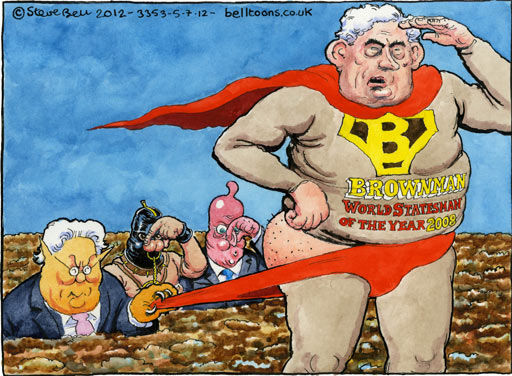
2. The amazing invisible bank - This National Geographic article describing the amazing growth of m-Pesa, the mobile phone based banking system in Kenya, is a fascinating story about how banks aren't necessarily crucial.
It suggests a way forward to for a mobile payments based world.
For people who live in isolated areas, the service means no longer having to carry lots of cash to markets or towns, risking losing huge amounts to banditry and theft. For people without permanent addresses or bank accounts, the service means they can pay what cash they have to m-Pesa in exchange for mobile credit, making payments and transfers and building up savings – becoming participants in an economy from which they had previously been locked out. For migrants, the service allows them to send money home to their families and villages safely and simply. Safaricom’s international money transfer service uses a similar system for international immigrants, coordinating great webs of remittances and payments across the world. For Kenyan businesses, the service means payments for stock or repairs can happen almost instantaneously, wiping out the need to rely on bank clearances and flawed infrastructure which had clogged the economy with inefficiencies and delays.
So how does it work? m-Pesa relies on a network of small shop-front retailers, who register to be m-Pesa agents. Customers come to these retailers and pay them cash in exchange for loading virtual credit onto their phone, known as e-float. E-float can be swapped and transferred between mobile users with a simple text message and a system of codes. The recipient of e-float takes her mobile phone into her nearest retailer when she wants to cash in, and swaps her text message code back for physical money. There are already more m-Pesa agents in Kenya than there are bank branches.
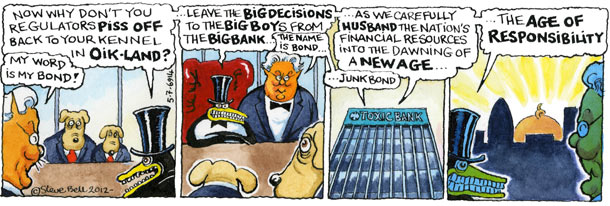
3. Enough is enough - Robert and Edward Skidelsky, the authors of 'How much is enough?: The love of money and the case for the good life' write in this excellent opinion piece in FT.com about why the world is richer than ever at the same time as people seem to work longer hours and many are poorer than ever. They wonder why we don't work fewer hours, employ more people and have a 'better' life rather than jumping on the bandwagon of ever more consumption.
Many of the older generation of economists underestimated insatiability. Having more seems to make us want more, or different. This is partly because we are by nature restless and easily bored. But it is mainly because wants are relative, not absolute: the grass is always greener on the other side. The richer we become, the more we feel our relative poverty.
There is a third factor, however, for which the earlier economists can’t really be blamed. They were not egalitarians, but they did think that growing prosperity would lift up all boats. They did not foresee that the rich would race ahead of everyone else, capturing most of the fruits of increased productivity. (Karl Marx is the main exception here.)
The result has been to leave big holes in our consumption society. A lot of people still do not have enough for a good life. In Britain, 13m households, 21 per cent of the total, live below the official poverty line. There is a lot of underconsumption going on relative to what society is producing. Earlier socialists called it “poverty in the midst of plenty”.

4. Boom, boom, boom, boom - Here's Alistair Helm at Unconditional with some useful extra analysis on yesterday's Barfoot and Thompson figures on house prices in Auckland. Central Suburbs prices were up 22% in June from a year ago.
This situation of new listings lagging the growth of sales can best be seen when stacking up the two sets of data (sales & listings) on the same chart. The data used in this chart below is the 3 month moving average and I have split the axis to emphasise the significant gap appearing between sales and listings – a situation not seen before over the past 5 years of data.

5. Balance Sheet Recessions - Nomura economist Richard Koo is the prime proponent of the Balance Sheet Recession theory, which says that the ageing, indebted developed economies face similar problems to those already seen in Japan where deleveraging households and corporates will drive economies into debt deflation spirals unless governments step in on the other side to borrow and spend to keep economies from slumping into full-on depressions.
I agree with Koo on this.
Here's FTAlphaville with a report on Koo's recent visit to unnamed leaders in Germany. They're not on board. A pity.
Koo says while he found some common ground on the subject of Greece, he and the Germans were miles apart on Spain and Italy, and his own balance sheet recession argument hadn’t really reached the policymakers there. Back to square one, then.
So he told them about Japan in 1997, and the US fiscal cliff, in an attempt to explain balance sheet recessions inevitably spawn massive private sector debt retrenchment, leading to a deflationary spiral.
Koo’s first effort did not go so well: "While the Germans politely listened to my explanation of this new (for them) concept, they continued to insist the competitiveness issue could not be resolved without structural reforms."
At this point, Koo writes, he was running short of time to elaborate with these non-economically-trained folk on exactly why the balance sheet/deflation problem was just as important, but somewhat more urgent, than the structural reforms.
So he resorted to a medical metaphor, with a patient suffering both pneumonia and diabetes — both need treating, but the former needs treating right now. You’d think his hosts would have heard the likes of this many times already (we certainly have), but not really. And… jackpot! "The politicians seemed to understand what I was saying, with one remarking that sometimes a patient being treated for cancer needs a shot of morphine."
6. The death of advertising-funded free-to-air television - Here's a Roy Morgan survey showing one million New Zealanders now use their MySky or other recorders to 'time shift' their watching of pay television, which usually means they fast forward through the ads on the free-to-air channels they see via Sky.. Good. I do that too. I haven't watched ads on free to air television since we got MySky in 2005.
According to the latest Roy Morgan data, 55% of New Zealanders who subscribe to Pay TV are recording TV programs to watch them at a more convenient time. This equates to approximately 1 million Kiwis. These are the findings from the Roy Morgan Single Source Survey of 11,800 New Zealanders in the 12 months to April 2012.
Pausing or rewinding live TV programs is the second most popular TV activity amongst Pay TV subscribers. Using an electronic programming guide comes in third, with 23% of New Zealanders making use of this technology.
.aspx?width=460&height=299)
7. New South Wales a 'State of Stagnation' - Miranda Devine writes at Sydney's The Daily Telegraph tabloid about why New South Wales just can't get any houses built.
Sounds awfully familiar. HT Hugh P.
From Sydney to the regions, there are councils dictating everything from the thickness of a doormat, the position of wardrobes in a bedroom, how a deciduous vine should be trained over a pergola and the size of condoms in a brothel.
Petty bureaucrats drunk with power, along with greenies and NIMBYs, have successfully slowed investment and development in NSW, forcing up the price of housing to the point where Sydney is now the third most “severely unaffordable city” in the world.
The examples of bureaucratic control freakery above are taken from real life complaints by developers to the Property Council of Australia, which last month published a booklet collating their beefs entitled Planning Gone Mad.
8. Growing grumpiness with Kiwis across the Tasman - ABC reports More than 1,000 workers rallied in Perth yesterday to protest against plans to bring in more foreign workers to Western Australia's mines.
Yesterday, the CFMEU said the boom needed to be used to train local workers. Opposition Leader Mark McGowan says the policy will also require resources projects to employ local workers in the manufacturing sector before foreign workers are sought. He says West Australians should be getting jobs ahead of foreign workers.
9. The end of economics as we know it - This series looks interesting from Ian Fraser (the UK journo not NZ's former TVNZ CEO).
I don’t know if it is just me, but I am increasingly detecting parallels between the Laputans portrayed by Swift in his 1726 satire and today’s neoclassical economists – who, let’s not forget have played a key part in shaping macroeconomic policy and, to a large extent, guided the trajectory of the global financial system for the best part of three decades.
There is now a growing clamour of dissent from a group of ‘new economists’ who are calling time on neoclassical economics and shaking it right down to its Laputan foundations. This series of articles and blogs is written for those who would like an introduction to the key players in this bid to define a new economic paradigm that takes what happens in the real world and empiricism into account.
10. Totally Aaron Sorkin on The Colbert Report talking about his new show about the news.
The Colbert Report
Get More: Colbert Report Full Episodes,Political Humor & Satire Blog,Video Archive
We welcome your comments below. If you are not already registered, please register to comment
Remember we welcome robust, respectful and insightful debate. We don't welcome abusive or defamatory comments and will de-register those repeatedly making such comments. Our current comment policy is here.