
Here's my Top 10 links from around the Internet at midday today in association with NZ Mint.
We welcome your additions in the comments below or via email to bernard.hickey@interest.co.nz.
See all previous Top 10s here.
My must read today is #9 on the risk of a 'fat tail' event in Europe. These are not good events.

1. Now Seth Africa cuts - Amid a sea of money printing by central banks oop in the Northern Hemisphere, South Africa has acted to stop its currency killing its economy and cut its interest rates, Bloomberg reports.
Brazil has also cut in recent times.
It's interesting to see that South Africa's inflation target is 3 to 6% and that it has cut its official cash rate to 5%, which is below its inflation rate of over 5%. This is essentially financial repression and a type of money printing to inflate away its debts and 'beggar thy neighbour' in response to the Northern Hemisphere's money printing. Fair enough. Last one to start printing is the loser. And it looks like Australia and New Zealand will be last.
If New Zealand did the same as South Africa by cutting our official interest rate to 0.5% below inflation our OCR would be around 0.5%, which would imply floating mortgage rates of around 3.5%.
So our OCR can't be cut that far without fueling another housing market surge.
That's why we need our Reserve Bank to introduce loan to value ratio limits and repayment-to-income limits, similar to those used by monetary authorities in Singapore, Hong Kong and Canada. That way it can cut the OCR to boost the economy without driving house prices and the New Zealand dollar into stratospheric territory.
(South Africa's) Policy makers cut the repurchase rate for the first time since November 2010, joining central banks in India, Brazil, China and Europe in reducing borrowing costs this year to protect their economies from slower global growth. Marcus was provided the room to ease monetary policy after inflation eased to a 10-month low in June, slowing further from the top end of the 3 percent to 6 percent target range.
Inflation slowed to 5.5 percent in June from 5.7 percent a month earlier, the statistics office said yesterday. At the same time, export demand is coming under pressure amid a debt crisis in Europe, undermining growth in Africa’s biggest economy. The government has cut its forecast for economic growth this year to 2.7 percent, the slowest pace since a recession in 2009. TheReserve Bank also lowered its forecast to 2.7 percent for this year.
2. The weaponsiation of Economic theory - Michael Hudson writes on his website that Europe needs a debt writedown, a real central bank and a more efficient tax system if it's going to extricate itself from its current mess.
The Canadian postal workers union has an informal slogan: “A job that’s not worth doing is not worth doing well.” I might apply this to Europe by saying that a badly structured economy is not worth subsidizing or saving. It should be made well.
This entails, for starters, writing down the debt overhead. That is what created the German Economic Miracle of 1948: the Allied Monetary Reform that wiped out debts over and above minimum working balances, and wages debts owed by employers to employees. It was easy to write down debts that were owed to Nazis. It is much harder to do so when the debts are owed to powerful and entrenched institutions – especially to banks.
Take the case of a Greek debt writedown. This would hurt the Greek banks first and foremost, and also more innocent German insurance companies and banks.I have a modest suggestion as to how to handle this. First, let the Greek banks go under. They helped stymie the Greek government’s attempt to stop tax evasion and money laundering. They have been described as co-conspirators and corrupt. Of course their depositors should be made whole by a standardized, public bank insurance scheme. But bank bondholders and stockholders, and even non-insured depositors, are another matter.
As for the German institutions, if a Greek Clean Slate pushes them into insolvency, the German Government should do what the U.S. Federal Deposit Insurance Corp. (FDIC) is empowered to do: take them over, make all the depositors and policy holders whole, and operate these institutions as a public option – either temporarily or permanently.

3. What's really happening in China's coal mines - Many financial market observers don't trust the broad economic statistics produced by China's authorities and instead look for the subsdiary and more direct indicators of activity, including power production, lending growth, rail volumes and car sales. Even China's incoming Prime Minister, Li Keqiang, has said he looks beneath the headlline figures to work out what is really happening because the GDP figures are 'man-made'.
So this piece from WantChinaTimes showing the parlous state of China's coal industry is interesting. It suggests severe financial stress, slumps in sales and big buildups in stockpiles.
Lengthy technological reforms and large monthly interest payments have put coal mine owners under even heavier financial pressure. Making matters worse, declining coal prices, high inventories and a slump in operations have caused mine operators to become cautious and pessimistic.
"If the situation continues, more than half of the private coal companies here will have to shut down," an official in Luliang responsible for the coal sector said.
4. Another way to look at America's problem - Paul Krugman points to this chart showing the divergence between the gains from productivity and wages in America in the last 40 years. Something went wrong in the mid-1970s. Now it has to be rectified with higher taxes on the rich and large corporates, along with the break-up and deleveraging of the Too Big To Fail banks.


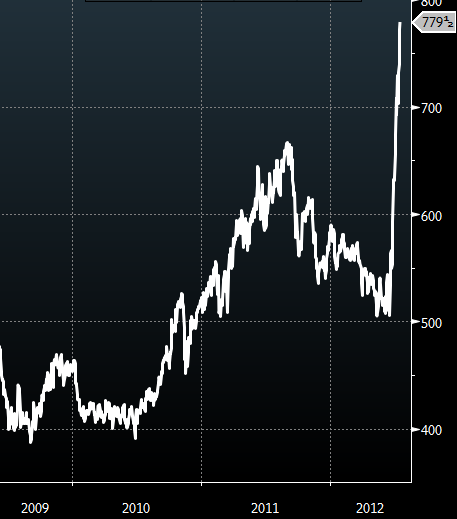
5. Keep an eye on the explosion in soft commodity prices in America - The 50 year drought in North America is causing all sorts of strife for corn, soyabean, wheat and canola prices. That may eventually flow through into higher dairy commodity prices.
This chart on corn futures prices from soberlook.com tells the story.
6. Sicily close to default - Ambrose Evans Pritchard reports Italy is having to intervene to prevent the default of regional bonds issued by Sicily. The mafia may be involved....
Mr Monti held an “urgent” meeting with the country’s president Giorgio Napolitano on Wednesday to grapple with the constitutional issue after it emerged that the region faces a deficit of up to €7bn (£5.49bn) this year and is in danger of default without sweeping cuts.
Sicily’s regional councillor Andrea Vecchio warned that the island has run out of money. “I’m afraid we will soon no longer be able to pay civil servants’ salaries,” he said.
“The developments in Sicily are very serious,” said Prof Giuseppe Ragusa from Luiss University in Rome. “It is just the sort of negative shock we don’t want right now. Everything has to go perfectly for Italy to pull through.”
7. Social strife growing in Spain - Reuters reports on growing mass protests in Spain. Youth unemployment is over 50% and general unemployment is 25%. Yet the government is slashing public sector wages and jobs, and hiking taxes to keep the Germans happy. It's not sustainable. Somethin's gotta give.
Hundreds of thousands of Spaniards marched against the centre-right government's latest austerity measures on Thursday evening, following more than a week of demonstrations across the country.
Parliament on Thursday approved a package of 65 billion euros ($80 billion) of spending cuts and tax hikes as part of measures to avert a full European bail-out, bringing more hardship in a severe economic downturn.
The sight of demonstrators on Spain's streets is nothing new. Young "Indignados" (Indignants) protested in their thousands against unemployment last year. One in four Spaniards is without work.
But since Prime Minister Mariano Rajoy announced spending cuts and tax rises last week there have been daily demonstrations drawing protests from public service workers like police that have previously stayed away.
8. Learn the lessons - Simon Johnson writes at The Guardian about the meaning of the ouster of Barclays CEO Bob Diamond.
There are three broader lessons of Diamond's demise at Barclays. First, the political backlash was not from backbenchers or uninformed spectators on the margins of the mainstream. Top politicians from all parties in the United Kingdom were united in condemning Barclays' actions, particularly with regard to its systemic cheating on the reporting of interest rates, exposed in the Libor scandal.
Indeed, chancellor of the exchequer George Osborne went so far as to say: "Fraud is a crime in ordinary business; why shouldn't it be so in banking?" His clear implication is that fraud was committed at Barclays – a serious allegation from Britain's finance minister.
After five years of global financial-sector scandals on a grand scale, patience is wearing thin. As Eduardo Porter of the New York Times put it: "Bigger markets allow bigger frauds. Bigger companies, with more complex balance sheets, have more places to hide them. And banks, when they get big enough that no government will let them fail, have the biggest incentive of all."
Second, Diamond apparently thought that he could take on the British establishment. His staff leaked the contents of a conversation he claimed to have had with Paul Tucker, a senior Bank of England official, suggesting that the BoE had told Barclays to report inaccurate interest-rate numbers.
Diamond apparently forgot that the continued existence of any bank with a balance sheet that is large relative to its home economy – and its ability to earn a return for shareholders – depends entirely on maintaining a good relationship with regulators. Barclays has total assets of around $2.5tn – roughly the size of the UK's annual GDP – and is either the fifth- or eighth-largest bank in the world, depending on how one measures balance sheets. Banks at this scale benefit from huge implicit government guarantees; this is what it means to be "too big to fail".

9. What Ray Dalio thinks - Ray Dalio at hedge fund Bridgewater is widely believed to be one of the most astute investors around. Here's his view on deleveraging, courtesy of Zerohedge.
Dalio is most worried about the possibility of a 'fat tail' event in Europe. That's code for a systemic meltdown.
At this point in time Europe is in the most critical stage of the deleveraging process, without a credible plan that will allow a transition from an "ugly" deleveraging, where incomes fall faster than debts decline, to a "beautiful" one, where income grows faster than debts. A transition from an "ugly" to a "beautiful" deleveraging requires an acceptable mix of default, redistribution and monetization. Steps have been taken in this direction, but they remain well short of what is necessary. The range of potential outcomes for Europe and the impacts on the global financial system are wide, so navigating this environment will require flexibility and an understanding of how new policy decisions will affect the path of the deleveraging.
The unresolved European imbalances and the differences in their impacts on each country have produced widening differences in the self-interests of these countries, which have led to political divergences that have magnified the risks. Unlike a year ago, Germany and France no longer stand in solidarity as backstops behind the euro system, but have been divided in their self-interest by divergent financial conditions which are leading to conflicting rather than unified political orientations. France's deteriorating finances and economy have shifted its self-interest toward alliances with "recipient" (lower credit rated) countries like Italy and Spain and away from "contributor" (higher credit rated) countries like Germany and the Netherlands, leaving Germany more isolated as a guarantor of the risks in the euro system and in its views about how to manage the imbalances.
Given these shifts in the alliances between contributor and recipient countries we think that the popular assumption that the Germans and the ECB (which requires agreement of the key factions within it) will come through with money to make all of these debts good should not be taken for granted. Said differently, we think that there are good reasons to doubt that European bank and sovereign deleveragings will be prevented from progressing to the next stage in a disorderly way, without a viable Plan B in place. This fat tail event must be considered a significant possibility.
10. Totally Clarke and Dawe on how all birds are cats, or at least some of them. It's a bit Australian, but you can't lose with Clarke and Dawe.
We welcome your comments below. If you are not already registered, please register to comment
Remember we welcome robust, respectful and insightful debate. We don't welcome abusive or defamatory comments and will de-register those repeatedly making such comments. Our current comment policy is here.