

Here's my Top 10 links from around the Internet at 7.30 pm today in association with NZ Mint.
As always, we welcome your additions in the comments below or via email tobernard.hickey@interest.co.nz.
See all previous Top 10s here.
My must read today is #1. This is a problem for everyone eventually.

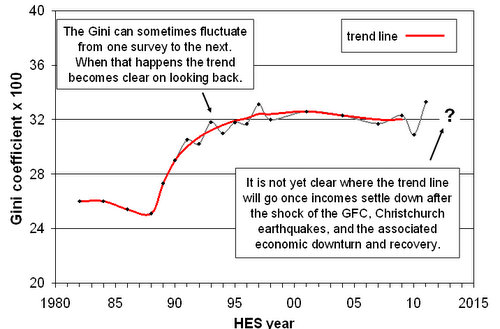
It shows the rich got much richer and the poor got quite a bit poorer, firstly in the late 1980s, and then again dramatically in the last couple of years.
The 'Gini' coefficient is the interntionally accepted measure of equality.
Only one other country's Gini has worsened more than ours in the last 20 years or so: the United States.
But this trend is evident across the Western World and many say it is one of the reasons we have now for the slump in investor confidence and the struggle to get the global economy going again.
Unless the middle is getting richer and spending more, it's hard to get your economy humming again.
Here's the MSD in its full report attached here:
The share of the total New Zealand income received by the top 1% roughly doubled from the mid 1980s to 2009, a similar trend to that reported in the US, the UK and Australia.
- Another way of looking at inequality is to track the share of a country’s total income that is received by the top 1%. Such information is not reliably available in sample surveys like the HES, but data based mainly on tax returns has recently been published for many OECD countries by a consortium of academics from France, the UK and the US.
- From the 1920s through to around 2010, English-speaking countries have shown a U-shaped curve for the income share of the top 1% with a lower flattish period from 1950 to the mid 1980s. The proportions have roughly doubled since the mid 1980s, from 5% to 9% for New Zealand and Australia, and to higher levels for the UK (15%) and the US (18%).
2. US vs China tensions - Harvard's Graham Allison has written in the FT of the growing military tensions between China and America.
If it came to it, who would New Zealand choose to side with? China is now much more important to us in trade and migration terms than America, both directly and via Australia.
China’s increasingly aggressive posture towards the South China Sea and the Senkaku Islands in the East China Sea is less important in itself than as a sign of things to come. For six decades after the second world war, an American “Pax Pacifica” has provided the security and economic framework within which Asian countries have produced the most rapid economic growth in history. However, having emerged as a great power that will overtake the US in the next decade to become the largest economy in the world, it is not surprising that China will demand revisions to the rules established by others.
The defining question about global order in the decades ahead will be: can China and the US escape Thucydides’s trap? The historian’s metaphor reminds us of the dangers two parties face when a rising power rivals a ruling power – as Athens did in 5th century BC and Germany did at the end of the 19th century. Most such challenges have ended in war. Peaceful cases required huge adjustments in the attitudes and actions of the governments and the societies of both countries involved.
3. China's biggest new export - Millionaires. The BBC reports on a growing number of wealthy Chinese people emigrating to keep their money and themselves safe.
Porsche-driving Louie Huang lives in Shanghai, having made his money - a lot of money - in property. He is having a 200-room villa built here and owns properties in at least five other cities around the world.
But he admits that for many of his wealthy friends it is a sense of insecurity which is leading them to ponder a life outside China. "Most of them think I've got so much money here but one day maybe the government will change the policies and take it all back," he says.
Entrepreneurial, well-connected or just plain corrupt, it does not matter how they made their fortunes, there is mounting evidence to show that China's super-rich are heading for the exit.
A survey last year of almost 1,000 Chinese dollar millionaires found 60% considering moving overseas. China is now one of Australia's biggest sources of migrants with figures released for 2011 showing that it had overtaken the UK for the first time.

4. Hubei's property taxes - Bloomberg reports Chinese stocks fell today after rumours that Hubei province was planning a new property tax. That battle is on and it may stop China from aggressively easing policy, which is what Australia and New Zealand needs it to do.
The nation’s two-year effort to curb a real-estate bubble included imposing a property tax for the first time in Shanghai and Chongqing, raising down-payment and mortgage requirements, increasing building of low-cost social housing and placing home purchase restrictions in about 40 cities.
China’s prices of new homes rose in the largest number of cities in 14 months in July. Prices climbed from a month earlier in 49 of the 70 cities tracked by the government, the National Bureau of Statistics said last weekend. That was the most since May last year and compared with 25 cities in June.
Rising property prices are constraining aggressive policy action from the central bank, Zhang Zhiwei, China economist at Nomura Holdings Inc., said Aug. 20.
5. Chinese iron ore stockpiles building - Caixin reports growing stockpiles of iron ore in China as demand for steel slumps. This is a problem for Australia.
"Inventories are high because ore can't be sold," said Umetal analyst Zhang Jiabin. "Steelmakers aren't willing to accept shipments. They're not willing at all. Everyone is still digesting inventory."
Ore averaged US$ 60 per ton in 2006, then shot up to US$ 160 a ton two years later with soaring global demand for steel products, particularly those made in China. Another high of US$ 200 a ton was reached in 2010.
"If you had iron ore, you could hold it for a couple months and then sell it and earn US$ 20 to US$ 30 per ton easily," said Wang Lei, who heads a Shandong ore trading company.
Wang said his company now finds itself stuck with large quantities bought during the heyday of high prices. "We bought ore for about US$ 135 per ton," he said. But today "no one will take it, even if we try to sell at a loss." Indeed, the price of iron ore has declined since last October. In August, the price dropped to less than US$ 120 a ton. Wang predicted it is likely to go lower, probably to less than US$ 100.
6. America the under-taxed - Here's Foreign Affairs with a useful piece on America's tax take, plus a useful chart showing New Zealand at the wrong end of the table -- depending of course on your views about the size of government...
Compared with other developed countries, the United States has very low taxes, little redistribution of income, and an extraordinarily complex tax code. If it wanted to, the government could raise taxes without crippling growth or productivity. Tax reform is ultimately a political choice -- not an economic one -- a statement about what sort of society America wants.

7. The Fiscal Cliff - Reuters reports the Congressional Budget Office has warned of economic grief if America's government goes over the Fiscal Cliff at the end of the year.
Massive U.S. government spending cuts and tax hikes due next year will cause even worse economic damage than previously thought if Washington fails to come up with a solution, the Congressional Budget Office warned on Wednesday.
Without action by Congress to avoid a "fiscal cliff," Americans should expect a "significant recession" and the loss of some 2 million jobs, CBO director Doug Elmendorf said in his gloomiest assessment yet.
He said the economy is already being "held back" by the mere anticipation of the fiscal cliff and the uncertainty surrounding it, causing businesses to put off investment and hiring decisions.
8. Responsive housing supply is a good thing - Leith van Onselen makes this good point at Macrobusiness.com.au, rebutting some unusual comments from an RBA official. Hughey P will love this.
The cities with more responsive land-use regulations (planning systems) have achieved both more affordable housing and lower levels of house price volatility than those with more onerous requirements (tighter planning).
Why? Because when supply is unable to respond quickly to changes in demand, the housing market becomes overly sensitive to demand shocks, resulting in greater price volatility and boom/bust cycles as demand rises/falls. During an upswing, the extra demand will automatically feed into higher home prices rather than new construction. In turn, the price rises and perceived scarcity will encourage speculative demand and ‘panic buying’ from first-time buyers, which helps to drive prices up even further. The opposite holds during a downturn, where unresponsive supply will help to accentuate price falls as new housing planned years ago continues to hit the market.
9.' I just give them lollies instead' - The LA Times reports on a Kentucky cattle farmer giving candy to his stock instead of high-priced grain. I wonder what that beef tastes like.
"It’s so hard to make any money when corn is eight or nine dollars a bushel," said Nick Smith, co-owner of United Livestock Commodities in Mayfield, Ky.
The candy, which has been rejected from retail sale, makes up from 5% to 8% of the cattle's feed ration, Smith said. The rest is a mixture of roughage and distillers grain, an ethanol byproduct.
And so far the candy's high caloric content is fattening up the cows quite nicely, he said in a phone interview.
10. Totally Jon Stewart on Joe Biden and Wall St Unchained.
We welcome your comments below. If you are not already registered, please register to comment
Remember we welcome robust, respectful and insightful debate. We don't welcome abusive or defamatory comments and will de-register those repeatedly making such comments. Our current comment policy is here.