

Here's my Top 10 links from around the Internet at 3 pm today in association with NZ Mint.
As always, we welcome your additions in the comments below or via email tobernard.hickey@interest.co.nz.
See all previous Top 10s here.
My must read today is #1 from Jamil Anderlini. New Zealand is depending on China repeating the miracle of 2008, but it's not happening and some for very good and real reasons. My apologies for no Top 10 yesterday. It got a bit hectic in Wellington. Sorry Gummy.

1. It's now all about China - Anyone trying to work out what is happening in the world, and what is likely to happen in New Zealand, should always look to China.
China's amazing growth through 2009, 2010 and early 2011 helped cushion the blow of the Global Financial Crisis for Australia, our largest trading partner and the home of our banks, and for New Zealand, both directly and indirectly.
All the self-congratulation about New Zealand being the least ugly country in the ugly country competition or (even better) the best looking horse in the glue factory, is in part dependent on China.
So what happens if it can't pull off the 2008 micracle again?
Here's FT reporter (and New Zealander) Jamil Anderlini reporting on what people are actually saying and thinking under their breath inside China.
It's not pretty.
Here's the report:
In contrast to the optimism of many international attendees in Tianjin this is what one highly respected Chinese economist told the FT: “I believe China is going to experience a very serious economic downturn and I think it has already started. The government is trying now to stabilize the economy but the instruments they have are very limited. If it can’t turn things around then I expect huge and widespread social unrest.”
That means global investors looking to China to save the world economy will almost certainly be disappointed and should probably reassess their assumptions about what is going on in the Chinese economy.
After a series of private meetings with Chinese officials and analysts at the WEF this week one senior executive from a very large western fund manager told the FT that he was doing just that: “After what I’ve heard I’m really worried now about being the dumb foreigner sitting across the negotiating table from the locals who are packed and ready to run to the airport.”
2. 'It was a heart attack' - The Daily Telegraph reports the next leader of China had a heart attack, which explains why he hasn't been seen for a while...or a stroke....or it might have been an assassination attempt....no one really knows.
3. China's productivity miracle is over - Leith van Onselen points at Macrobusiness to an excellent research note on China's structural challenges by UBS' George Magnus.
The slowdown in TFP (Total Factor Productivity), along with investment, testifies to the need for reforms to raise the growth and levels of efficiency, and as explained later, to change the contributions and functions of the State vis-a-vis the private sector – probably one of China’s biggest structural challenges in the next decade.
For China and Asia generally, higher sustainable economic growth, based around greater efficiency and innovation, depends on political and institutional reforms. Without these, we believe the miracle could fade and slower long-term growth will result – not a cheery prospect, given high expectations.
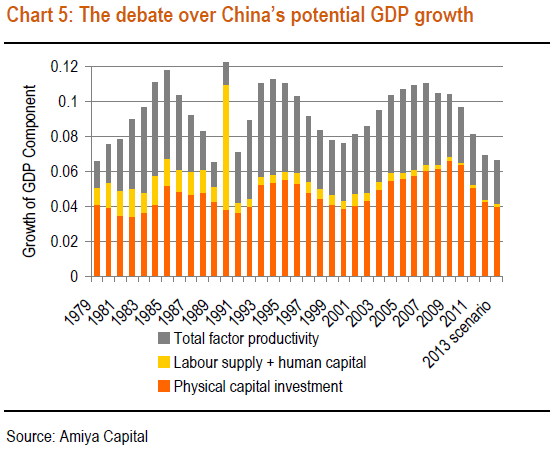
One way or another, China is going to rebalance. The question is whether it occurs in an orderly fashion with the investment side of the economy slowing to a rate less than the growth in GDP, but still growing. Or whether it happens in the context of a sharp decline in investment, with more alarming economic and political consequences that will cut across the economy.
After two decades of unparalleled economic success, we believe China now needs a reform programme on a scale similar to that adopted 30 years ago. Without it, a heavily investment-centric and credit-intensive economic model could soon become unstable, and later stall in a middle income trap. There’s only so much labour transfer from rural areas to urban factories. There’s a limit to how high the investment share of GDP can go. Rapid population ageing is chipping away at Chinese growth. The exceptional impact of accession to the WTO a decade ago is fading. And the significant, direct role of the government, state banks and SOEs in the economy as agents of economic policy, and owners and providers of heavy investment and infrastructure may no longer be appropriate as the economy becomes richer, more complex, and in need of greater competition and innovation.
In our view, the bottom line about reform is whether the CPC is willing and able to do three fundamental things. First, we feel it should move towards a fuller market economy, changing the legacy role of the state. Second, it should allow power to drain from itself, regional governments, state entities and the military towards the private sector and households. And third, it should introduce rules and transparency, including adoption of the rule of law, into the overall system of governance.
You can be optimistic or pessimistic about the outcomes, but you can’t speak of the China or, by implication Asia, miracle nowadays, without considering the chances of successful political and institutional reforms. More to the point, perhaps, what would the consequences be for China if, for existential reasons, the CPC wasn’t willing or able to go down this path?
4. Peak Helium - The Washington Post reports on America's Helium crisis.
It seems the problem is more than just for party balloon blowers.
A severe helium shortage, experts say, would cause problems for large swaths of the economy, from medical scanners to welding to the manufacturing of optical fibers and LCD screens.
So how did we get to this point? Back in the 1920s, when blimps and other airships seemed like a useful military technology, the United States set up a national helium program. In the 1960s, it opened the Federal Helium Reserve, an 11,000-acre site in the Hugoton-Panhandle Gas Field that spans Texas, Oklahoma and Kansas. The porous brown rock is one of the only geological formations on Earth that can hold huge quantities of helium. And the natural gas from the field itself was particularly rich in helium — a relative rarity in the world.
By 1996, however, the Helium Reserve looked like a waste. Blimps no longer seemed quite so vital to the nation’s defense and, more important, the reserve was $1.4 billion in debt after paying drillers to extract helium from natural gas. The Republican-led Congress, looking to save money, passed the Helium Privatization Act, ordering a sell-off by the end of 2014.

5. Chinese over-investment - Patrick Chovanec has written an excellent piece for WSJ.com on overinvestment in China.
Chinese solar companies blame many of their woes on the antidumping tariffs recently imposed by the U.S. and Europe. The real problem, however, is rampant overinvestment driven largely by subsidies. Since 2010, the price of polysilicon wafers used to make solar cells has dropped 73%, according to Maxim Group, while the price of solar cells has fallen 68% and the price of solar modules 57%. At these prices, even low-cost Chinese producers are finding it impossible to break even.
Wind power is seeing similar overcapacity. China's top wind turbine manufacturers, Goldwind and Sinovel, saw their earnings plummet by 83% and 96% respectively in the first half of 2012, year-on-year. Domestic wind farm operators Huaneng and Datang saw profits plunge 63% and 76%, respectively, due to low capacity utilization. China's national electricity regulator, SERC, reported that 53% of the wind power generated in Inner Mongolia province in the first half of this year was wasted. One analyst told China Securities Journal that "40-50% of wind power projects are left idle," with many not even connected to the grid.
China's high-speed rail ambitions put the Ministry of Railways so deeply in debt that by the end of last year it was forced to halt all construction and ask Beijing for a $126 billion bailout. Central authorities agreed to give it $31.5 billion to pay its state-owned suppliers and avoid an outright default, and had to issue a blanket guarantee on its bonds to help it raise more. While a handful of high-traffic lines, such as the Shanghai-Beijing route, have some prospect of breaking even, Prof. Zhao Jian of Beijing Jiaotong University compared the rest of the network to "a 160-story luxury hotel where only 11 stories are used and the occupancy rate of those floors is below 50%."
6. 'We're not going to do that again' - Xinhua is reporting China is not going to repeat its massive stimulus of late 2008 and early 2009. Are you listening Prime Minister Key? And Bob Jones?
Massive stimulus measures would hurt China’s long-term growth and the government’s hesitation in making “bold moves” to support the economy is pragmatic, the official Xinhua News Agency wrote in a commentary.
“Many have expected the government to announce an aggressive plan, similar to the 4-trillion-yuan ($632 billion) stimulus package issued in 2008, to keep the economy from stalling for a second time,” Xinhua writer Liu Jie wrote in the commentary published yesterday. “However, a massive stimulus plan is not only unlikely, but would be detrimental to the country’s sustainable growth.”
7. What Ray Dalio thinks - Dalio is one of the world's most renowned (and reclusive) hedge fund managers.
8. What QE Infinity means - Here's David Llewellyn Smith at Macrobusiness with his view on what The Bernank might achieve with last night's QE Infinity.
The Fed hopes to keep the return (interest rates) on MBS lower than they’d otherwise be and close the yield spread between them and the 30 year government bond. Although most US mortgages have fixed rates, the result will be lower mortgage interest rates for longer and that should enable more mortgagors to refinance at lower interest rates.
According to Credit Suisse, there is also one other potential reason. As European banks deleverage, the risk is rising that some will sell their US assets. That could risk rising interest rates for MBS so the Fed is backstopping that outcome.
A new flood of ill-directed liquidity will not be welcome and comes with a second problem for the Chinese, food inflation. There is a strong correlation between global food prices and Chinese inflation. Having just contained price rises, the last thing Chinese authorities will want is to see is a new outbreak. The policy environment for the Chinese has gotten more complex as it wrestles with its slowdown. It’s not called competitive devaluation for nothing.
9. Watch the leadership transition in China - Here's the New York Times with the latest gossip and speculation on what's really happening in China. This is not a smooth once-in-a-decade transition of power.
The most obvious sign of discord is that the dates for the congress have not been set. Most political experts here expected it to be held in mid-October, but without an official announcement, some are predicting it will be delayed.
One reason for the delay, the experts say, is what now appears to have been a contentious meeting in early August at the seaside resort of Beidaihe, China. According to the official script, this was to have been the final big meeting before the congress of leaders from the party’s various factions: the military, big state enterprises, descendants of revolutionary families, leaders of critical Communist Party organizations and others. The details of the congress were to be finalized at Beidaihe and the dates announced later in August.
Instead, according to information that is slowly leaking out, the Beidaihe meeting and other sessions beforehand in Beijing were especially tense. “The atmosphere was very bad, and the struggles were very intense,” said a political analyst with connections to the party’s nerve center, the General Office.
We welcome your comments below. If you are not already registered, please register to comment
Remember we welcome robust, respectful and insightful debate. We don't welcome abusive or defamatory comments and will de-register those repeatedly making such comments. Our current comment policy is here.