

Here's my Top 10 links from around the Internet at midday today in association with NZ Mint.
As always, we welcome your additions in the comments below or via email to bernard.hickey@interest.co.nz.
See all previous Top 10s here.
My must read is #4 on why Australia is about to have a hard time as hard commodity prices slump.

1, Why are the Germans so grumpy? - There seem few reasons for the Germans to be so reluctant to help out the rest of Europe, particularly when the Euro-zone has been great for Germany.
The weak Euro has been hugely beneficial to Germany's exporters, and by extension, its workers.
German unemployment is near its lows.
Yet still most Germans want to stop helping Southern Europe and a good proportion want to return to the Deutschemark. And it's not all about Weimar hyperinflation fars.
This Guardian piece helps explain the reluctance. The Germans are tired after 20 years of bailing out East Germany with 1.3 trillion euros of transfers...with more to come.
Here's the detail:
The enormous costs the country has shouldered since 1989 have pushed many to the limits of their largesse, with people fed up with how much they have had to pay and for how long. "People feel these transfers will never stop, that the money will just keep flowing," says Matthias Kullas of the Centre for European Policy.
In a domestic debate that mirrors the rancour and resentments that have broken out across the EU as leaders bicker endlessly over who should pay to rescue the euro, richer German states now complain about constantly having to help out poorer states via the national federal subsidies system. Just as tens of thousands of Germans tried and failed last week to persuade the country's constitutional court to rule against the eurozone's bailout fund, the rich southern state of Bavaria is taking similar action to try to freeze payments to poorer areas. Some southerners are calling for Bavarian independence from Germany, arguing it would be better off. In addition to the subsidies, German taxpayers stump up a "solidarity surcharge" of 5.5% of income tax to fund the hefty costs of unification in an arrangement due to last until 2019. "East Germany might well need another trillion," said Katinka Barysch, a German economist at the Centre for European Reform.
2. Infrastructure as an asset class - Liberal UK thinktank The Cornerhouse has written a useful analysis of private equity infrastructure funds and the controversial practice of Public Private Partnerships.
It's all very topical as governments increasingly use infrastructure spending to support economies. Who benefits?
Viewed as an asset class, infrastructure has political and economic consequences that go beyond the immediate social and environmental impacts of the projects that are built. The increased financialisation of the infrastructure sector has profound implications for what is funded (and what is not) and who gets to benefit (and who does not).
In the energy sector, infrastructure-as-asset-class is hindering a transition away from fossil fuels. Strategies that civil society has developed to hold infrastructure developers to account and to ensure positive outcomes from specific projects - such as safeguards and standards - are not keeping up with these swiftly-evolving new realities.

3. 'Where can I stash my money tax-free?' - Reuters reports on the inevitable fallout from the US crackdown on people hiding money away from the tax man in Swiss bank accounts. A whistleblower who handed over details of all the tax avoiding dodginess was recently paid more than US$100 million in bounties for dobbing in tax avoiders at UBS.
Now UBS is expecting a whole bunch of customers to clear out their accounts. I wonder where it will go. Auckland property? I have a house in Epsom someone can buy. I will take Swiss francs, but only lots and lots and lots of them because they're being printed hand over fist.
Juerg Zeltner, head of UBS wealth management, reiterated an estimate he gave in May that Switzerland's biggest bank could see outflows of 12-30 billion Swiss francs ($12.8-31.9 billion) from total European assets under management of over 300 billion.
"As a consequence of the realignment of the financial centre and the planned withholding tax, we assume that a total of hundreds of billions of francs will flow out of Switzerland," he told the Schweizer Bank magazine in an interview on Monday. "In the offshore business with European customers, I assume that we will have to live with significant outflows of wealth for quite a long time yet." German financial services consultancy Zeb/Rolfes Schierenbeck Associates estimates Swiss banks could see European clients pull up to 200 billion francs by 2016 of the 789 billion it believes they currently hold in untaxed assets.

4. 'By 2015 hard commodity prices will have collapsed' - So says China-watcher Michael Pettis in this long and well argued piece.
There are four reasons why I expect prices to drop a lot more. First, during the last decade commodity producers were caught by surprise by the surge in demand. Their belated response was to ramp up production dramatically, but since there is a long lead-time between intention and supply, for the next several years we will continue to experience rapid growth in supply. As an aside, in my many talks to different groups of investors and boards of directors it has been my impression that commodity producers have been the slowest at understanding the full implications of a Chinese rebalancing, and I would suggest that in many cases they still have not caught on.
Second, almost all the increase in demand in the past twenty years, which in practice occurred mostly in the past decade, can be explained as the consequence of the incredibly unbalanced growth process in China. But as even the most exuberant of China bulls now recognize, China’s economic growth is slowing and I expect it to decline a lot more in the next few years.
Third, and more importantly, as China’s economy rebalances towards a much more sustainable form of growth, this will automatically make Chinese growth much less commodity intensive. It doesn’t matter whether you agree or disagree with my expectations of further economic slowing. Even if China is miraculously able to regain growth rates of 10-11% annually, a rebalancing economy will demand much less in the way of hard commodities.
And fourth, surging Chinese hard commodity purchases in the past few years supplied not just growing domestic needs but also rapidly growing inventory. The result is that inventory levels in China are much too high to support what growth in demand there will be over the next few years, and I expect Chinese in some cases to be net sellers, not net buyers, of a number of commodities.
This combination of factors – rising supply, dropping demand, and lots of inventory to work off – all but guarantee that the prices of hard commodities will collapse. I expect that certain commodities, like copper, will drop by 50% or more in the next two to three years.

5. 'A lost decade' - Former US economic maestro and now Harvard Professor Larry Summers argues in this FT.com piece that Britain risks a lost decade unless it changes course from its austerity focus. He makes some good points about how bond vigilantes actually care about growth prospects, rather deficits. Growth helps reduce debt loads.
It is the mark of science and perhaps rational thought to operate with a falsifiable understanding of how the world works. So it is fair to ask economists a fundamental question: what could happen that would cause you to revise your views of how the economy operates and acknowledge that the model you had been using was flawed? As a vigorous advocate of fiscal expansion as an appropriate response to a major economic slump in an economy with zero or near-zero interest rates, I have for the past several years suggested that if the British economy – with its major attempts at fiscal consolidation – were to enjoy a rapid recovery, it would force me to substantially revise my views about fiscal policy and the macroeconomy.
Unfortunately for the British economy, nothing in the past several years compels me revise my views. British economic growth post-crisis has lagged substantially behind the US and the gap is growing. British gross domestic product has not yet returned to its pre-crisis level and is more than 10 per cent below what would have been forecast from the pre-crisis trend. The cumulative output loss from this British downturn in its first five years exceeds even that experienced during the 1930s. Forecasts continue to be revised downwards, with a decade or more of Japan-style stagnation emerging as a real risk.
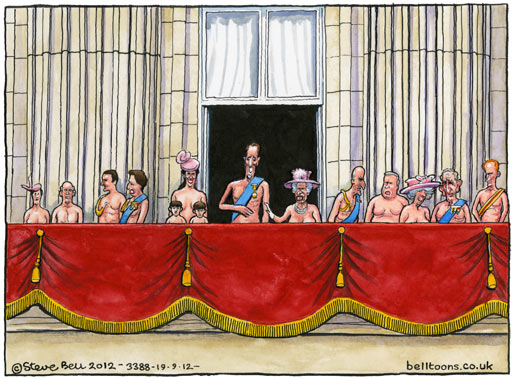
Sorry couldn't resist this from Steve Bell. I think he's a Republican, and not in the American political sense.
6. The craziness of those anti-Japanese protests in China - Here's an example of what people in China have said and done in the last couple of days. Here's the translation of this sign below, which was displayed outside an Audi dealership. HT BusinessInsider.
"Even if China becomes nothing but tombstones, we must exterminate the Japanese; even if we have to destroy our own country, we must take back the Diaoyu Islands."

And this picture shows how big these protests are:

7. Tax cuts don't work to increase economic growth - Here's David Leonhardt at the New York Times showing tax cuts actually coincided with reduced economic growth in America, while tax increases coincided with increased economic growth.
The chart tells the story best.

8. Sanctions on Japan - Could China actually impose sanctions on Japan over the Diaoyu Islands spat? And how damaging would that be?
Senior Chinese officials have been talking about it out loud. Here's WSJ on what it might mean:
“Japan’s economy will suffer severely if China were to impose sanctions on it. China’s loss would be relatively less,” said the piece in China Daily, penned by Jin Baisong, an analyst at a think tank affiliated with China’s Ministry of Commerce. The headline of the piece: “Consider Sanctions on Japan.”
It’s arguable who would be hit worse. Both economies would suffer for sure. China has relied heavily on Japanese investment capital and technology and Japan is a key export market, its third largest after the U.S. and E.U. (not counting Hong Kong, which is mostly a transshipment point). Japan benefits from those investments it makes in China in terms of corporate profits. And China is Japan’s biggest customer of expensive exports like heavy machinery and high tech gear.
Damage from a China-Japan trade war would spread beyond the two countries. Supply chains for everything from iPads to automobiles rely on parts and materials making it back and forth easily between Japan and China. U.S., South Korean, Malaysia, German and Thai companies are in the middle of the China-Japan economic relationship.
9. African wariness of China - China has been rapidly expanding trade with and investment in Africa over the last decade.
A backlash is brewing, Reuters reports.
Jaffa Shaibu, a burly 32-year-old merchant in a clothes market in Salima, a dusty town near the shores of Lake Malawi, feels less than welcoming to the Chinese traders who have moved in over the past four years. "The way it looks, one day there will be a big fight with them," Shaibu said. "One day there will be blood."
Echoing a grievance heard across Africa, Shaibu and his colleagues in this town of 40,000 complain of Chinese businessmen with better access to cheap imports of clothes, shoes and electronics, and deeper pockets that allow them to reduce their margins. That sentiment is part of a grass-roots backlash against Beijing's increasing diplomatic and commercial clout in Africa.
10. Totally Jon Stewart promoting his upcoming clash with Fox's Bill O'Reilly. Should be fun.
We welcome your comments below. If you are not already registered, please register to comment
Remember we welcome robust, respectful and insightful debate. We don't welcome abusive or defamatory comments and will de-register those repeatedly making such comments. Our current comment policy is here.