

Here's my Top 10 links from around the Internet at 9.30 am today in association with NZ Mint.
As always, we welcome your additions in the comments below or via email to bernard.hickey@interest.co.nz.
See all previous Top 10s here.
My must read is #1, which mentions Faust, the devil and unlimited money printing in the same story.

1. 'The work of the devil' - This is extraordinarily powerful stuff from Bundesbank President Jens Weidemann.
He has compared the unlimited mass money printing around the world (Fed, Bank of Japan, European Central Bank and Bank of England) to the work of the devil in Faust.
Think about this for a moment.
The head of a nation's central bank is comparing the work of his colleagues at the European Central Bank to that of the most hated figure in the history of German literature. He is criticising a policy endorsed by the German Chancellor and the German government. He is evoking the memory of the hyper-inflationary periods in Germany after both World Wars to criticise the policies of the world's largest central banks.
Can you imagine our own central bank governor taking such a stance in opposition to our Government?
He may not be right, but you've got to admire his Chutzpah and his turn of phrase.
Here's the detail courtesy of The Telegraph:
Jens Weidmann said that efforts by central banks to pump money into the economy reminded him of the scene in Faust, when the devil Mephistopheles, “disguised as a fool”, convinces an emperor to issue large amounts of paper money. In Goethe’s classic, the money printing solves the kingdom’s financial problems but the tale ends badly with rampant inflation.
Without specifically mentioning Mario Draghi’s bond-buying programme, he said: “If a central bank can potentially create unlimited money from nothing, how can it ensure that money is sufficiently scarce to retain its value?” He added: “Yes, this temptation certainly exists, and many in monetary history have succumbed to it,” Mr Weidmann warned.
Although the remarks were in context - Frankfurt is currently marking the 180th anniversary of the death of Goethe - they defy calls by leaders for Mr Weidmann to tone down his criticism of the ECB, particularly at a febrile moment in the crisis. The launch by Mr Draghi of an unlimited bond-buying programme has boosted both confidence and markets.
2. 'Just dump their bonds' - Most of the focus on China's bond holdings is on its massive holding of US Treasuries. But it also owns masses of Japanese government bonds. The latest tensions between China and Japan raise the risk China could use those bond holdings as a type of weapon of economic warfare.
Here's Ambrose Evans Pritchard at The Telegraph with another pearler:
A senior advisor to the Chinese government has called for an attack on the Japanese bond market to precipitate a funding crisis and bring the country to its knees, unless Tokyo reverses its decision to nationalise the disputed Senkaku/Diaoyu islands in the East China Sea.Jin Baisong from the Chinese Academy of International Trade – a branch of the commerce ministry – said China should use its power as Japan’s biggest creditor with $230bn (£141bn) of bonds to “impose sanctions on Japan in the most effective manner” and bring Tokyo’s festering fiscal crisis to a head.
Writing in the Communist Party newspaper China Daily, Mr Jin called on China to invoke the “security exception” rule under the World Trade Organisation to punish Japan, rejecting arguments that a trade war between the two Pacific giants would be mutually destructive. Separately, the Hong Kong Economic Journal reported that China is drawing up plans to cut off Japan’s supplies of rare earth metals needed for hi-tech industry.
3. The Burning Platform - I'm often accused of 'gloomsterising' by the likes of GBH. Fair enough. I do see some of the problems in the world and have done for a few years, mainly because many of the things that should normally be happening in a recovery are not.
Here's Jim Quinn from The Burning Platform with a right old rant about what he's seeing in his neighbourhoods in America, interwoven with plenty of useful charts. It's well worth a read, just to get a sense of what's gone wrong in America. It's a bit of a rant, but it does pull everything together.
Remember. My job is not to cheer-lead. I'm the guy who's supposed to challenge the current 'group think' and be the slice of lemon in the gin and tonic.
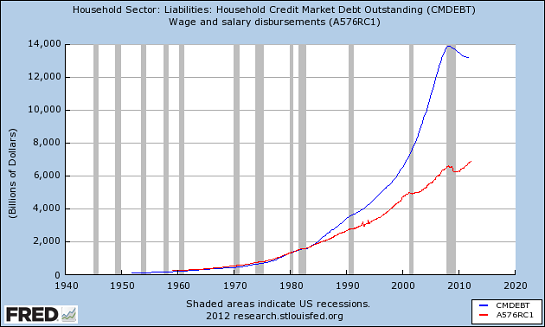
Here's Quinn and a cracking chart showing how US debt has risen (blue line) while incomes haven't risen nearly as fast, particularly after 1990 when banks leveraged up and borrowing exploded.
The thirty years of delusion were financed with debt – peddled, hawked, marketed, and pushed by the drug dealers on Wall Street. The American people got hooked on debt and still have not kicked the habit. The decline in household debt since 2008 is solely due to the Wall Street banks writing off $800 billion of mortgage, credit card, and auto loan debt and transferring the cost to the already drowning American taxpayer.
The powers that be are desperately attempting to keep this unsustainable, dysfunctional debt choked scheme from disintegrating by doling out more subprime auto debt, subprime student loan debt, low down payment mortgages, and good old credit card debt. It won’t work. The consumer is tapped out. Last week’s horrific retail sales report for August confirmed this fact. Declining household income and rising costs for energy, food, clothing, tuition, taxes, health insurance, and the other things needed to survive in the real world, have broken the spirit of Middle America. The protracted implosion of our consumer society has only just begun. There are thousands of retail outlets to be closed, hundreds of thousands of jobs to be eliminated, thousands of malls to be demolished, and billions of loan losses to be incurred by the criminal Wall Street banks.
4. Some light relief - Someone in Britain has published a calendar of fat cats. That's cats that are fat, not bankers.
Thanks (I think) to the Daily Mail.

5. Oily flash crash - The algos seemed to go mad again this week. The oil price dropped US$4 a barrel in a matter of minutes and authorities are now investigating whether algorythmic traders (ie computers trading in nanoseconds against each other) were to blame.
6. Why Wall St Always Wins - Matt Taibbi reviews this book from a US Senate staffer explaining how policy is actually made and enforced in Washington. It will chill you to the bone.
The great mystery story in American politics these days is why, over the course of two presidential administrations (one from each party), there’s been no serious federal criminal investigation of Wall Street during a period of what appears to be epic corruption. People on the outside have speculated and come up with dozens of possible reasons, some plausible, some tending toward the conspiratorial – but there have been very few who've come at the issue from the inside.
We get one of those rare inside accounts in The Payoff: Why Wall Street Always Wins, a new book by Jeff Connaughton, the former aide to Senators Ted Kaufman and Joe Biden. Jeff is well known to reporters like me; during a period when most government officials double-talked or downplayed the Wall Street corruption problem, Jeff was one of the few voices on the Hill who always talked about the subject with appropriate alarm.
Most damningly, Connaughton writes about something he calls "The Blob," a kind of catchall term describing an oozy pile of Hill insiders who are all incestuously interconnected, sometimes by financial or political ties, sometimes by marriage, sometimes by all three. And what Connaughton and Kaufman found is that taking on Wall Street even with the aim of imposing simple, logical fixes often inspired immediate hostile responses from The Blob.

7. A promo video for the iPhone 5 - Here's an exclusive insiders' account on how brilliant the iPhone 5 really is. I can't wait.
Literally. I can't. Wait.
8. What Martin Wolf says - I always read FT columnist Martin Wolf. He's often a voice of reason amid the cacophony.
Here he comments on the Fed's QE Infinity and how serious people are now considering nominal GDP targeting (which our Reserve Bank continues to say is anathema)
In a lengthy discussion of monetary policy “at the interest-rate lower bound”, also given at Jackson Hole, Michael Woodford of Columbia University argues for an explicit nominal GDP target, for fiscal stimulus and for close co-ordination of monetary and fiscal policies. But tighter co-ordination is inconceivable in the US. If the Fed did announce a plan to get nominal GDP back to its 1990-2007 trend by, say, the fourth quarter of 2016, it would need to deliver a 45 per cent increase from the second quarter of this year. That is an indicator of the scale of the demand shortfall. Needless to say, such a target is hugely unlikely.
Critics argue that the new Fed policy will not only fail to work as hoped, which is likely, but will do vast damage, which is far less so. Many have been prophesying hyperinflation for years. This fear is misguided. Unconventional policies do indeed create costs and risks. But the costs and risks of deficient demand are far greater. The Fed has decided to err on the side of expansion. That is surely right. It is, in truth, more likely to achieve too little of what it seeks than too much.
9. Why does China save much more than anyone else? - LSE Economist Keyu Jin suggests at Project Syndicate it's because the Chinese banks aren't very good at encouraging consumers to borrow while American, European (and Australasian) banks are very good at encouraging borrowing.
The answer may be that credit markets are more developed in advanced economies than they are in emerging countries, particularly in terms of the degree to which households are able to borrow. Of course, one might argue that Asian thrift and American profligacy merely reflect asymmetric demands for credit: Asians are intrinsically more reluctant to borrow. In that case, however, the vast differences in household debt (Figure 2) – ranging from 25% of GDP in emerging Asia (Southeast Asia, China, India, Hong Kong, and South Korea) to more than 90% in the US and other Anglo-Saxon economies (including Australia, Canada, Ireland, New Zealand, and the United Kingdom) – would reflect only a dissimilarity in taste.
CommentsA more plausible explanation is that institutional differences in the ability to borrow dictate to some extent the disparity in savings rates across countries. The argument is simple: All economies have both borrowers and savers, and changes in the cost of borrowing (or the return to saving) affect them differently. When interest rates decline, borrowers are able to borrow more. Savers, on the other hand, may be compelled to save more in the face of shrinking interest income.
CommentsAt the macro level, a less credit-constrained economy (with a large mass of effective borrowers) could then experience a fall in the savings rate as borrowing rose. However, in a country with a large mass of effective savers, the savings rate can rise, rather than fall. This asymmetry in savings patterns might thus reflect the simple fact that credit-constrained economies are less sensitive to drops in the cost of borrowing relative to less constrained economies.
10. Totally Jon Stewart and John Hodgman on Mitt Romney's inelegant comments on the 47% of America's population who are slackers, bludgers and don't pay tax!
We welcome your comments below. If you are not already registered, please register to comment
Remember we welcome robust, respectful and insightful debate. We don't welcome abusive or defamatory comments and will de-register those repeatedly making such comments. Our current comment policy is here.