

Here's my Top 10 links from around the Internet at 3 pm today in association with NZ Mint.
As always, we welcome your additions in the comments below or via email tobernard.hickey@interest.co.nz.
See all previous Top 10s here.
My must read chart is #5 from Roger Bootle explaining exactly what is wrong in Europe.

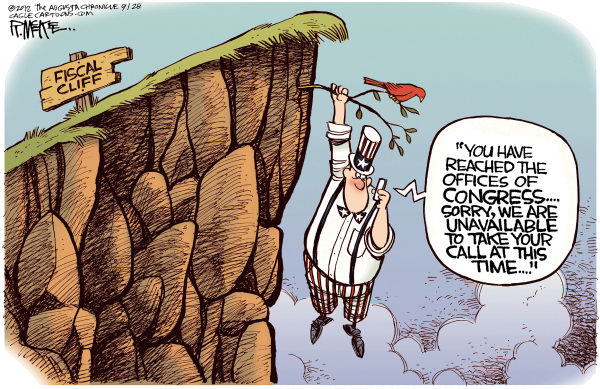
1, Watch out for the cliff - Reuters analyses the fear in corporate America over the Fiscal Cliff.
Corporates are sitting on cash like there's no tomorrow.
The presidential election doesn't look like a decisive solution to the problem of looming spending cuts and tax hikes.
Businesses are already fearful enough, given the grief rolling out across China and Europe.
The next two to three months are shaping up as crucial for the global economy, particularly with leadership transitions in China and America. And the risks of an Iranian conflict.
The uncertainty, coupled with slowing demand in Asia and Europe, is forcing corporate leaders to postpone decisions on major investments and hiring, and hurting sales of everything from textbooks to telephone lines.
"If we don't deal with the fiscal cliff and don't deal with predictability on taxes for both citizens and business, with the rest of the world in a struggling state, this is really bad for us," John Chambers, CEO of network equipment maker Cisco Systems Inc (CSCO.O), told Reuters on Tuesday.
Some 34 percent of U.S. CEOs plan to cut jobs in the United States over the next six months, up from 20 percent a quarter ago, according to a Business Roundtable survey released on Wednesday. Only 30 percent plan to raise capital spending, compared with 43 percent previously.
2. Trouble oop mill - The WSJ looks here at the implications of the FoxConn riot and concludes the Chinese manufacturing engine may be headed for a labour relations splutter or two.
The detail about the way security guards treat workers in these massive dormitory style factories is interesting. It sounds a lot like a prison camp where the guards can be paid off with cigarettes to look the other way when minor infractions happen.
The riot raises questions about the sustainability of China's vaunted manufacturing machine. And it poses a challenge to the government that is struggling to satisfy the soaring expectations of a new generation of Chinese workers who came of age in an era of double-digit economic growth and are less willing than their parents to make personal sacrifices for their country.
Many workers said they had previous problems with security forces, and though the confrontations varied in severity from simple scoldings to violence, they indicate China's new generation of laborers is less tolerant of the rigid, military-style of management used on earlier generations of more pliant migrant workers in China's largest factories. A tight labor market in China as the working-age population peaks also means they will be more able to pick and choose jobs.
To plug labor shortage gaps and train workers, Foxconn has brought in a number of workers from a plant in Shenzhen, in southern China, and another in the central city of Zhengzhou, it said. Mr. Wang, who moved up from Shenzhen in May, said the attitude of the guards at the plant is threatening. One night, when he was caught playing poker in his room, against the rules, he said the guards brought him and his friends to the bottom floor of the dorm and threatened to fire them.
"In Shenzhen that would never happen. The guards have character," he said, adding, "if they were really upset, you could get them some cigarettes and it would be OK."

3. Chinese capital flight - Chinaeconomicreview.com has a look at signs of capital flight from China as locals and foreigners alike worry about Renminbi depreciation and crackdowns on corruption and fraud.
The slowing economy and the risk of inflation returning later this year are encouraging those who can get some money out of the country to do so. Chinese have become the second largest group of foreign buyers of real estate in the US behind Canadians. A survey by the Hurun Report and consultancy Bain & Co last year showed that 60% of the 960,000 Chinese with assets of more than RMB10 million (US$1.6 million) are considering emigrating or have already begun the process.
China’s super-rich own a huge proportion of the country’s wealth; the top 1% in China controls 70% of the country’s financial assets, according to a 2008 report by Boston Consulting Group. They are also best positioned to find means to circum vent the country’s tight controls on the export of capital. This presents a small but significant economic risk: If the economy worsens and China’s elite move more of their wealth abroad, that could drain liquidity from the country at a time when it needs it most.
Official data on capital flows is available only on a quarterly basis, but a monthly model by RBC Capital Markets showed in August that capital outflows had been recorded in eight of the previous 10 months. Total capital outflows reached US$168 billion in the past year, a much deeper and more persistent deficit than during the 2008-2009 global financial crisis.
This may seem small compared to China’s US$3.24 trillion foreign exchange stockpile, but there is reason to be cautious. Well-known academic Victor Shih estimates that the wealthiest 1% of households in China command wealth that is at least as large as two-thirds of forex reserves and is possibly twice its size. Moving even a portion of this wealth abroad could have a noticeable effect on the banking system.
4. The Bristol Pound - The Guardian reports on an alternative currency gaining traction in the British city of Bristol. Further to #3 above, the Bristol money printers have also had interest from China...
More than 300 businesses – including butchers, bakers, solicitors, plumbers, electricians, book stores, art galleries, a chimney sweep, supplier of firewood, even a pole dancing tutor – have signed up, making the Bristol pound the largest local currency in the UK.
The idea is simple: to encourage consumers to spend more of their money in the local independent shops that accept the one, five, 10 and 20 pound notes and stop money leaking out of the area to faceless multinationals, unknown shareholders or the discredited banking system.
The scheme is creating a buzz. New businesses are joining every day and consumers are queuing to exchange their sterling pounds for the Bristol equivalent (the rate is a simple-to-understand 1:1). Shops are planning discounts for customers who proffer the Bristol pound and some businesses considering paying employees partly in the local currency. The city council has said it will accept Bristol pounds as payment for business rates.
"The phone has been ringing off the hook," said Cieran Mundy, director of Bristol Pound, the community interest company that runs the scheme with the Bristol Credit Union. "We've had interest from across the globe, from the US, Russia, even China."

5. 'The euro is a depression-making machine' - Fortune Editor At Large Shawn Tully reports on Roger Bootle's view the euro is toast. It's my must read today.
Today Bootle is betting his professional reputation on another bold contrarian call, one with long-term ramifications for the world economy and global stock markets: He strongly believes that at least a partial breakup of the eurozone is inevitable and that massive changes are coming for the euro, the currency now shared by 17 nations accounting for one-eighth of world GDP.
In July, Bootle and his team won the prestigious Wolfson Economics Prize for providing the best answer to the following question: "If member states leave the Economic and Monetary Union, what is the best way for the economic process to be managed?" In a 114-page report, "Leaving the Euro: A Practical Guide," Bootle delivered a blueprint for the steps a nation should take in exiting the common currency. He also went further, summoning a powerful argument for why an exodus of weak countries is the only solution for Europe's deep malaise.
Bootle is not shy about championing his highly unpopular view. "The euro is a depression-making machine," he tells Fortune. "The politicians keep throwing money to support the weaker nations' debt problem. They never talk about restoring growth. Far from a disaster, a breakup of the euro is the only way to bring back growth and get Europe out of this mess. It can't happen soon enough."
Most economists see the great problem of gold as twofold: 1) there is insufficient supply and 2) there is insufficient supply growth. The first argument is spurious. The volume of gold is not important; instead it is the value that is ascribed to this gold that is important. A zero can easily be added to a paper bill to change its value; similarly it can be added to the value of an ounce of gold. Absolute values are in fact unimportant. As we have already asserted, gold is infinitely divisible. Does it matter that a paper bill is backed by a gram or a kilogram of gold? Theoretically it shouldn’t matter in our view.
The second argument, in addition to being fallacious, shows a certain lack of humility. In order to achieve reasonable price stability within a growing economy money supply also needs to grow. The critical question is, how fast. The rate is important, grow the money supply too quickly and inflation results, too slowly and deflation is the consequence (assuming money velocity is constant in both situations).
We believe there are two key elements which are needed to approach an appropriate rate of money supply growth. The first: population growth – as the number of users of money changes, a money supply adjustment is needed to prevent the distortions in pricing that this would create. The second: unleveraged productivity – an estimate of the increase in per capita productivity (or value creation) that a society experiences over time – without the assistance of credit growth.
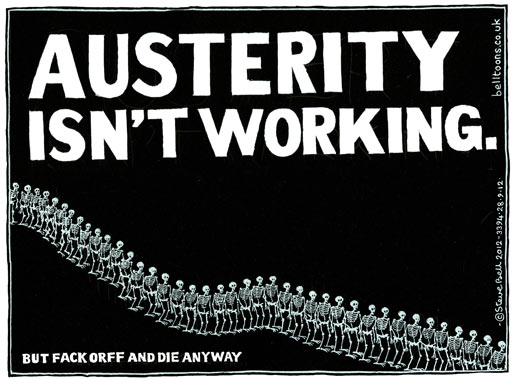
7. Catalan secession? - The FT's David Gardner seriously asks this question. The Spanish political crisis, which is the same as the European Financial Crisis, could take on a whole new dimension if this actually happens.
The eurozone crisis that has brought down governments across Europe’s periphery now threatens the survival of a nation-state. The north-south fractures inside the EU are starting to open up within member states.
When the Soviet Union and some of its buffer states broke up at the end of the cold war, EU leaders on the whole regarded this exercise of the democratic right to self-determination as a good thing. But the idea that separatism could seep into the settled structures of western Europe is wholly alien to them, notwithstanding frequent inter-regional tensions.
Such tensions are a regular feature of the tug-of-war in, for example, Italy and Belgium, between a more prosperous north and a relatively less wealthy south. In Spain, where for a combination of economic, historic and cultural reasons the industrial revolution first took root among Basques and Catalans – peoples with a deep sense of nationhood and linguistic identity – the “national question” is always alive.

Politicians on both sides of the Atlantic can be uncooperative, but inter-state disputes are more easily finessed under the American federal system than the Eurozone politically weakly integrated system. The disparity is traced to the EU's and Eurozone's special form of governance called "supra-nationality" (a partially sovereign transnational organization) that has been largely ignored in economic treatises about the costs and benefits of monetary unions. The EZ members have put themselves in a monetary cage, akin to the gold standard, in which member states have surrendered control over their monetary and foreign exchange rate policies to the German dominated European Central Bank (ECB), without supplementary central fiscal, private banking and political union institutions.
"There is a danger of China and Japan having a military conflict," said Yan Xuetong, one of China's most influential foreign policy strategists, and a noted hawk.
"One country must make a concession. But I do not see Japan making concessions. I do not see either side making concessions. Both sides want to solve the situation peacefully, but neither side can provide the right approach," he added.
He warned that unless one side backs down, there could be a repeat of the Falklands Conflict in Asia.
10. Totally Clarke and Dawe - Tony Abbott talks about his gaffe prone history of late...and whether he knows the difference between his glutes and his elbow...
We welcome your comments below. If you are not already registered, please register to comment
Remember we welcome robust, respectful and insightful debate. We don't welcome abusive or defamatory comments and will de-register those repeatedly making such comments. Our current comment policy is here.