

Here's my Top 10 links from around the Internet at 11 am in association with NZ Mint.
As always, we welcome your additions in the comments below or via email to bernard.hickey@interest.co.nz.
See all previous Top 10s here.
My must reads today are numbers 6 and 7 on the prospects for deflation rather than inflation. Everyone assumes mass money printing causes inflation. What if it doesn't and can't offset the deflationary forces of household deleveraging, ageing, technological unemployment and globalisation?

1. The end of Austerity - Anatole Kaletsky at Reuters writes about how Britain has essentially given up on its austerity strategy.
Economies with heavy private sector deleveraging are clearly contracting when governments cut spending and increase taxes.
The multiplier effects seem much bigger than expected when households in particular are on debt reduction drives.
It just reinforces the idea that households and governments can't be deleveraging at the same time.
When they do, recession or worse is inevitable. New Zealand's government is planning 3.2% of fiscal contraction over the next 4 years. That makes sense when households are leveraging up. However, the sustainability of that leveraging up is questionable when household debt to disposable income is already at painfully high levels and ticking up again towards 150%.
The Age of Austerity is over. This is not a prediction, but a simple statement of fact. No serious policymaker anywhere in the world is trying to reduce deficits or debt any longer, and all major central banks are happy to finance more government borrowing with printed money.
After Japan’s election of Prime Minister Shinzo Abe and the undeclared budgetary ceasefire in Washington that followed President Obama’s victory last year, there were just two significant hold-outs against this trend: Britain and the euro-zone. Now, the fiscal “Austerians” and “sado-monetarists” in both these economies have surrendered, albeit for very different reasons.
2. The price of corruption - This is sort of funny. Bloomberg reports shares in France's Pernod Ricard slumped in the last week after it revealed a crackdown on corruption in China had hammered sales of its champagne and cognac...
Coppere, speaking today on a webcast with analysts, said the distiller still saw “high single-digit volume growth” over Chinese New Year for Martell cognac, but that demand for whisky was affected by measures implemented by China’s new government to limit excessive gift-giving and banqueting.
Distillers including Pernod and Remy Cointreau SA (RCO) have benefited from demand for their higher-priced spirits in China, particularly cognac, as sales growth becomes tougher to achieve in the straitened economies of Europe. Chinese President Xi Jinping has been cracking down on extravagant gift-giving and feasting by businessmen and government officials.
3. Why no Wall St executives have been jailed - Here's a compelling PBS documentary called 'The Untouchables'. HT Andrew Patterson.
Watch The Untouchables on PBS. See more from FRONTLINE.
3. In praise of gentle inflation - David Pilling writes an excellent column here at FT.com about Japan's new strategy of trying to increase inflation to transfer wealth from old savers to younger workers.
One objection to “Abenomics”, the reflationary creed adopted by Japan’s new government, is that it will erode hard-earned savings. Instead of simply grabbing them over the weekend – as has become fashionable in certain parts of Europe – the government hopes to siphon them off gradually through gentle inflation. This is a dastardly plan. It is unlikely to prove popular with the over-60s, who make up a quarter of Japan’s population, but who control two-thirds of its vast household assets. It is a good idea all the same.
The reason for welcoming this intergenerational theft is that, for 20 years, Japan has prioritised the interests of older generations over younger ones. That is not only unfair. Penalising youth is also not the best way to build a nation’s future. Taxing the old through inflation is one way to redress what has been a long squeeze of one generation by another.
4. Preparing for war - Reuters reports Japan and the United States are preparing for war with China over the Senkaku/Diaoyu Islands.
Seriously. Keep an eye on this. Everyone assumes no one will pull the trigger, but there are a few trigger happy generals around these days.
Japan and the United States have started talks on operational plans in the case of armed conflict over a group of East China Sea islets claimed by Tokyo and Beijing, Japanese media said on Thursday, prompting China to complain of "outside pressure".
The dispute in recent months had escalated to the point where both sides scrambled fighter jets while patrol ships shadow each other, raising fears that an unintended collision or other incident could lead to a broader clash.
5. The United States of Inequality - Timothy Noah has done an excellent job here at Slate of picking apart the amazing growth in inequality in America over the last 20 years. This chart tells the story.
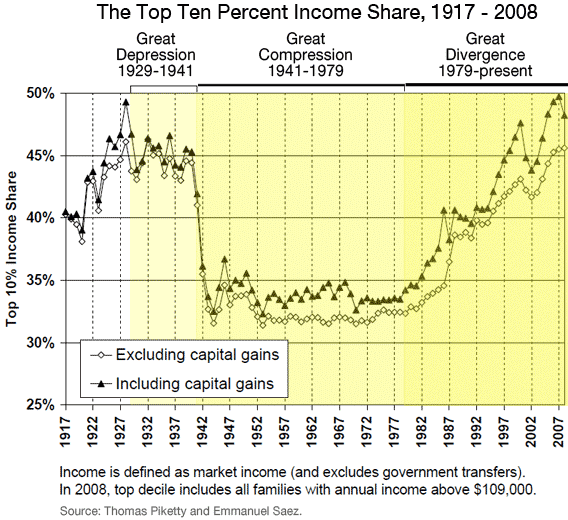
All my life I've heard Latin America described as a failed society (or collection of failed societies) because of its grotesque maldistribution of wealth. Peasants in rags beg for food outside the high walls of opulent villas, and so on. But according to the Central Intelligence Agency (whose patriotism I hesitate to question), income distribution in the United States is more unequal than in Guyana, Nicaragua, and Venezuela, and roughly on par with Uruguay, Argentina, and Ecuador.
Income inequality is actually declining in Latin America even as it continues to increase in the United States. Economically speaking, the richest nation on earth is starting to resemble a banana republic. The main difference is that the United States is big enough to maintain geographic distance between the villa-dweller and the beggar. As Ralston Thorpe tells his St. Paul's classmate, the investment banker Sherman McCoy, in Tom Wolfe's 1987 novelThe Bonfire of the Vanities: "You've got to insulate, insulate, insulate."
6. Why global economies face an age of Deflation - Here's Gary Shilling with his view via Bloomberg on the great debate about inflation vs deflation.
I'm in the camp that says (consumer price) deflation is more likely because of the triple drags of ageing populations, develeraging and flat to falling middle/lower incomes.
In recent years, monetary and fiscal stimulus across the world have led to the assumption that serious inflation, if not hyperinflation, is on its way. I believe chronic deflation is more likely.
In the 95 wartime years since 1749, wholesale price increases averaged 5.7 percent. In the 168 peacetime years, they fell 1.2 percent annually on average. As the U.S. withdraws from Iraq and Afghanistan and asdefense spending declines, peacetime conditions are likely to prevail.
Furthermore, we tend to have biases that cloud our perception of inflation. When we pay higher prices, we think inflation is at work, but we believe lower prices are a result of our smart shopping and bargaining skills.
The huge fiscal and monetary stimulus dispensed in recent years has staved off the onset of chronic deflation. For now.
The deficits created by this spending would be inflationary only if the measures occurred in a period of full employment and created excess demand. That isn’t the case in the U.S., where the large budget shortfalls are a response to private-sector weakness that has depleted tax revenue.
8. The bond rally without end - AP reports via New York Times on the amazingly robust demand for bonds despite stunningly low interest rates. It all makes sense if you think deflation is inevitable and you understand the power of ageing populations, who are congenitally driven towards low risk investments in bonds.
This is another reason why I think governments should take advantage of these low government bond yields to borrow to invest in infrastructure that drives productivity growth and efficiency gains.
Market pros call it the Great Rotation. That's the long-awaited scenario when investors take their money out of bonds and sink it into stocks.
It was the buzzword this month when the Dow Jones industrial average reached a record high. The idea was that investors were confident enough in the economy to shed their financial crisis fears and leave the safety of bonds. But it's not happening.
Money keeps flowing into bonds. Industry consultant Strategic Insight says U.S. bond mutual funds have attracted $64 billion in cash in the first two months of the year, just below last year's pace of $68 billion over the same period.
Even with low yields, bonds will continue to attract retiring baby boomers and others who want reliable income for daily expenses. The yield on the 10-year Treasury note — a benchmark — is hovering under 2 percent. Other types offer higher yields. Investment-grade corporate bonds yield 3 percent and riskier "junk" bonds yield just under 6 percent.
And many older investors don't really believe the stock market rally.
Justin Beal, a 39-year-old municipal fire inspector from Clovis, Calif., believes the stock market will continue to remain at or near record levels in the coming months. But that's partly due to the Federal Reserve's policy of maintaining historically low interest rates through its bond-buying program, he thinks. The program will have to be pulled back or ended at some point, potentially ending the stock market's surge.
"The records don't really mean a lot," Beal says. "The average guy needs to understand that you can't be jumping on the bandwagon at the end of the rally, when it's greed that's driving the market."
9. ACCC expects out of cycle rate cuts - Fairfax's banking reporter Clancy Yeates reports Australia's Competition Watchdog, as opposed to the Reserve Bank, expects the banks there to start passing on the benefits of lower funding costs on global markets in the form of out-of-cycle interest rate cuts.
This is yet more evidence for borrowers to keep pushing banks hard for cheap interest rates. The banks can afford it. Here's the ammo too at the RBNZ showing another rise in bank net interest margins in January.
Mr Sims, chairman of the Australian Competition and Consumer Commission, said he also expected banks to eventually pass on lower costs to borrowers.
''Logically if you, as it were, push up rates independently of the Reserve, there must come a time when you push them down,'' he said this week. ''I think it would be absurd for it to be otherwise.''
Wholesale funding costs have fallen to their lowest level since 2009, the RBA said this week. Some analysts also say competition for deposits is waning, giving lenders an opportunity to cut independently of the central bank.
10. Totally Stephen Colbert on the difference between Warren Buffett and Jimmy Buffett
The Colbert Report
Get More: Colbert Report Full Episodes,Indecision Political Humor,Video Archive
We welcome your comments below. If you are not already registered, please register to comment
Remember we welcome robust, respectful and insightful debate. We don't welcome abusive or defamatory comments and will de-register those repeatedly making such comments. Our current comment policy is here.