

Here's my Top 10 links from around the Internet at 10 am in association with NZ Mint.
As always, we welcome your additions in the comments below or via email to bernard.hickey@interest.co.nz.
See all previous Top 10s here.
My must reads today are #4 and #5 on the developed world's bet on financial repression. Might work. Might not.

1. Peak oil is dead. Really? - Here's James Hamilton rebutting the idea that all the shale oil and gas discoveries in America mean the theory of peak oil is history.
Just look at the oil price, he rightly says.
Whereever I turn lately, there are people saying we don't need to worry about peak oil.
So why hasn't the price fallen then?
Hamilton points to Texan production rising, but still below its previous levels.
And he also says Saudi production is falling.
He also has a great chart below showing how Saudi output is falling despite an increase in drilling activity.
Texas production in 2012 was still 1.4 mb/d below the state's peak production in 1970, and I haven't heard anyone suggest that Texas is ever going to get close again to 1970 levels. Production from any individual tight-formation well in Texas has been observed to fall very rapidly over time, as has also been the experience everywhere else.
Total U.S. production-- including Texas, offshore, and every other state-- is up 1 mb/d since 2012. But interestingly, that's almost the magnitude by which Saudi production (which accounted for 13% of the 2012 total in Figure 2 above) has recently declined.

2. What's really happening in Wenzhou - Here's an excellent Bloomberg feature on the struggles of small businesses in the once-vibrant south-eastern coastal province of Wenzhou, often seen as the birthplace of the boom of private business in China.
It documents the failure of a state-run vehicle to lend to struggling businesses after a spate of suicides by business people in hock to loan sharks.
Underground lending funded Wenzhou’s growth over the past decade, with almost 90 percent of families and 60 percent of companies taking part in 110 billion yuan of such financing, according to a 2011 survey by the People’s Bank of China.
Last year’s slowdown in underground financing left small businesses and the local economy struggling. It also led to a pileup of nonperforming debt at banks as borrowers were cut off from cash flows they needed to pay back loans.
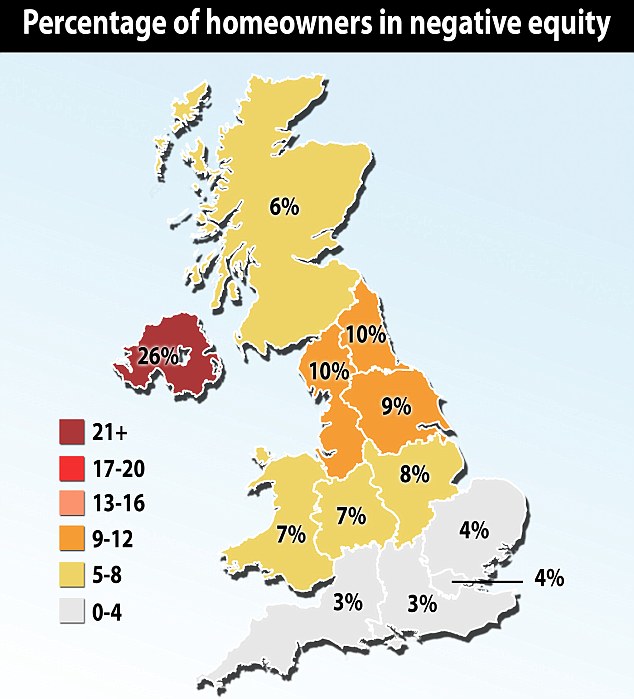
3. Britain's negative equity map - This is useful from the Daily Mail and it doesn't even have a picture of a lightly dressed celebrity.
4. 'Either way, savers should beware' - This is an excellent piece from The Economist's Buttonwood columnist on how the problems of entire economies having too much debt have not been solved.
Hopes a burst of growth and/or inflation would solve the problem are fading. The only other option is default.
An alternative to default is to inflate the debt away, to create so much money that the creditor suffers default in real terms, not nominal ones. As last week's column points out, this is being done in part by financial repression; holding real rates negative. Maybe this is what QE is designed to accomplish. So far, however, the central banks have had very little success in achieving the right kind of inflation; rapid growth in personal incomes. Such income growth will make it easier for individuals to repay their debts. Instead the West has tended to see imported inflation in the form of higher commodity prices. And that of course depresses real wages and makes it harder for individuals to repay their debts.
In short, we are nearly six years into this crisis and we have made precious little progress in running down debts and thus are vulnerable to further crises; Cyprus is just the latest example. Nor have we decided whether default or inflation is the preferred option. Either way, savers should beware.
5. A Financial Repression levy - Here's Buttonwood again with more detail on the tactic of Financial Repression being used by central banks and governments to quietly make the debt go away without disruptive defaults. It's the dirty little secret of global economic policy at the moment. Though not here. New Zealand's real returns are quite respectably positive.
Buttonwood makes the point financial repression works best with capital controls to stop savers fleeing to other countries. Any surprise then that every man and his dog wants to put money in New Zealand?
In the developed world total debt (including that of the financial sector, consumers and companies, as well as governments) is so high that it is implausible that it can be repaid via the fruits of economic growth. The debt must either be written off (defaulted on) or slowly inflated away. That means inflicting pain on someone: sorting out the crisis has been so difficult because no one wants to take the hit.
The Cypriot deal is a very clumsy attempt at a write-off. Your humble deposits are banks’ debts. So taking the deposits and using the proceeds to recapitalise the banks is a roundabout way of defaulting. But any form of outright default creates the potential for contagion.
Because it is more subtle, financial repression is more successful. It was the way that many countries reduced their debt burdens after the second world war. It takes advantage of the phenomenon of money illusion: people get confused between nominal and real numbers.
The danger is that savers will eventually get wise to the erosion of their spending power. In the post-war era capital controls stopped them from moving their money abroad. Now there are no such controls, but with most developed countries having the same rock-bottom interest rates, there is little incentive to shift.
6. Now this is an email leak - The International Consortium of Investigative Journalists, which includes NZ's own Nicky Hager, have 'discovered' more than 2 million emails from tax havens, mostly the British Virgin Islands.
They have produced a special report on the findings, including the names of officials from all around the world with secret accounts in all sorts of places.
Here's the key findings:
- Government officials and their families and associates in Azerbaijan, Russia, Canada, Pakistan, the Philippines, Thailand, Canada, Mongolia and other countries have embraced the use of covert companies and bank accounts.
- The mega-rich use complex offshore structures to own mansions, yachts, art masterpieces and other assets, gaining tax advantages and anonymity not available to average people.
- Many of the world’s top’s banks – including UBS, Clariden and Deutsche Bank – have aggressively worked to provide their customers with secrecy-cloaked companies in the British Virgin Islands and other offshore hideaways.
- A well-paid industry of accountants, middlemen and other operatives has helped offshore patrons shroud their identities and business interests, providing shelter in many cases to money laundering or other misconduct.
- Ponzi schemers and other large-scale fraudsters routinely use offshore havens to pull off their shell games and move their ill-gotten gains.
7. Most fun Sun front page I've seen in a while - Argentinian Carlos Tevez was sentenced to community service as a cleaner for driving while disqualified.

8. Uridashi anyone? - Japan's decision overnight to double its money supply over the next two years is very important for New Zealand. At least some of that enormous sum of printed money is going to squirt out the sides and flood into those countries that are growing and have an interest rate over 0% and no capital controls.
Japanese holding cash for the bonds they just sold to the Bank of Japan will look to put it somewhere where the central bank is not printing money. I wonder if we'll see the Uridashi trade starting again.
New Zealnd's banks have started borrowing overseas again because loans are growing faster than term deposits. May as well be Japanese money that the banks suck in to fund the New Zealand housing boom, pushing up the currency again. Haven't we seen this somewhere before? Oh yes, there was that time between 2002 and 2007 when we had a housing boom that we thought would never happen again...
Over the last couple of years our banks have been borrowing recently printed Swiss money through the issue of covered bonds. Maybe it's time to crank up the Uridashis again.
And we wonder why the New Zealand dollar is 15% over-valued...
Here's a useful FT Q&A on the Bank of Japan's move.
9. 'All you need is a shotgun as a downpayment for a pickup' - Here's a fun Reuters article on how the US Federal Reserve's money printing machine is pumping more debt out into the economy.
Thanks largely to the U.S. Federal Reserve, Jeffrey Nelson was able to put up a shotgun as down payment on a car. Money was tight last year for the school-bus driver and neighborhood constable in Jasper, Alabama, a beaten-down town of 14,000 people. One car had already been repossessed. Medical bills were piling up.
And still, though Nelson's credit history was an unhappy one, local car dealer Maloy Chrysler Dodge Jeep had no problem arranging a $10,294 loan from Wall Street-backed subprime lender Exeter Finance Corp so Nelson and his wife could buy a charcoal gray 2007 Suzuki Grand Vitara.
All the Nelsons had to do was cover the $1,000 down payment. For most of that amount, Maloy accepted Jeffrey's 12-gauge Mossberg & Sons shotgun, valued at about $700 online.

10. Totally Clarke and Dawe - Ewan Whosarmy has a few views on the Australian political scene.
The Australian economy is the envy of the entire world, it seems.
And one more tabloid front page for fun. This time from the Daily Mirror on Chancellor of the Exchequer George Osborne parking in a disabled bay.

We welcome your comments below. If you are not already registered, please register to comment
Remember we welcome robust, respectful and insightful debate. We don't welcome abusive or defamatory comments and will de-register those repeatedly making such comments. Our current comment policy is here.