

Here's my Top 10 links from around the Internet at 10.30 am today in association with NZ Mint.
As always, we welcome your additions in the comments below or via email to bernard.hickey@interest.co.nz.
See all previous Top 10s here.
My must watches today are #7 and #8 from Stephen Colbert on the Reinhart/Rogoff mistake. Hilarity ensues from a spreadsheet error. Jon Stewart at #10 on the plunge in the gold price made me LOL too.

1. The austerity obsession is ending - FT reports Italy has just elected a new Prime Minister who wants to end the European obsession with so-called 'expansionist austerity'.
This is where governments cut their spending and increase taxes to return to budget surplus in order to avoid 'crowding out' the private sector, thus driving more efficient, productive and stronger growth in the private sector. This is the John Key/Bill English plan.
It's a strategy that can work when the private sector is healthy and has headroom to grow, particularly with it debt to income ratios. But when households and businesses are deleveraging it's difficult to make 'expansionist austerity' work.
Europe has this problem in spades. Its household sectors, particularly in Southern Europe, are horribly indebted with little prospect of restructuring and the inability to use inflation to make the debt go away.
The three year experiment with austerity in Europe also seems to be coming to an end as it's simply not working and voters are working this out. Spending and tax crackdowns are actually driving European economies deeper into recession (or worse) and are increasing debt loads, rather than reducing them.
The final straw was the debunking of the key academic argument underpinning the austerity strategy. The revelations in the last couple of weeks that the Reinhart/Rogoff theory of a 90% tipping point for public debt/GDP was based on a dodgy spreadsheet has tipped the balance.
Yet this theory that government austerity is exactly what drives growth is the one being pursued by John Key and Bill English.
Outlining a programme of institutional reforms and measures to create employment, Mr Letta immediately weighed into the pressing eurozone debate, sending a strong message to Brussels and Berlin that a change of direction was needed.
“Europe’s policy of austerity is no longer sufficient,” he said, echoing similar remarks this week by Jose Manuel Barroso, European Commission president.
------------------------------------------------------------------------------------------------------------------------------------------
Keep it safe. Keep it in a New Zealand Mint safety deposit box. Details here »
------------------------------------------------------------------------------------------------------------------------------------------
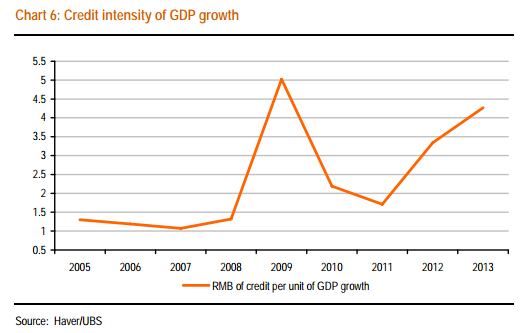
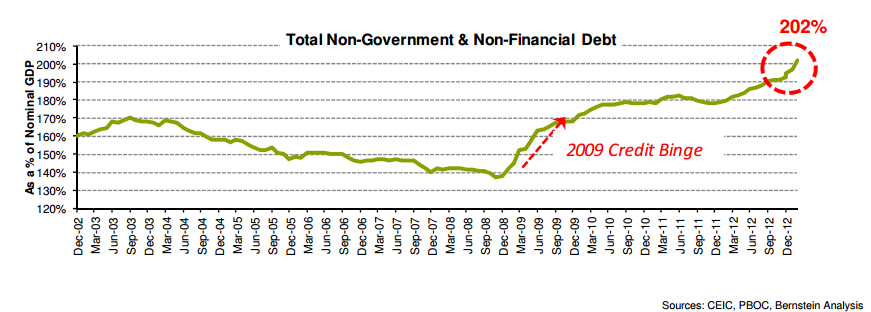
2. Two charts that tell the story - These are two cracking charts cited in FT Alphaville showing just how much China's economic growth has relied on expanding credit in the last year or so. The incremental return from the extra debt is dropping fast.
Here's the first chart and comments from UBS Economist George Magnus. The bolding is mine:
In the face of the sharp slowdown in growth in early 2012, the government decided to play safe, especially ahead of the leadership change in October, and allowed credit to reaccelerate. But if it hoped the investment side of the economy would spring to life, the outcome has been disappointing, at least so far. Instead – and it’s hard to be specific – credit expansion is taking on a more Minsky-ish character: refinancing of maturing bad debt, borrowing to service debt because of weak cash flows and negative commercial returns, and the financing of ‘investment’positions in real estate and commodities.
It is estimated, for example, that banks rolled over some RMB 3 trillion, or three quarters, of loans to local governments that matured in 2012.1 And the IMF has noted that in the broadly defined corporate sector, company profits are failing to keep up with rising interest rate expense, obliging firms to seek recourse to borrowed funds
The second chart from Berstein analysis also tells the story.
------------------------------------------------------------------------------------------------------------------------------------------
New Zealand Mint. Experts in gold & silver bullion, commemorative coins and jewellery. Details here »
------------------------------------------------------------------------------------------------------------------------------------------
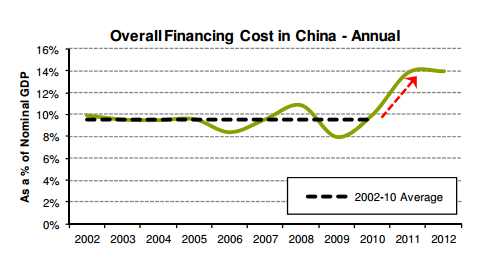
An increasing amount of the total GDP is being directed back into financing costs. Michael Werner of Bernstein, who made some of the interesting charts comparing credit growth and GDP growth rates, says it’s difficult to predict where exactly the growing debt levels may lead, there is a fairly simple mathematical truth (we’re paraphrasing him here) contained in this chart:
Rising financing costs, now at 14 per cent of GDP, underline Magnus’ point that credit is becoming less productive because it’s increasingly being directed towards financing itself.
That brings us to the third point about why the debt-to-GDP ratio is important — it’s a point specific to China. China’s investment has of course been largely credit-fuelled, and that investment has achieved a massive outsize role in its economy. It’s also been a significant contributor to China’s rapid growth rates post-2008. So, credit needs to be directed to (good) investment to create growth.
Yet both credit and investment are unsustainably high... This could end a number of ways, but it doesn’t seem that sustained high single-digit GDP growth levels is one of them.
And FTAlphaville's conclusion:
China’s rising levels of credit growth, and slowing GDP growth, don’t necessarily foreshadow a crisis. But they do provide another signal that the economy’s growth level will decelerate, one way or another, and more quickly than many are expecting. This time, growth opportunities through past mechanisms of cheap labour, exports, and investment are all increasingly tapped out.
------------------------------------------------------------------------------------------------------------------------------------------
Available now. Our brand new 1 oz Taku gold bullion coin. Details here »
------------------------------------------------------------------------------------------------------------------------------------------
4. She may become the most powerful woman in the world - US Federal Reserve Vice Chair Janet Yellen is apparently the insiders' tip to replace Ben Bernake. Here's a useful NY Times profile. She's a bit of a dove on inflation. Good.
5. De-globalisation? - One of the great fears after the Global Financial Crisis is that governments and central banks would pull up the drawbridges and block free movements of trade and capital.
Now the Americans are forcing foreign banks with US branches to hold more capital. Some worry this will make it harder to shift large chunks of capital around or somehow make financial markets less efficient.
I'd prefer stability to efficiency most days, if that's the trade off.
It's hard to feel to sympathetic to the very-undercapitalised and struggling European banks who are using easy access to cheap Fed funds and low equity levels in an attempt to generate capital from trading on markets rather than actually raise fresh capital from shareholders or impose haircuts on their creditors...
Here's the NY Times reporting on the moves:
Until the turn of the century, American operations of foreign banks tended to receive financing from home. But as the credit party grew after 2003, those banks increasingly borrowed in America’s short-term markets and sent the money back home to the parent. When the credit crisis appeared, that financing — a significant part of which had come from selling short-term securities to United States money market funds — dried up.
“Foreign banks that relied heavily on short-term U.S. dollar liabilities were forced to sell U.S. dollar assets and reduce lending rapidly when that funding source evaporated, thereby compounding risks to U.S. financial stability,” Daniel K. Tarullo, a Fed governor, said in a speech late last year.
The foreign banks ended up needing a disproportionate share of loans the Fed handed out to stabilize banks. And since then the ability, let alone the willingness, of some countries, particularly in Europe, to provide what the Fed delicately calls “backstops” — a term that sounds much less harsh than “bailouts” — appears to have diminished.
In December, the Fed proposed new rules that have set off loud protests from overseas and are likely to provoke a flood of complaints before the comment period ends on Tuesday.
The rules would require that American subsidiaries of each foreign bank be put together in a holding company that would have to maintain capital, and liquidity, in the United States. In some cases the requirements would be greater than home countries require of the parent institutions.
6. The war of the coding error - Here's Philip Stephens at the FT looking through the rubble after the debunking of Reinhart/Rogoff and concluding that economists can't be trusted to run economies. He makes some sensible points about timing.
A heavy price must be paid for the unchecked spending and credit booms that ended in the global financial crash. But timing and pace matter. Governments with a demonstrable determination to raise long-term economic growth with supply-side reforms should be given more time to cut deficits.
During the past couple of years politicians have prized credibility with markets above real economic performance. It hasn’t worked. Bond traders such as Pimco’s Bill Gross now attack austerity, calling for measures to rekindle growth. Bond markets, like economists, are rarely known for their consistency. In this instance, though, Mr Gross is right.
The present confusion – visible in open debates at the International Monetary Fund – gives politicians and central bankers a chance to think again. The response should be a calibrated policy shift to combine accelerated supply-side reforms with flexible fiscal timetables and increased investment. To the extent fiscal restraint weighs on demand, it should be offset by policies to expand productive potential.
What circumstance now demands of politicians is the confidence to break free of the defunct, and debunked, economic theorising. Economists are not always wrong; nor does the real problem lie with dodgy data. The mistake comes when policy makers invest the findings of a faith-based discipline with the certainties of science. They would do better to rely on common sense and observed behaviour. By underscoring this fairly simple lesson, the War of the Spreadsheet Coding Error may yet do Europe a huge service.
7. Austerity's spreadsheet error - Here's Stephen Colbert on the spreadsheet error by Reinhart and Rogoff. Hilarity from a spreadsheet mistake in an academic paper. Who would have thunk it.
"If ignoring everything in New Zealand, Australia and Canada was a crime, everyone would be on death row."
The Colbert Report
Get More: Colbert Report Full Episodes,Indecision Political Humor,Video Archive
The Colbert Report
Get More: Colbert Report Full Episodes,Indecision Political Humor,Video Archive
9. Ageing and Europe - Alan Wheatley at Reuters points out the huge drag on Europe's economy, besides its household and government debt.
Long after the debt crisis is over, Europe will be grappling with an even more serious problem - how to pay for growing numbers of old people. The population of some countries is stagnant or already shrinking, notably Germany's. That will reduce savings and potential economic growth. The workers who remain are getting older and so are less productive. That will hold back living standards. And the ranks of retirees are swelling.
That will threatening the financing of pensions and health care. In the 27 countries of the European Union, each pensioner is today supported on average by four people of working age. By 2050, this old-age support ratio will have fallen to just 2:1, according to United Nations and EU projections.
10. Totally Jon Stewart on the slump in the gold price. God has a few views on gold too, it seems.
We welcome your comments below. If you are not already registered, please register to comment
Remember we welcome robust, respectful and insightful debate. We don't welcome abusive or defamatory comments and will de-register those repeatedly making such comments. Our current comment policy is here.