

Here's my Top 10 links from around the Internet at 10 am today in association with NZ Mint.
As always, we welcome your additions in the comments below or via email to bernard.hickey@interest.co.nz.
See all previous Top 10s here.
My must read is #2 from Walter Russell Mead on the problem with jobs in the developed world. HT Waymad. A cracker: "Is the new economy locking us into permanent inequality, insecurity, polarization and class conflict?" He's ulitmately hopeful, but nails the challenges.

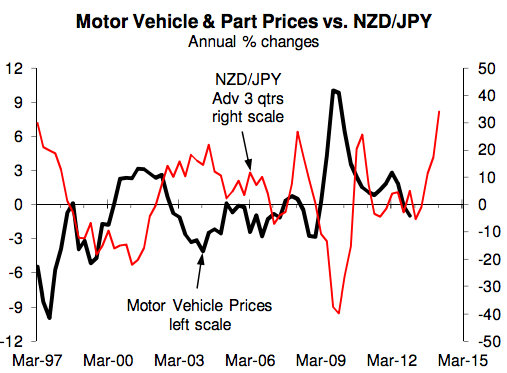
It shows that car prices and car part prices often fall significantly in the following 9 months after the New Zealand dollar appreciates versus the Japanese yen.
The New Zealand dollar has risen 44% vs the yen in the last year, with most of that increase in the last six months on the anticipation and then confirmation of 'Abenomics', a plan to double Japan's money supply in two years.
I've seen a few ads for new Japanese cars for less than NZ$20,000, but the big shift in the currency has yet to feed through.
Rodney uses this chart below to show how soon car prices might drop and by how much.
If I was buying now I'd be trying to drive a very hard bargain to pull forward some of this change.
Print out Rodney's note and take it to your dealer!
The chart shows a general inverse relationship between the annual % change in the NZD/JPY (right scale) and the annual % change in motor vehicle and parts prices as reported by Statistics NZ (left scale). It isn’t a perfect relationship, but more often than not significant appreciations in the NZD/JPY have been followed, three quarters later on average, by moderate falls in motor vehicle and parts prices.
The lagged impact is reflected in the chart by the red NZD/JPY line being advanced or shifted to the right by three quarters. Other factors can have a significant impact at times, but the odds probably favour a moderate fall in motor vehicle prices over the next three quarters.
------------------------------------------------------------------------------------------------------------------------------------------
Keep it safe. Keep it in a New Zealand Mint safety deposit box. Details here »
------------------------------------------------------------------------------------------------------------------------------------------
2. The problem with jobs - The American Interest has a very thoughtful piece here on how the increasing automation of production of both products and services is reducing the breadth and depth of high paid manufacturing and services jobs in many developed economies. HT Waymad in the comments of yesterday's Top 10.
The ways many multinational companies are able to use globalisation to reduce their unit costs and elevate profits is deepening this jobs crisis.
Maybe a new industry will turn up that needs lots of highly skilled and highly skilled humans who can live in these developed countries. It's happened before after the big shift in the workforce from the farm to the factory between the late 1800s and the mid 1900s.
There are now pockets of these high paid and high skilled jobs in places like Silicon Valley and Hollywood, but only pockets and the scale of the income and wealth inequality is vast.
That step change in the global economy between 1880 or so and 1960 was epic and caused massive disruption. We had two awful World Wars as a result (partly) of that epic shift.
Here's hoping we can manage another transition without renewed social conflict. Here's Walter Russell Mead at the American Interest:
We are seeing the greatest wave of economic transition since the mechanization of agriculture reduced the percentage of the labor force engaged in farming from more than half the American labor force in 1890 to less than two percent today.
The old engines of job growth, especially in manufacturing, aren’t working, and the competition for good jobs keeps getting tighter. With the entry of billions of Asians and others beyond the old industrial economies of North America, Europe and Japan into the modern economy, the competition is global. And if low wage workers can’t do the job cheaper than you, computers and, increasingly, robots mean that you can still lose your job.
his is an economy that produces inequality very different from what most citizens of the old industrial economies are used to, and the social and political consequences of rising inequality play a growing role in many countries who once prided themselves on their success in building a vast and stable middle class.
Much of the inequality is generational. For many young people, the road to a middle class job is harder than ever before: more years of school, more years of debt, more internships, more years of scrabbling after graduation until that first real, career building job comes through.
Is the new economy locking us into permanent inequality, insecurity, polarization and class conflict? Are we at the early stage of a Great Unraveling that will roll back the clock on the social achievements of the twentieth century and fall back from Blue Model Fordism to Victorian capitalism red in tooth and claw? People in Italy and France are asking this as much as people in California and Connecticut; these changes in the labor market are stirring huge and justifiable anxieties across the entire developed world.
------------------------------------------------------------------------------------------------------------------------------------------
New Zealand Mint. Experts in gold & silver bullion, commemorative coins and jewellery. Details here »
------------------------------------------------------------------------------------------------------------------------------------------
3. The pain in Spain - Is falling on the plain and in every other place. Ambrose Evans Pritchard reports on what a leading Spanish bishop is saying about austerity, unemployment and risk of social turmoil in Spain.
"We have to change direction, otherwise this is going to bring down whole political systems," said Braulio Rodriguez, the Archbishop of Toledo.
"It is very dangerous. Unemployment has reached tremendous levels and austerity cuts don't seem to be producing results," he told The Telegraph.
"There is deep unease across the whole society, and it is not just in Spain. We have to give people some hope or this is going to foment conflict and mutual hatred."

------------------------------------------------------------------------------------------------------------------------------------------
Available now. Our brand new 1 oz Taku gold bullion coin. Details here »
------------------------------------------------------------------------------------------------------------------------------------------
4. Money squirting everywhere - China's money supply grew 16.1% in April from a year ago, Bloomberg reports. Of course, some of it is going to squirt out the sides and trickle down to places like New Zealand.
The worrying thing is that money supply growth is currently running twice as fast as economic growth. There are big structural problems in the Chinese economy.
“There are few signs of renewed dynamism” in economic growth, Standard Chartered analysts led by Stephen Green, head of Greater China research in Hong Kong, wrote in a report dated May 10. “Credit growth should support near-term activity, though it raises questions about leverage, credit quality and growth sustainability in the next few years.”
Aggregate financing was a record in the first three months and new yuan loans were the most for a quarter in almost four years, spurring concerns that faster credit isn’t translating into economic growth.The central bank said this week that it will use various tools to guide “stable and reasonable” growth in money supply and credit. “The negative spillover effects from loose monetary policy in major economies are growing, which has helped pro-cyclical credit expansion at home,” the PBOC said.
5. Freeing up capital flows - Xinhua (China's Pravda) reports one of the solutions for China's structural problems is to liberalise capital flows in and out of China as part of a plan to free up the currency from its current crawling peg.
It looks like some real reforms were agreed over the weekend.
China only allows a limited number of financial institutions to buy stocks and bonds overseas, as it fears demolishing its currency curb could trigger a capital flight and lead to instability of the financial market in the world's second largest economy.
"It's not a surprising move. The regulators have been inching towards an opened capital account," said Yao Wei, China economist with Societe Generale. "An opened capital account will make China's financial market more efficient, more transparent, and up to international standards."
Capital inflows to China have been surging as indicated in recent trade data, and with major central banks pumping cheap money into financial markets, relaxing capital regulation would entice more hot money given big spreads between Chinese and foreign interest rates, according to Liu.

6. Sweeping Chinese reforms - John Garnault is an excellent observer from within China from an Antipodean point of view. He lives in China, but writes for the Sydney Morning Herald.
This is my second must read today.
China is drawing up a blueprint for sweeping reforms aimed at averting an economic crisis, sources with close ties to the leadership say. The reforms are aimed at revitalising the world's second-largest economy amid deepening fears about a trend of rising corruption, wasteful investment and local government debt.
Liu He, who leads the party's Central Leading Group on Financial and Economic Affairs, has been given the task of preparing a seven-point blueprint for the Third Plenum of the 18th Communist Party Congress, which is due in about October, according to a source with close ties to several members of the Politburo Standing Committee.
If executed as intended, the new reform program would go some way to answering doubts about whether China can continue underwriting the Australian economy, including huge gas and other resource investment plans over the next decade. Some hedge fund managers say China's has reached a "zugzwang" moment, referring to the predicament when a chess player must make a move but prefers to pass.
"In China policy is made when the pain of inaction is higher than the pain of action, and we've reached that point," said David Hoffman, managing director of the Conference Board China Centre for Economics and Business.
He points to a price to income multiple of 6.5 times in Australia. That's nothin' It's nearly 15 times income in Auckland.
"We concluded that by almost any affordability metric, Australia had the largest housing bubble on the planet." The words of David Hurwitz of SC Fundamental, a large US-based hedge fund, neatly explain why he's shorting Commonwealth Bank. He's not alone, either. Jim Grant of Grant's Interest Rate Observer recently recommended shorting Westpac and Bank of Queensland.
Grant's colleague Evan Lorenz warns that, "Houses in the major Australian markets are priced at an average of 6.5 times median household income, compared to 3.1 times in the United States today and 4.6 times in the zany year of 2006. [Yet] In all my calls to Australia no one was willing to venture a bearish view on the Aussie housing market outside of a few suburbs in Queensland." Maybe he's calling the wrong people.
8. EU plans massive tariffs on Chinese solar panels - Reuters reports the EU has had enough of China's massively subsidised solar panel makers dumping excess stock in their market and may impose tariffs of 30% or more.
We've had lots of warnings before about Smoot-Hawley type tariffs being imposed as they were soon after the 1929 crash. It hasn't happened.
Yet.
Here's Reuters with the latest EU moves. See #3 above to get a sense of the pressures involved.
Trade Commissioner Karel De Gucht is expected to tell his fellow EU commissioners on Wednesday that Brussels should levy the tariffs to guard against Chinese production that quadrupled between 2009 and 2011 to more than the entire global demand.
EU producers say Chinese companies have captured more than 80 percent of the European market from almost zero a few years ago, prompting the European Commission to act against what it terms dumping. Europe accounted for about half of the global solar market last year, which was worth $77 billion, according to research firm IHS.
9. A sign of the time - Bloomberg reports with this nifty chart below that Swiss watch exports to China have slumped after austerity and anti-corruption edicts were issued by the new leadership of Xi Jingping and Li Keiqiang. Swiss watches were the 'gift' of choice to officials, it seems.
One, known as 'Brother Watch', had 12 luxury watches. Greedy bugger.
Hermes International (RMS) SCA reported a drop in first-quarter watch sales due to a slowdown in China, while LVMH Moet Hennessy Louis Vuitton SA (MC), the world’s largest maker of luxury goods, said Chinese retailers have been buying fewer watches than expected. Communist Party official Yang Dacai was fired last year after photos posted online showed him wearing 11 luxury watches at different times, earning him the nickname “Brother Watch,” according to Xinhua News Agency.
“The corruption crackdown campaign is having a big effect on luxury watch sales,” said James Roy, senior analyst with China Market Research Group in Shanghai. “High-end watches are very common gifts and they are items that are quite conspicuous and associated as a sign of corruption.”


"Student loans are like herpes with compounding interest."

We welcome your comments below. If you are not already registered, please register to comment
Remember we welcome robust, respectful and insightful debate. We don't welcome abusive or defamatory comments and will de-register those repeatedly making such comments. Our current comment policy is here.