

Here's my Top 10 links from around the Internet at 2 pm today in association with NZ Mint.
As always, we welcome your additions in the comments below or via email to bernard.hickey@interest.co.nz.
See all previous Top 10s here.
My must read is #6 on how low interest rates forever create zombies. Yum. Yum. Have a great weekend.

1. Speaking of housing bubbles - Canada's housing bubble may have started deflating.
One of the triggers looks to have been measures taken by the government to reduce high loan to value ratio (LVR) lending over the last year.
Sound familiar?
I'd be surprised if we saw any similar effects here yet.
There are plenty of hurdles to jump.
The Reserve Bank has to decide to limit high LVR lending. So far, it only has the tool and the Governor said as recently as December he wouldn't use the tool even if he had it.
Also, reading between the lines, I think the RBNZ is very reluctant to use the LVR limit.
And finally, buyers are adept at getting around rules like this.
The only real and effective way to spike a housing bubble is to put up interest rates. And, unfortunately for everyone, inflation is below the RBNZ's target band so it would struggle to justify such a hike given its current Act and policy targets agreement.
Here's CNBC with the news on Canada.
Home prices in the greater Vancouver area are down 3.9 percent from a year ago,according to the Real Estate Board of Greater Vancouver. In West Vancouver, which is sometimes said to be the wealthiest municipality in Canada, home prices have fallen 5.6 percent. Sales are down 20 percent from a year ago.
Vancouver is not alone. All over Canada there is fear that the country is in a housing bubble that is now in the process of popping. In March, Montreal saw sales decline 17 percent year over year, even while inventory continues to climb. In Ottawa, sales have fallen 16 percent.
"A housing correction—or, possibly, a crash—is no longer coming. It's here, "Macleans magazine declared this past January.
------------------------------------------------------------------------------------------------------------------------------------------
Keep it safe. Keep it in a New Zealand Mint safety deposit box. Details here »
------------------------------------------------------------------------------------------------------------------------------------------
2. How to avoid the rules - CNBC explains how Canadians are avoiding the tough rules imposed by the government on high LVR lending.
The Canadian government is attempting to engineer a soft landing. It has tightened mortgage lending rules four times in the last four years. The maximum length of mortgages is being reduced from 40 to 25 years. Home equity loans were curtailed. And the government stopped backing mortgages on the most expensive homes.
But it's not clear how effective these measures will be. The Globe and Mail recently ran a feature titled "Canadians can still buy a house without saving their pennies." It is more or less a guide to buying a house with no money down. The website eHow has a page for doing that.
Some of the loopholes people use to avoid the mortgage restrictions are quite extraordinary. For example, although the government requires buyers to purchase private mortgage insurance on mortgages with 100 percent loan-to-value ratios, eHow says this can be avoided just by getting two mortgages, each for 50 percent of the home value.
------------------------------------------------------------------------------------------------------------------------------------------
New Zealand Mint. Experts in gold & silver bullion, commemorative coins and jewellery. Details here »
------------------------------------------------------------------------------------------------------------------------------------------
3. China's relucantance to stimulate - Bloomberg reports China's new leadership are reluctant to juice its stretched economy with yet more investment.
Chinese Premier Li Keqiang signaled policy makers are reluctant to use stimulus to counter a slowdown in the world’s second-largest economy because the risks outweigh the benefits.
“To achieve this year’s targets, the room to rely on stimulus policies or government direct investment is not big -- we must rely on market mechanisms,” Li said in a May 13 speech broadcast to officials around the country, according to a transcript published last night on the central government’s website. Relying on government-led investment for growth “is not only difficult to sustain but also creates new problems and risks,” he said.
------------------------------------------------------------------------------------------------------------------------------------------
Available now. Our brand new 1 oz Taku gold bullion coin. Details here »
------------------------------------------------------------------------------------------------------------------------------------------
4. Is Spain insolvent? - Jeremy Warner in The Telegraph reckons so. This has not made him popular in Spain

A massive housing over-supply is a major part of the problem. If only we could import those houses in containers to New Zealand.
The elemental problem for Spain is that if does manage to pull off an "internal devaluation" by cutting wages back to parity, it will make its debt burden worse. It is damned if it does, and damned if it doesn't.
The country is already in deflation. Prices fell 0.6pc last month, stripping out the one-off effects of higher VAT and levies. Officials appear delighted by victory over inflation but they should be careful what they wish for. The "denominator effect" is going to bite even deeper.
The level of pain still to come depends on the housing market, the great disaster that has infected everything. Prices are down 33pc from the peak so far, or 45pc in real terms. The government's stress test for the banks is premised on a real fall of 50pc. If that proves correct, Spain is nearly there.
If the dissenters are right, Spain is nowhere near bottom. Madrid consultants RR de Acuna have a report coming out this month warning that the glut of unsold properties has risen to a fresh peak of 2.25m homes, including those in the hands of builders and banks, or in the eviction process.
"It will take 10 years to get rid of the stock. We're pretty sure that prices will bleed another 15pc," said Fernando Rodriguez de Acuna. "The market is broken, and the quoted prices in many areas are a fiction. You can't sell even if you offer a 50pc haircut. A lot of buildings will have to be knocked down and land is going to revert to farmland, or just to nothing."

6. Attack of the 0% powered zombies - WSJ reports how the Bank of Canada is now warning that low interest rates for an awful long time leave zombie banks and companies alive and feeding off the living for way too long.
Quantitative easing–or bond buying measures by central banks in major countries, including the U.S., U.K. and Japan–has led to an extended period of low rates across the yield curve. That means cheap borrowing costs, which is great for any company that’s growing and creating jobs and contributing to the economy.
But the low rates can also have scary consequences: propping up firms that would have gone bust under ordinary circumstances.
“Low for long (rates) may lead to forbearance” as cheap loans are extended to firms that are not viable, Bank of Canada analysts Eric Santor and Lena Suchanek said in a report examining the costs of unconventional monetary policies.
This also applies to lenders who are being kept afloat by low rates, since banks also need to borrow from each other.
“These zombie firms/banks would impede the needed restructuring of the economy,” according to the analysts. In other words, these firms prevent resources going where they would be much more useful, such as the creation of new and more viable firms. In that sense, the zombies are limiting competition.

7. The Bitcoin universe's new backer - Peter Thiel, the co-founder of PayPal and a very early big investor in Facebook, is well known in these parts as a shareholder in Xero and a backer of the now-defunct Pacific Fibre cable project.
Now it seems he's dipping his toes in the Bitcoin world. Liberty Blitzkreig (!) reports on how the renowned libertarian is investing in Bitpay, which aims to make Bitcoin accessible for corporates.
Here's what I consider the most amazing thing about this pretty amazing graph. It's not just that the U.S. had the shallowest recession, or the best recovery, among similar countries in Europe and Japan. It's this. We had the shallowest recession and the best recovery primarily because we (a) control our own currency and (b) used aggressive monetary policy to save the banks and lower interest rates while running high deficits.
And yet! Even as we smoked Europe and Japan in the race back to pre-recession GDP, we have actively debated undoing both of the things that clearly made our recovery superior. Weird conservatives have begged us to return to the gold standard at the very moment that an inflexible currency was dooming Europe. Normal conservatives have begged us to cut deficits even as austerity was dooming Europe.

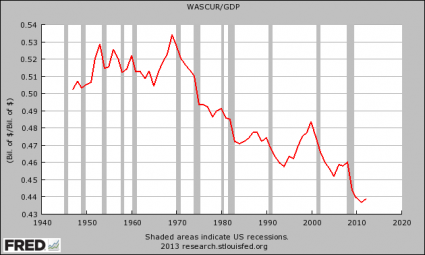
9. Some cracking charts showing the decline of the American middle class as the powerhouse behind America's consumer economy - Here's Michael Snyder with the compilation and a sample showing the wages share of US GDP since 1945.
In the old days, when the big corporations that dominate our society did well, that also meant good things for American workers since those corporations would need more of us to work for them. But in the emerging one world economic system that our economy is being merged into, those corporations have other choices now. For instance, the big corporations can now choose to limit the number of "expensive" American workers that they employ by shipping millions of jobs to the other side of the world.
And from their perspective, it makes perfect sense. They can make much bigger profits by hiring people on the other side of the planet to work for them for less than a dollar an hour. If they can get good production out of those people, then why should they hire Americans for ten to twenty times as much, plus have to give those Americans health insurance and other benefits? Another major factor in the slow, agonizing death of the American worker is technology. We live during a period when technology is advancing at a pace that is almost unimaginable at the same time that it is steadily becoming cheaper and cheaper.
That means that it is going to become easier and easier for companies to replace workers with robots and computers. As I have written about previously, it is being projected that our economy will lose millions of jobs to technology in the coming years. Yes, some of us will still be needed to help build the robots and the computers, but not all of us will. And of course the overall general weakness of the economy is not helping matters either. The American people inherited the greatest economic machine in the history of the world, and we have wrecked it.
10. Totally Clarke and Dawe with a big week in publishing.
We welcome your comments below. If you are not already registered, please register to comment
Remember we welcome robust, respectful and insightful debate. We don't welcome abusive or defamatory comments and will de-register those repeatedly making such comments. Our current comment policy is here.