

Here's my Top 10 links from around the Internet at 10 am today in association with NZ Mint.
As always, we welcome your additions in the comments below or via email to bernard.hickey@interest.co.nz.
See all previous Top 10s here.
My must read is #8 on how stock and property markets are rallying on the back of printed money, rather than real economic growth.

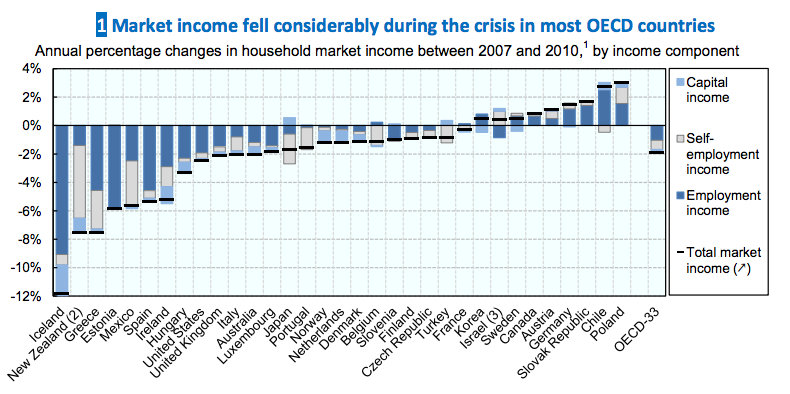
1. Really? - The OECD has just published a report on the Global Financial Crisis, poverty and inequality that says New Zealand household market income (which includes wages, salaries, self employed income but not government transfers such as Working For Families) was the second worst performing in the OECD between 2007 and 2010 behind Iceland.
The drop in New Zealand household market incomes was the same as for Greece.
The chart below shows the biggest drop was for self-employed income.
This number is harder to track and doesn't necessarily show up so easily in unemployment or income statistics.
Certainly those working for themselves in that precarious world between full on unemployment and a full job have had a tough time.
But the OECD's measures surprised me. It does however point out that transfer payments, such as the unemployment benefit, pensions and the likes of Working for Families helped soften the blow a lot.
Here's the OECD report and the chart below:
------------------------------------------------------------------------------------------------------------------------------------------
Keep it safe. Keep it in a New Zealand Mint safety deposit box. Details here »
------------------------------------------------------------------------------------------------------------------------------------------
I'm glad I don't live there any more or have any money stuck there in either a bank account or a house. HT Andyh in Friday's Top 10.
Mr Osborne may think he can create recovery by driving up house prices, thus making Brits feel richer and encouraging them to save less, borrow more and spend.
The Bank of England may think it can create recovery by trying to force up asset prices, including equities. But until wages rise, growth will have a bubble feel about it.
Wages can only really rise in a sustainable way once productivity improves, but that improvement remains elusive.

------------------------------------------------------------------------------------------------------------------------------------------
New Zealand Mint. Experts in gold & silver bullion, commemorative coins and jewellery. Details here »
------------------------------------------------------------------------------------------------------------------------------------------
3. The drums are beating - A rash of commentary over the weekend looked at what can or should be done about foreign demand and cash pushing up house prices in Auckland.
Tony Alexander's survey of estate agents suggests about 8% of buyers at the moment are from offshore with low proportion being non resident buyers.
The Greens are proposing a Hong Kong-style 15% tax on non-resident purchasers of residential property and Alexander is calling for an Australian-style application process with limits to 'off-the-plan' purchases.
Alexander told ONE News: "The number of Chinese migrating to New Zealand is rising, their desire to get assets outside of China is rising, we'll see more foreign purchasing and because I believe New Zealand house prices for domestic reasons are going to go higher I do think we need a foreign house purchase policy."
Alexander is calling on the Government to adopt Australia's foreign ownership model, which dictates that anyone without permanent residency must apply to buy property and can only purchase 'off the plan' new builds or build their own houses.
This way they contribute to housing stock and do not put pressure on existing stock, Alexander said. They must also sell property if they move overseas again.
------------------------------------------------------------------------------------------------------------------------------------------
Available now. Our brand new 1 oz Taku gold bullion coin. Details here »
------------------------------------------------------------------------------------------------------------------------------------------
4. Our national shame - The Pike River tragedy and an ongoing series of four-wheeler and forestry accidents is forcing people to confront New Zealand's disastrous workplace safety situation.
Dave Armstrong has written a very strong editorial here at The Press:
Though our workplace safety record is three times as bad as Britain's and twice as bad as Australia's, it hardly rates a mention.
Kiwis were justifiably outraged last week when they heard a story about a "gold elite" passenger on an Air New Zealand flight refusing to give up her prime seat to a wheelchair-bound passenger. I was almost as outraged as I had been a few weeks previously when I heard about a certain lowly ranked list MP allegedly threatening to get his boss, the prime minister, to fire a waiter if a drink wasn't immediately served.
So why, when a far more serious incident occurred - a building contractor tragically killed in a workplace accident in Napier - was there so little media coverage or public outrage?
5. China's aluminium surplus - This is something for Tiwai Pt watchers to watch. The explosion of aluminium smelting capacity in China over the last decade looks to have been the death knell for Rio Tinto in its thinking about keeping smelters such as Tiwai Pt.
Here's Bloomberg on the size of the Chinese aluminium surplus.
Chinese aluminum capacity and production have more than doubled since 2005, according to Morgan Stanley. The aluminum market had an estimated glut of 900,000 tons last year, the sixth consecutive year of surplus and will be oversupplied until at least 2018, according to the bank.
About one-third of Chinese producers are losing money at current Shanghai prices, according to London-based CRU. Production equaling 4.6 million tons in the world excluding China is currently operating at a loss, according to Georgiou. Prices have failed to spur aluminum producers to permanently curtail supply, Morgan Stanley said in a report last month.Production cuts announced by aluminum producers are “still not enough,” Oleg Mukhamedshin, deputy chief executive officer of Moscow-based United Co. Rusal, the world’s largest aluminum producer, said at a CRU conference in London on May 15.
“Why is this production still operational?” Georgiou said at the conference. “Some of them have a strong importance to their domestic economies and it’s the reluctance of governments to allow these smelters to close.”
6. Chinese local government debt problems? - The massive spike in lending to Chinese local governments in recent years worries some. Now SCMP reports one Chinese city, Dongguan, has starting restricting public services because it can't repay its debts.
In a telling sign of the mainland's mounting local government debt crisis, some towns in Dongguan - one of the richest cities - are being forced to suspend free public services and infrastructure projects.
In February, Shipai town terminated the free bus services that it introduced with much fanfare about two years ago. Then in March, the township government said it was reviewing a policy of providing free education to all residents aged below 25 because the government's coffers had dried up.
The town of Zhangmutou - dubbed little Hong Kong because of its popularity as an investment and holiday destination - has scrapped an ambitious plan to build a 100-million yuan (HK$126.4 million) recreational park, leaving a large chunk of empty land in the town centre. Many local township authorities in Dongguan are struggling to pay the salaries of their employees.
7. Here come the reforms - The reform plan from China's new leadership has been surfacing in a series of reports in the last couple of weeks. Here's more from Reuters on the scale of the 'sweeping' reforms.
Chinese President Xi Jinping has taken charge of drawing up ambitious reform plans to revitalize the economy, sources close to the government said, shunning policy stimulus for fear it could worsen local government debt and inflate property prices.
A consensus had been reached among top leaders that reforms would be the only way to put the world's second-largest economy on a more sustainable footing, said the sources, who are familiar with the plans and Xi's involvement.
8. The emperor is scantily clad - The FT reports with a shake of its head how US and other stock and property markets are surging ahead thanks to easy money rather than real economic growth.
This is an equity market that rallies most trading days and shrugs aside disappointing economic news with limited price corrections. A case in point was the modest pullback on Thursday after a series of weak data, led by monthly inflation easing the most in four years. That pullback was yet another blip as the market closed at a record high on Friday.
The performance of equities is truly eye opening, and it’s a rally being fuelled by the Federal Reserve’s easy money policy of quantitative easing, all the while downplaying the fundamental and technical basics that ultimately must underpin financial markets.
An uneven recovery in the economy and modest sales growth at the corporate level are being brushed aside for now by the power of central bank liquidity. The equity rally has also occurred without significant fund flows into the market that would confirm investors are back in a big way, let alone justify the big rise in prices since January.
The problem with stepping back from the QE pedal is that it would focus attention on a sub-par performance for the economy that is hardly growing at a pace to justify the current equity market rally. Ultimately, easy money is the driver of the equity rally, and for investors contemplating their next move it really all comes down to the Fed. In the current momentum driven market we are on the cusp of partying like its 1999, all the while flirting with the danger that when the music stops the consequences of having bought anywhere near the top are likely to be brutal and swift.
9. Where's the demand growth? - The FT reports on a 'three speed' global economy and a lack of demand growth from consumers and businesses.
Falling commodity prices and a rising dollar show the broad picture: the global outlook is weakening a little and becoming more dependent on the US. For every country putting out good news, such as Japan, there are weaker data elsewhere – for example in China. It is a global economy that lacks a strong source of demand growth. While that is so, it will remain sensitive to policy moves – especially to the US Federal Reserve and when it decides to slow the pace of its third, $85bn-a-month round of quantitative easing.
10. Totally Jon Stewart and Larry Wilmore on Barack Obama.
We welcome your comments below. If you are not already registered, please register to comment
Remember we welcome robust, respectful and insightful debate. We don't welcome abusive or defamatory comments and will de-register those repeatedly making such comments. Our current comment policy is here.