

Here's my Top 10 links from around the Internet at 1 pm today in association with NZ Mint.
As always, we welcome your additions in the comments below or via email to bernard.hickey@interest.co.nz.
See all previous Top 10s here.
Today is the last Top 10 sponsored by NZ Mint. I'd just like to personally thank NZ Mint for three years of sponsorship. We'd welcome a new sponsor. Email david.chaston@interest.co.nz for details. My must read today is from Joe Stiglitz at #7.

1. The madness of low junk bond yields - It's a good time to be Graeme Hart.
New Zealand's richest man is also one of the world's junk bond kings and right now he can borrow extremely cheaply, as can many of the world's corporates who borrow with junk bonds.
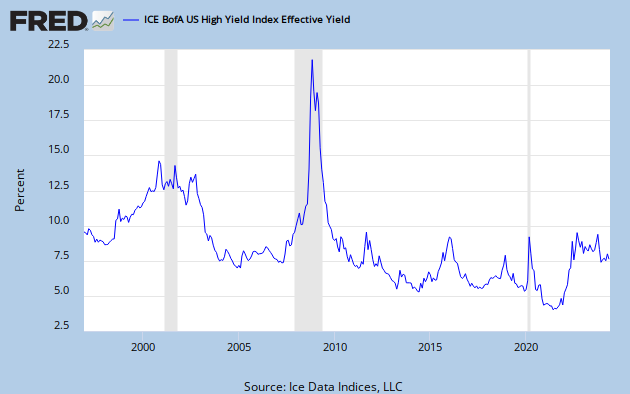
This chart below shows what has happened to 'high yield' corporate debt yields over the years, suffice to say they're now not very high.
The rush out to higher yielding assets as central banks have flooded the money with cheap money and cut interest rates is astonishing.
The build up of so-called 'covenant lite' lending to corporates is a symptom of that global hunt for yield.
This can't go on forever and when those yields rise there is going to be carnage. Just look at this chart courtesy of alephblog to get a sense of how low these rates are and what happens when they rise in a hurry.
The point of this piece is to tell you not to look at the level of risky interest rates, but to look at the rate of change in risky interest rates. It tells a lot regarding future prospects of the stock and bond markets. The rate of change matters a great deal, not the absolute level of rates.
So, the implication is watch for a sustained rise in in high-yield bond yields. When those yields cross their 10-month moving average, it is time to be gone from risk assets.
------------------------------------------------------------------------------------------------------------------------------------------
Keep it safe. Keep it in a New Zealand Mint safety deposit box. Details here »
------------------------------------------------------------------------------------------------------------------------------------------
2. As good as it gets - Ambrose Evans Pritchard reports from The Telegraph that global growth has turned the corner and is heading down again.
------------------------------------------------------------------------------------------------------------------------------------------
New Zealand Mint. Experts in gold & silver bullion, commemorative coins and jewellery. Details here »
------------------------------------------------------------------------------------------------------------------------------------------
3. Japanese housewives - Strangely perhaps, the Japanese housewives who have been big buyers of Australian Uridashi bonds have pulled back in recent months and have repatriated funds to invest in local stocks.
This is somewhat counter-intuitive, given the mas money printing in Japan should be forcing local investors outwards to sell the yen and buy other currencies to get better returns. Hasn't happened that way.
Here's Bloomberg on the latest Uridashi moves.

------------------------------------------------------------------------------------------------------------------------------------------
Available now. Our brand new 1 oz Taku gold bullion coin. Details here »
------------------------------------------------------------------------------------------------------------------------------------------
4. Austerity U-turn - The Europeans are saying they're going to loosen their government spending belts to try to pull Europe out of a nosedive.
The FT reckons though it may not be enough to turn it around.
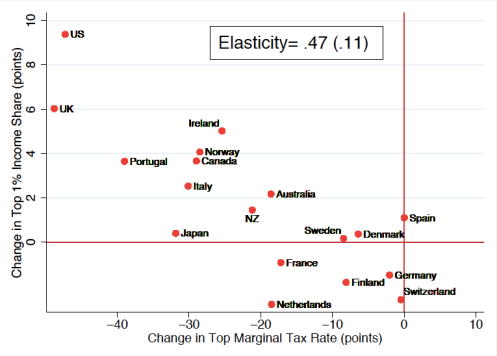
5. Do falling tax rates increase inequality? - This research via Miles Corak suggests they do. NZ gets a mention, although the data ends before the latest 'tax switch' took effect. The chart below is fun.
Countries experiencing the largest falls in top tax rates have also experienced the largest increases in top income shares.
Facundo Alvaredo, Anthony Atkinson, Thomas Piketty, and Emmanuel Saezoffer this intriguing picture in a recently released working paper called The top 1 percent in international and historical perspective.
6. Watch for a Chinese bond default - So says a Chinese credit rating agency via Caijin. This would be a shock, given one has never happened before...
The China Securities Regulatory Commission (CSRC) has also warned investors about the default risk. Last year, shortly after small and medium-sized enterprises were allowed to issue high-yield private placement bonds, or junk bonds, Huo Da, a CSRC official, told brokerage firms underwriting the bonds to pass on a message to investors.
"Local governments and exchanges will not provide any form of risk relief," he said. "So don't have any delusion about a government or exchange bailout. Default by bond issuers is a regular occurrence in the global market."
Nevertheless, in January, the Shanghai government stepped in to help a troubled solar firm by instructing its debtor banks to defer collecting their loans so the company could have breathing room to prepare for a bond interest payment scheduled for March.
But the expectation was growing that a default was bound to occur this year, and the implications would be significant, Mao said.
7. A global deal on taxes? - Joseph Stiglitz reckons in this Guardian Op-Ed that a deal to make multi-nationals pay more taxes is needed between countries. I agree.
Big corporates are gaming one nation's taxpayers against another's: we need a global deal to make them pay their way
It is time the international community faced the reality: we have an unmanageable, unfair, distortionary global tax regime. It is a tax system that is pivotal in creating the increasing inequality that marks most advanced countries today – with America standing out in the forefront and the UK not far behind. It is the starving of the public sector which has been pivotal in America no longer being the land of opportunity – with a child's life prospects more dependent on the income and education of its parents than in other advanced countries.
Globalisation has made us increasingly interdependent. These international corporations are the big beneficiaries of globalisation – it is not, for instance, the average American worker and those in many other countries, who, partly under the pressure from globalisation, has seen his income fully adjusted for inflation, including the lowering of prices that globalisation has brought about, fall year after year, to the point where a fulltime male worker in the US has an income lower than four decades ago. Our multinationals have learned how to exploit globalisation in every sense of the term – including exploiting the tax loopholes that allow them to evade their global social responsibilities.

Is it bubble time? Maybe.
There's a lot of "flipping" going on.
The concern is if these rates of increase continue. If a market is properly priced today, but follows the same path as the bottom tier of the Phoenix market and rises 50 percent over the next year, then it will be seriously over-valued in another year. Even worse, if one of these markets were to sustain the 70 percent rate of increase recently seen in the bottom tier of the Las Vegas market over the next year, then we could be looking at a market that is 70 percent over-valued.
Investors are driving prices in the markets seeing the rapid run-ups. In many cases, hedge funds and private equity investors are buying up large blocks of houses. Some may plan to rent them out for a period of time, but most undoubtedly expect to flip them for substantial profits in the near future. Similarly, many smaller investors are buying up homes, doing minor repairs, and then looking to resell them for a substantial profit a few months later, just as they did in the bubble days.
9. China's amazing credit-fueled growth - Bloomberg reports on Fitch's worry about China's extremely rapid growth in credit.
Chinese banks are adding assets at the rate of an entire U.S. banking system in five years. To Charlene Chu of Fitch Ratings, that signals a crisis is brewing.
Total lending from banks and other financial institutions in China was 198 percent of gross domestic product last year, compared with 125 percent four years earlier, according to calculations by Chu, the company’s Beijing-based head of China financial institutions. Fitch cut the nation’s long-term local-currency debt rating last month, in the first downgrade by one of the top three rating companies in 14 years.
“There is just no way to grow out of a debt problem when credit is already twice as large as GDP and growing nearly twice as fast,” Chu, 41, said in an interview.
(Updated with number 6! and cartoons)
We welcome your comments below. If you are not already registered, please register to comment
Remember we welcome robust, respectful and insightful debate. We don't welcome abusive or defamatory comments and will de-register those repeatedly making such comments. Our current comment policy is here.