

Here's my Top 10 links from around the Internet at 11.30 am today.
As always, we welcome your additions in the comments below or via email to bernard.hickey@interest.co.nz.
See all previous Top 10s here.
My must read today is #5 on what China's biggest policy wonk really thinks.

1, What the Chinese are thinking - It's worth watching this escalating trade dispute between China and Europe to get a sense of how the new Chinese leadership are thinking and what they're doing with China's new bigger strategic muscles.
They're flexing them.
We can only hope this exchange doesn't turn into a modern version of the Smoot Hawley Act that worsened the Great Depression of the 1930s.
China's new leaders seem surprisingly isolationist and defensive on this stuff.
Read the tone of the comments below from the People's Daily and you can see why they were remarkably slow to react on our own little sheep and beef export documentation issue.
We are operating in an imperial environment where decisions are made on whims and emotions. I've bolded the key quote.
Here's Reuters with the quotes:
The People's Daily, the ruling Communist Party's official mouthpiece, said in a commentary that Beijing could take yet more measures against the EU.
"We have set the table for talks, (yet) there are still plenty of cards we can play," the newspaper wrote. "China does not want a trade war, but trade protectionism cannot but bring about a counter-attack."
A declining Europe needs to understand it can no longer laud it over other countries, the paper added. "Times change and power rises and falls. Still this has not changed the deep-rooted, haughty attitudes of certain Europeans," it wrote.
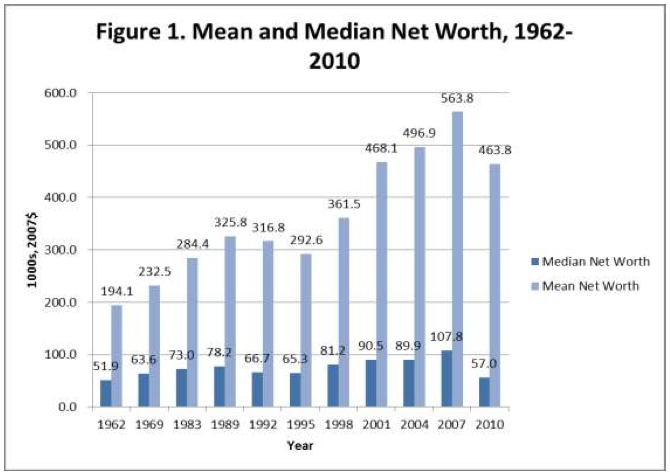
2. The differences between means and medians - They can be a good measure of widening inequality. These charts cited by FTAlphaville on American incomes certainly show that in the context of how the monetary policy activism of the Fed, the BoE and the BoJ has benefited the wealthiest most.
Last week, Pew reported that the rebound in net worth has been unevenly distributed in the economic recovery: the wealth of the richest 7 per cent of households climbed by 28 per cent on average, while the rest of the population lost 4 per cent of its wealth.
And the annual report from the St Louis Fed found that 62 per cent of the wealth recovery through the end of last year has been the result of rising stock markets — and stock ownership is concentrated among richer households.
China is now dependent as never before on the rest of the world to keep it going. Until the mid-1990s, it was more or less self-sufficient. Now it relies on other countries for oil, copper, iron ore, soya and many other commodities, without which it could not sustain its breakneck development nor satisfy its people’s rising aspirations.
Geoff Raby, former Australian ambassador to China, put it this way in a lecture at Melbourne’s Monash University last year. “China is now, for the first time in its history, utterly dependent on foreign markets and foreigners for all things to keep its economy growing,” he said. Remember the Qianlong emperor who scoffed at the wares brought by a British emissary of King George III in 1793, declaring that China had no need of foreign trifles.
Almost without realising it, China has been transformed from the mercantilist power Deng Xiaoping envisioned when he launched his Opening and Reform measures in the late 1970s to a country today wedded to the concept of Ricardian comparative advantage, or a global division of labour. That makes it, in Raby’s phrase, “a highly constrained power”. When it was growing fastest, the US, by contrast, had everything it needed to grow bar people, which it brought from Europe voluntarily and Africa involuntarily.
4. Slowing Chinese lending - This might explain China's slowing economic growth and the shift lower in Australia's economic outlook.
Here's Caijin with the report:
Chinese banks continued to slow down their pace in extending new loans in May, in line with 8-month low PMI figures which suggested a marginal weakening of manufacturing activities.
China’s “big four”, the four largest state-owned banks in the country extended CNY208billion yuan in May, compared with CNY245.5billion in the previous month and CNY 250billion in the same period last year, the 21st Century Business Herald quoted an authoritative source as saying in report.
Monthly drops in new lending from the four banks underscore weakening credit demands in an economy with slowing momentum, said the paper.
5. The wonk with the ear of the Chinese President - Here's the WSJ with a nice piece on the guy behind the guy running New Zealand's most important strategic partner.
Even in China, few people would recognize Wang Huning, head of the Communist Party's secretive Central Policy Research Office. And small wonder: The former university professor almost never talks in public, barely speaks to old acquaintances and makes a point of not associating with foreigners.
Yet party insiders and experts on Chinese politics consider him one of the most influential figures in China today, a key architect of its domestic and foreign policy over the past decade, and now of Mr. Xi's signature "China Dream" campaign that evokes a militarily and economically strong nation reclaiming its place of prominence in the world.
"Wang Huning's now got more power and will have stronger influence on foreign policy," said Huang Jing, who also attended Fudan University at the same time and is now a professor and expert on Chinese politics at the National University of Singapore. "That's good news for China, but not very good news for other countries."
Another Chinese scholar who has known Mr. Wang since the 1980s said it would be a "disaster" if Mr. Wang is given greater say in foreign policy because he is a leading advocate of the more assertive diplomacy that has alienated many of China's neighbors.
A recent Australian High Court case reveals the challenge facing national governments in trying to fix the international tax system to capture profits earned by multinationals around the world.
In this test case involving complex and technical Australian company tax rules, the High Court was asked to consider how rules these applied to the Commonwealth Bank of Australia’s controversial $2 billion capital raising in 2009.
The outcome was that CBA was legally able to reduce the cost of its capital raising – while both the Australian and New Zealand governments lost out on tax revenue.
8. America's great unwinding - This piece from the NYT about George Packer's latest bookis fun.
If you were born after 1960, Mr. Packer suggests, you have spent much of your life watching structures long in place collapsing — things like farms, factories, subdivisions and public schools on the one hand, and “ways and means in Washington caucus rooms, taboos on New York trading desks” and “manners and morals everywhere” on the other.
What has replaced them, he says, is organized money, as well as a society in which “winners win bigger than ever, floating away like bloated dirigibles, and losers have a long way to fall before they hit bottom, and sometimes they never do.”
If a solitary fact can stand in for Mr. Packer’s arguments in “The Unwinding,” it is probably this one, about the heirs to Walton’s Walmart fortune: “Eventually six of the surviving Waltons,” the author writes, “would have as much money as the bottom 30 percent of Americans.”
9. The macroeconomics of European disunion - Paul Krugman does his thing here.

(Updated with videos/cartoons/quotes)
We welcome your comments below. If you are not already registered, please register to comment
Remember we welcome robust, respectful and insightful debate. We don't welcome abusive or defamatory comments and will de-register those repeatedly making such comments. Our current comment policy is here.