

Here's my Top 10 links from around the Internet at 2 pm today.
As always, we welcome your additions in the comments below or via email to bernard.hickey@interest.co.nz.
See all previous Top 10s here.
My must read today is #9 on the Hukou for those who want to understand China better.

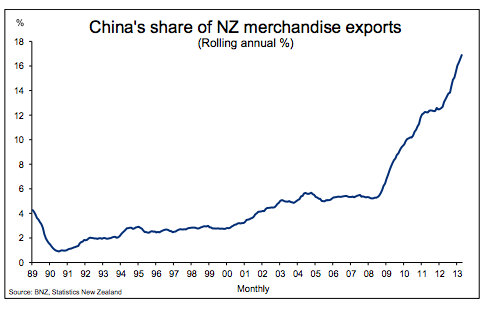
1. Concentration risk - David Hargreaves has already pointed to it, but Stephen Toplis' research note on the risk that New Zealand is too exposed to dairy exports to China is well worth a read.
This week's botulism scare was a useful wake up call.
Our government's economic strategy is based on increasing milk powder exports to China and encouraging Chinese tourists to come to New Zealand.
That's fair enough and worth pursuing, but the risk is China becomes our only source of growth.
The BNZ Chief Economist also makes some good points about regional development.
Keep an eye on this topic. The drums are beating down South about the loss of jobs to the North.
Here's Toplis:
This concentration risk largely revolves around our export mix and the destinations to which we export. However, the argument for excess concentration might also be applied to regional development. While there is a strong body of literature saying that larger cities are more efficient it must also be true that economic dependence on a single city must also bring with it increased vulnerability. The vulnerability of places like Wellington and Christchurch are readily apparent but Auckland is not immune to regional disaster. Excess concentration on a single market or product typically leads to increased export revenue volatility which in turn is strongly linked to growth volatility.
So not only is the economy more vulnerable but also, typically, it records lower growth than a more diverse economy.We are not anti-Chinese and we are not anti-dairy but the last thing New Zealand wants to become is nothing more than a milk powder exporter to China. Economic diversification is as important as investment diversification from a risk profile perspective. The answer is not to kill off existing trading relationships or reduce dairy production but to look to other sectors to play a bigger part.
2. Here's what Shanghai looked like in 1987, courtesy of The Atlantic.

And here's what it looks like now.

3. The real cost of smoking - The NYTimes reports here on an academic study showing the average extra cost of a US smoker for an employer is US$5,816 a year.
Researchers at The Ohio State University estimated that the largest cost, at $3,077 annually, came from taking smoking breaks. Smokers took, on average, about five breaks a day, compared with the three breaks typically sanctioned for most workers. The second largest cost, at $2,056, was related to excess health care expenses. Smokers typically have more health problems than nonsmokers, including heart and lung disease and various cancers.
The remaining costs came from increased absenteeism — the researchers found that smokers miss about two-and-a-half extra workdays each year — and lost productivity at work, perhaps because of nicotine’s withdrawal effects. The findings appeared online in June in the journal Tobacco Control.
4. The problem with hoarding - Here's HuffPo with a piece on how the richest 1% in America are saving 37% of their income, rather than spending it.
America's top 1 percent saved their money at a rate of 37 percent last quarter, according to a recent survey from American Express Publishing and the Harrison Group highlighted by CNBC. That means that during that period, wealthy Americans put away about 37 cents for every dollar they earned, which is more than triple their savings rate in 2007. In addition, a Bank of America study cited in the CNBC report found that more than half of millionaires have a "substantial" amount of cash on hand and of that group, about 60 percent said they didn't plan to invest it in the next two years.
As the recovery struggles to gain solid ground, the findings indicate that even while America's wealthiest households are taking home a larger share than ever of the income pie, they're doing little to put that money to productive use in the economy, experts say. One possible solution: raising taxes on the rich.
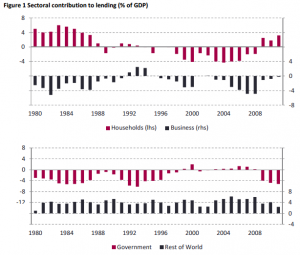
5. Have Australia's really stopped borrowing - Macrobusiness reports on Professor Rodney Maddock's study of Australian funding needs, and in particular the idea that households there are back to their pre-boom habits of being net savers, having spent about a decade gearing up. The implication is that Australia can't rely on another housing boom to restart its growth and take over from the mining boom.
The high level of household debt in Australia means that households are more sensitive to expected changes in income. And with most of their debt sitting on bank balance sheets, this makes the banking sector more vulnerable to a significant rise in household debt, particularly if it coincides with a major correction to house prices. This scenario is one that is very widely recognized. Indeed, it is the basis for many of the stress tests run by the banks and APRA (Davis 2011). These stress tests typically also assume that there will be a substantial slowing of household credit growth, if not an outright decline.
Summary: We believe that the most likely course is that household demand for debt will broadly grow in line with income growth. The recent volatility in global economies and declining asset price growth is likely to have had a long-lasting and moderating impact upon household demand for credit.
6. The grim reaper - Danwei brings together the various front pages from Wednesday in China. It's not pretty.
The vast majority of Chinese daily newspapers yesterday featured the massive New Zealand milk powder product recall as a front page story, most as either the leading headline or as a large and prominent graphic feature. The imagery is very much that of a scare campaign, with dozens of papers using evocative images of microscopic bacteria.
The cover of the Xiamen-based West Strait Morning Post even showed the grim reaper lurking behind the recalled products. The New Zealand flag was also prominent on some front pages.

Luckily no harm was done, it seems.
China’s domestic media largely ignored Spierings’ faux pas. Perhaps they were impressed by the sight of a Dutch head of a New Zealand dairy company racing to their capital to apologise for a quality control lapse that has not resulted in any sicknesses, let alone fatalities. Many Chinese company bosses have declined to apologise for far more grievous mistakes.
8. Deflation in Chna? - Here's George Magnus at FT.com warning that a China slowdown is more dangerous than a US 'taper' of money printing.
One way or another, the model is going to change. The role of physical capital formation will fade as the economy rebalances. Physical labour input has been more or less exploited, and the credit intensity of GDP growth has to be brought down. China’s top leaders understand this, but changing the model to one based on efficiency, innovation and a greater role for markets at the expense of the state, is easier said than politically done.
Even if they succeeded, making the change could only be done in the context of slower, sustainable growth, and policies designed to absorb or address overcapacity in heavy and commodity-intensive industries, and a rise in debt service problems, defaults, and non-performing loans.
This comprises an unequivocally deflationary risk for global markets, which is likely to challenge risk appetite again and push up the US dollar, especially against emerging market currencies, including even the renminbi.
In China, the GDP deflator (a measure of the level of prices of all new, domestically produced, goods and services in an economy) has already slumped to a reported annual rate of 0.5 per cent in the June quarter, from around 7 per cent just two years ago. The combination of overcapacity in several industries and weaker growth could generate further downward pressure on Chinese goods prices at home and abroad.
9. Reforming the Hukou - The system of people registriation in China known as the 'Hukou' is crucial to how the country operates and has to be understood when thinking about China. It means migrants from the countryside don't have the same rights to education or healthcare or property as those who were born in the cities. It's a festering sore, if I can use that phrase in relation to China...
Caixin reports that reform is imminent.
Come autumn, the government will consider a series of major reforms, one of which is household registration reform. The reform, which is closely linked to urbanization, involves people's land, welfare and a host of other issues, and progress has been slow.
In the face of China's declining growth potential, a shrinking demographic dividend and growing social tensions, changing the dual rural-urban social structure is the effective way to move human resources to areas and regions where production is more efficient. At the same time, it accelerates the country's switch to a new pattern of economic growth so as to prevent falling into the "middle-income trap."
Therefore, household registration reform is a major step the country must take.
Household registration, or hukou, is embedded in the social system. Established in 1958, the system was intended not only to be a community management tool, but also intertwines with many social welfare issues unique to cities.
10. Totally Clarke and Dawe - Tony Abbott makes his case, where it's safe to do so...
We welcome your comments below. If you are not already registered, please register to comment
Remember we welcome robust, respectful and insightful debate. We don't welcome abusive or defamatory comments and will de-register those repeatedly making such comments. Our current comment policy is here.