

Here's my Top 10 links from around the Internet at 10 am today.
As always, we welcome your additions in the comments below or via email to bernard.hickey@interest.co.nz.
See all previous Top 10s here.
My must read today is #6 on the changing economics and science of solar power and how the US military is leading the way, just as it did with semi-conductors in the 1960s.

1. They're coming home - Australia's economic slowdown affects us in all sorts of ways. Firstly there's the weakness in demand for our manufactured exports.
Then there's the weakness in the Australian dollar relative to the New Zealand dollar.
But mostly there's a major turnaround in migration figures as fewer New Zealanders go to Australia to find jobs, given they are drying up.
Also, there's lots of people who are coming home because their own job has dried up.
Treasury has a useful discussion in its most recent monthly economic indicators about the turnaround.
Here's the chat and the chart below showing how most of the returnees are in the 20-29 brackets:
By the way, this is not a hint for Quade Cooper to come home, even though we seem to be down to our fourth choice first five. Next on the list after Colin Slade is Stephen Donald. That's how much we want you to stay in Australia Quade...
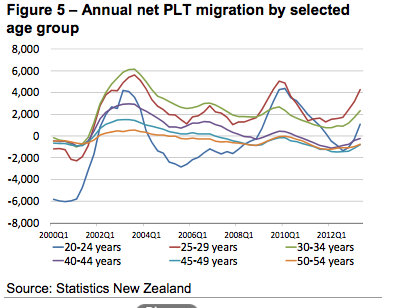
While net flows for several age groups have turned more positive very quickly, 20-24 year olds have seen the sharpest change. This has come through both a fall in departures and an increase in arrivals. In keeping with overall trends, a significant proportion of the increase is arrivals from Australia, with a high proportion of these arrivals NZ citizens (ie, returning Kiwis).
A similar pattern is evident for the 25-29 and 30-34 age groups, although their net flows have been positive for a while. The recent acceleration has also been caused by both a fall in departures and an increase in arrivals, including from Australia.
2. What a Chinese hard landing would mean - Treasury has also looked at what a slump in China's economic growth rate to 3% would mean for New Zealand. We'd fare better than the Australians, but there would still be an impact.
This would be similar to the downside scenario in Budget 2012 in which lower growth in emerging Asia, especially China, led to real GDP growth in New Zealand being 2.1 percentage points lower over the forecast period, the terms of trade falling 9% in the first year, the current account deficit increasing by nearly 1.5% of GDP after two years and nominal GDP being around $25 billion lower over the 5- year forecast period as a whole (approximately 2.5%), with a commensurate impact on tax revenue.
We do not expect such a scenario to occur, but if it did it would have a significant negative impact on the economy and the government’s finances. Automatic macroeconomic stabilisers, coupled with room for further monetary and fiscal stimulus, could provide some offset to this.
3. Bigger than we think - SCMP reports the bad debts in China's banking system may be at least twice that given in official figures.
"We did see sharp growth in overdue loans in recent months," said a senior manager with the Bank of Shanghai. "It's a very bad sign and it's obvious that all banks are facing the problem."
The banker added that he had never before seen such a large increase in overdue loans.
Loans made to steel traders and solar-panel makers were likely to turn sour now that a large number of such businesses were near collapse, bankers said.
"The risk of a bad-debt crisis is in the making," said Jonathan Cornish of Fitch Ratings. "China's GDP growth is lower and asset quality is deteriorating, which means higher risks on NPLs."
4. Bike lanes could boost retail sales - I'm a mad cyclist so forgive my enthusiasm for this ThinkProgress blog on research out of America showing that removing parking spaces in retail districts to replace them with bike lanes actually increased retail sales in one example. It didn't hurt them in other examples.

5. Counterfeit lion - We all know about the amazing copies many Chinese bag, watch, CD and DVD manufacturers make of Western products.
Here's a great Buzzfeed story about a Chinese zoo that tried to convince visitors this animal below was a lion.
The “lion” was really a Tibetan mastiff. Visitors reportedly called the zoo’s bluff when they heard the animal bark.

"The US Defence Department is racing ahead. This could be like the semiconductor industry in 1980s where the military changed the game," said Jeremy Leggett, chairman of Solarcentury.
Nor is the Pentagon alone. Grant lists from the "SunShot Initiative" of the US Energy Department show that America's top research institutes are grappling with each of the key issues that have bedevilled solar energy for so long.
Los Alamos - home of the Manhattan Project - is working on smart grids and better ways to capture excess electricity produced in peak sunlight hours. The Argonne labs are working on thermal energy storage to overcome "intermittency", the curse of solar and wind.

7. Gross Metropolitan Product - Here's an AtlanticCities piece looking at the economic benefits of 'agglomeration', whereby more public transport boosts the economic growth of a city and the wages of its workers. HT Auckland Transport Blog.
With so many variables in play — from job density to population growth to transit development — studying agglomeration has been extremely difficult. So Chatman and Noland ran a number of statistical models that took into account all these factors, as well as economic productivity measures like average wage, for more than 300 metropolitan areas across the United States. ("It really is a new kind of thing we did here," says Chatman.) The numbers were so complex that many of the models failed to pass statistical muster.
Those that did revealed a pretty clear line from transit expansion to economic growth via agglomeration.
Every time a metro area added about 4 seats to rails and buses per 1,000 residents, the central city ended up with 320 more employees per square mile — an increase of 19 percent. Adding 85 rail miles delivered a 7 percent increase. A 10 percent expansion in transit service (by adding either rail and bus seats or rail miles) produced a wage increase between $53 and $194 per worker per year in the city center. The gross metropolitan product rose between 1 and 2 percent, too.
8. Inflation is dead - But the king is long lived. Paul Krugman points out, rightly, that inflation is dead and all the doomsayers and warners about Zimbabwean-style hyperinflation are just plain wrong.
He cites these US inflation expectations figures.
I know that there are economists for whom it’s always 1978, who are constantly fearing — or, I suspect, in their innermost selves, hoping — for a return of the good old days when inflation was a constant threat. But in the world we’ve been living in this past quarter-century or more, inflation expectations haven’t moved much, and nominal interest rates have, in practice, been a pretty good guide to the stance of monetary policy.

9. Full speed backwards - Rod Oram seemed to strike a nerve in this wide-ranging Sunday Star Times critique of the Government's policy moves of the last month or so.
Our driverless Government is taking us for a ride. Guided by damage control, it is running amok over good governance, democracy and even its own policies and principles.
In the past 10 days alone, it has let rip with expedient decisions harmful to seven of its top priorities: housing, KiwiSaver, state-owned enterprise sales, revitalising the stock market, broadband, the Resource Management Act and trade with China.
Prime Minister John Key prides himself on pragmatism. But his quick fixes, shortcuts and deals are piling up in a mass of contradictory and counter-productive actions.
10. Totally John Oliver on the end of his reign as John Stewart's replacement. It's not pretty.

We welcome your comments below. If you are not already registered, please register to comment
Remember we welcome robust, respectful and insightful debate. We don't welcome abusive or defamatory comments and will de-register those repeatedly making such comments. Our current comment policy is here.