

Here's my Top 10 links from around the Internet at 1 pm today.
As always, we welcome your additions in the comments below or via email to bernard.hickey@interest.co.nz.
See all previous Top 10s here.
My must read today is #3 from the WSJ about how Xi Jingping is starting to look more and more like an old Maoist.

1. The problem with the Consumer Price Index - Yesterday's comment stream included lots of indignant denials about the death of inflation.
Many people said it was was far from dead for small businesses or households that used lots of petrol and power.
Rob Stock looks at this problem of different types of Consumers and whether the CPI is actually accurate for the likes of pensioners and beneficiaries.
It turns out Statistics NZ is looking hard at this problem.
I wonder though. My weekend column on changing spending patterns talks about how consumers adjust their behaviour to relative price changes. We're now driving less and buying more iPads because of these changes. In theory, we still have to eat and turn on the lights and the heater. We shouldn't be surprised though if we insulate more, eat different (and worse) and change the light bulbs.
Here's Stock at the Sunday Star Times:
The real experience of inflation for Maori, superannuitants, the poor and some regions is that the national CPI does not reflect their experiences because the it is skewed to reflect the experience of white, middle-income New Zealand.
That has been spelled out by a CPI Review Committee, headed by former retirement commissioner Diana Crossan, which said: "Lower-income households had the highest price change and higher-income households had the lowest price change."
Work is now under way at Statistics New Zealand to correct that by creating inflation indexes that will more accurately track cost of living increases for "sub- national" groups such as Maori, Pacific people, beneficiaries and superannuitants after recommendations to do just that fell by the wayside in 1996 and 2004.
Analysis by Statistics NZ shows the average annual inflation rate for the superannuitants sub- group, for instance, was 2.6 per cent between June 2008 and September 2012, compared with 2.35 per cent overall.
The difference was even more marked using a payment-based system, as opposed to the current "acquisitions" methodology, at 2.43 per cent compared with 1.65 per cent overall.
2. Where's the graphene? - Rebecca Clancy at the Telegraph writes about global race to find a cheap way to produce graphene, an amazing new material that is light, strong, flexible and conductive.
In theory, it could be printed with 3D printers. I haven't given up yet on the potential for new technology such as graphene, solar power and rechargeable batteries to help give global economic growth a new kick higher, despite the massive challenges of peak oil, climate change, ageing populations and falling wages shares globally.
It is lighter than a feather, stronger than steel, yet incredibly flexible and more conductive than copper. It has been hailed as “the miracle material”, its possible uses apparently almost endless.
The material is graphene, a single layer of carbon atoms forming a regular hexagonal pattern, extracted from graphite, with astonishing properties and impressive potential.
Unbreakable, foldable touch screens for mobile phones; a revolution in how drugs are administered; protective coating for everything from food packaging to wind turbines, faster computer chips and broadband; batteries of infinitely higher capacity than today’s – these are just a few of graphene’s possibilities.

3. Xi Jingping and Mao Zedong - China's new leader Xi Jingping is consolidating his grip on power. The WSJ reckons he is adopting many of the same tones and tools of Maoism, including a puritan-like drive for 'purification'. He's not keen on democratic reforms and takes a particularly nationalist view of the world. We shouldn't be surprised to see foreign companies targeted by Chinese regulators and media then...
It isn't just Mr. Xi's rhetoric that has taken on a Maoist tinge in recent months. He has borrowed from Mao's tactical playbook, launching a "rectification" campaign to purify the Communist Party, while tightening limits on discussion of ideas such as democracy, rule of law and enforcement of the constitution.
Mr. Xi's apparent lurch to the left comes as Chinese authorities prepare for the coming trial of Bo Xilai, the former party rising star who led a Maoist revival movement until his dramatic downfall last year.
Mr. Xi's attitude toward political reform is a critical issue in China today because the country may be entering a prolonged period of slower economic growth and mounting public discontent over environmental problems, patchy public services and widespread corruption.
The new Chinese leadership has sent clear signals that it plans to unveil a package of economic reforms this year to stimulate domestic consumption as an alternative growth engine to the investment and exports that have powered the economy for the past 30 years.
On the political front, however, Mr. Xi has shown no sign of considering even limited liberalization, party insiders say. "Xi is really starting to show his true colors," said one childhood friend who recalls Mr. Xi spending hours reading books on Marxist and Maoist theory as a teenager. "I think this is just the beginning."
4. 20% time is dead - This is a bit off the beaten track, but I still find it interesting. Quartz reports on how Google's '20% time', where engineers are given 'free' time to experiment, seems to have been abandoned as Google strives to keep its stock market shareholders happy.
It does make you wonder if publicly listed shareholder capitalism can really be as innovative as family or privately owned companies. The lust for short term capital gains and cash dividends or share buybacks (often funded through investment droughts and debt) seems to mitigate against long-term 'out-of-the-box' risk taking and invention.
Here’s how Google has effectively shut down 20% time without actually ending the program, says our source: First, as has been reported previously, Google began to require that engineers get approval from management to take 20% time in order to work on independent projects, a marked departure from the company’s previous policy of making 20% time a right of all Googlers.
Recently, however, Google’s upper management has clamped down even further, by strongly discouraging managers from approving any 20% projects at all. Managers are judged on the productivity of their teams—Google has a highly developed internal analytics team that constantly measures all employees’ productivity—and the level of productivity that teams are expected to deliver assumes that employees are working on their primary responsibilities 100% of the time.
5. How the wealthy keep themselves on top - Here's Tim Harford at FT.com with a provocative piece on inequality and wealth.
Between 1993 and 2011, in the US, average incomes grew a modest 13.1 per cent in total. But the average income of the poorest 99 per cent – that is everyone up to families making about $370,000 a year – grew just 5.8 per cent. That gap is a measure of just how much the top 1 per cent are making. The stakes are high.
I set out two reasons why we might care about inequality: an unfair process or a harmful outcome. But what really should concern us is that the two reasons are not actually distinct after all. The harmful outcome and the unfair process feed each other. The more unequal a society becomes, the greater the incentive for the rich to pull up the ladder behind them.
At the very top of the scale, plutocrats can shape the conversation by buying up newspapers and television channels or funding political campaigns. The merely prosperous scramble desperately to get their children into the right neighbourhood, nursery, school, university and internship – we know how big the gap has grown between winners and also-rans.
The painful truth is that in the most unequal developed nations – the UK and the US – the intergenerational transmission of income is stronger. In more equal societies such as Denmark, the tendency of privilege to breed privilege is much lower.
This is what sticks in the throat about the rise in inequality: the knowledge that the more unequal our societies become, the more we all become prisoners of that inequality. The well-off feel that they must strain to prevent their children from slipping down the income ladder. The poor see the best schools, colleges, even art clubs and ballet classes, disappearing behind a wall of fees or unaffordable housing.
The idea of a free, market-based society is that everyone can reach his or her potential. Somewhere, we lost our way.

While countries like Spain and Ireland battle to reform the boom-era mortgage lending that has left millions of borrowers at risk of losing their homes, corners of the continent better known for their sturdy finances seem to be still lending as if the financial crisis never happened.
In the AAA-rated Netherlands, home to one of the earliest and biggest bailouts of the crisis - ABN Amro's 2008 rescue ultimately cost 30 billion euros - first-time buyers can still borrow up to 105 percent of the value of their new home and can get up to five and a half times their gross salary.
A deflating housing bubble means the Dutch government is now cutting back on some of the riskier mortgage products so the maximum amount lent will fall by 2018, but still only to 100 percent. And in AAA-rated Sweden, a mortgage will outlast the youngest buyer, and their grandchildren.
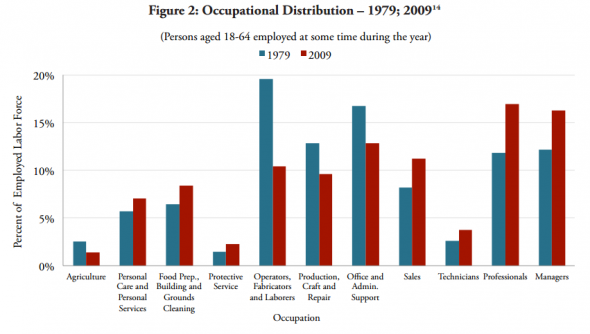
7. A hollowing out of the US middle class - Here's more via FTAlphaville on this trend, which is partly explained by the increasing use of robots and computers to replace highly paid middle class jobs, while much of the jobs growth that is happening is happening in minimum wage services sector jobs such as fast food and aged care.
8. Further to that - This book called Dancing With Robots looks useful.
In Dancing with Robots, Frank Levy and Richard Murnane make a compelling case that the hollowing out of middle class jobs in America has as much to do with the technology revolution and computerization of tasks as with global pressures like China. In so doing, they predict what the future of work will be in America and what it will take for the middle class to succeed. The collapse of the once substantial middle class job picture has begun a robust debate among those who argue that it has its roots in policy versus those who argue that it has its roots in structural changes in the economy. Levy and Murnane delve deeply into structural economic changes brought about by technology.
These two pioneers in the field (Murnane at Harvard’s Graduate School of Education and Levy at MIT) argue that “the human labor market will center on three kinds of work: solving unstructured problems, working with new information, and carrying out non-routine manual tasks.” The bulk of the rest of the work will be done by computers with some work reserved for low wage workers abroad. They argue that the future success of the middle class rests on the nation’s ability “to sharply increase the fraction of American children with the foundational skills needed to develop job-relevant knowledge and to learn efficiently over a lifetime.”

One couple believe they bought their house - at number 44 on an Auckland street - for a bargain price in a rising market. Alice and Adam Gordon bought the four-bedroom weatherboard house in Morningside for $790,000 - $40,000 above its valuation, set in July 2011.
Massey University marketing professor Henry Chung, who was born in Taiwan and whose ancestors are Chinese, said he would buy a home with a number four on the letterbox only "if I absolutely had to". Eight and six were lucky numbers.
"Four is death, and this is double death. If they changed it from 44 to 88, that would be big sales. Four definitely is a taboo.
"In quite a lot of elevators, and quite a lot of buildings in China, they don't have a fourth floor. They jump from three to five. With some very elegant, expensive apartments, rich people will particularly ask, 'Please do not have a number four, because we want a long life'."
10. Totally John Oliver signing off from his summer stint standing in for Jon Stewart.
We welcome your comments below. If you are not already registered, please register to comment
Remember we welcome robust, respectful and insightful debate. We don't welcome abusive or defamatory comments and will de-register those repeatedly making such comments. Our current comment policy is here.