

Here's my Top 10 links from around the Internet at midday today.
As always, we welcome your additions in the comments below or via email to bernard.hickey@interest.co.nz.
See all previous Top 10s here.
My must reads are #1-4 and #8. Seriously. Click through to the Eslake speech and read it from top to bottom. You will immediately want to vote for a politician that imposes a land tax, funds state housing, abolishes negative gearing and gets rid of first home buyer subsidies.

He describes how over the last decade there has been a collapse in home ownership rates among the young, a constipation of housing supply and the first increase in the number of people per house in a century.
He also argues persuasively for a land tax, which is far from as radical as many would suggest. He points out that 6% of Melbourne's houses are actually empty for whatever reason, which a land tax would help to improve.
I'd love to see Labour and Greens really challenge the electorate with a land tax, and not just the window dressing of a capital gains tax on second homes.
Eslake estimates that Australia is short of 228,000 dwellings. Many of his comments are directly applicable on this side of the Tasman.
Here's more from Eslake: (HT Leith van Onselen at Macrobusiness)
I think there are two principal reasons for the increasing failure of the stock of housing to grow at a rate commensurate with the growth rate (and changing needs) of the population:
First, the direct contribution of the public sector to growing the housing stock has declined substantially. From the mid-1950s to the mid-1970s, public sector agencies completed an average of 15,512 new dwellings per annum (and they indirectly financed the completion of another 3,600 dwellings annually through low-interest loan schemes). From the mid-1970s to the early 1990s, they completed an average of 12,379 new dwellings per annum. But since then, they have completed an average of less than 6,000 new dwellings per annum (indeed between 1999 and 2009 the public sector built fewer than 4,000 new dwellings per annum, on average).
Second, state and local government planning schemes and policies for charging for the provision of suburban infrastructure have made it increasingly difficult for the private sector to supply new housing, especially at the more affordable end of the spectrum.This second reason has three distinct dimensions. First, state and local authorities have imposed increasingly more onerous requirements on developers for the provision of infrastructure and services in new housing estates. While that undoubtedly represents ‘progress’ in many respects – and certainly adds to the amenity of ‘greenfields’ developments from the perspective of those who move into them – it comes at a cost.
Second, local authorities have changed the way in which this infrastructure and these services are provided, from a model based on paying for them largely through debt, which was then serviced and repaid out of subsequent increases in rate revenues, to one based on paying for them through ‘up front charges’ on developers.
While this is consistent with a ‘user pays’ philosophy, and appeases the growing voter aversion to public debt, it has meant (especially in New South Wales, where developer charges have risen to much higher levels than in other States) that developers find it increasingly difficult to produce house-and-land packages at prices which are affordable for first-time buyers and still make a profit, so they have reacted by building a smaller number of more expensive houses targeted at the trade-up market.
Third, metropolitan planning authorities and inner-city local governments have made it increasingly more time-consuming and onerous to undertake higher-density or ‘infill’ developments on ‘brownfields’ sites – in particular by imposing tighter planning controls, and by providing more opportunities for objections to and appeals against planning decisions.

2. First home buyers subsidies don't work - Apart from arguing for a land tax, Eslake also does an excellent job of pointing out that expansions of first home buyer subsidies, similar to those announced by John Key last month, don't work.
He details how governments have spent A$22.5 billion on such subsidies since the late 1960s, yet home ownership rates in the age groups from 24-44 have collapsed by around 10 percentage points over the last two decades.
Governments have thus been providing cash handouts to first-time home-buyers for almost half a century. Yet, as I mentioned earlier, the overall home ownership rate has never been higher than it was at the 1961 Census, immediately before governments started going down this path; and among the age groups which are supposedly most intended to benefit from these handouts, home ownership rates have declined almost vertiginously over the past two decades.
And it’s pretty obvious why. Cash grants and other forms of assistance to first-time home buyers have served simply to exacerbate the already substantial imbalance between the underlying demand for housing and the supply of it.
In those circumstances, cash handouts for first home buyers have simply added to upward pressure on housing prices, enriching vendors (and making those who already housing feel richer) whilst doing precisely nothing to assist young people (or anybody else) into home ownership. For that reason, I often think that these grants should be called ‘Existing Home Vendors’ Grants’ – because that’s where the money ends up – rather than First Home Owners’ Grants.

3. The problem with negative gearing - Eslake also spends a lot of time criticising the practice of negative gearing whereby rental property investors make losses and then use those losses to reduce their tax bill from other income, often from wages and salaries. It becomes particularly attractive when capital gains are not taxed.
Now where have I seen that before...
I hadn't realised Australia halved its capital gains tax on residential property in 1999. It also makes New Zealand a very attractive destination for Australian investors, given we have no capital gains tax on residential property. (And please don't tell me the IRD polices the existing rules rigorously. They don't.) It might explain why places like Rotorua are chock-a-block full of houses owned by Australian landlords.

In 1998-99, when capital gains were last taxed at the same rate as other types of income (less an allowance for inflation), Australia had 1.3 million tax-paying landlords who in total made a taxable profit of almost $700mn. By 2010-11, the latest year for which statistics are presently available, the number of tax-paying landlords had risen to over 1.8mn (or 14% of the total number of individual taxpayers), but they collectively lost more than $7.8bn, largely because the amount they paid out in interest rose more than fourfold (from just over $5bn to almost $23bn over this period), while the amount they collected in rent ‘only’ slightly less than trebled (from $11bn to $30bn), as did other (non-interest) expenses.
If all of the 1.2mn landlords who in total reported net losses in 2010-11 were in the 38% income tax bracket, their ability to offset those losses against their other taxable income would have cost over $5bn in revenue foregone; to the extent that some of them are in the top tax bracket then the revenue loss is obviously higher.
This is a pretty large subsidy from people who are working and saving to people who are borrowing and speculating (since those landlords who are making ‘running losses’ on their property investments expect to more than make up those losses through capital gains when they eventually sell them).
And it’s hard to think of any worthwhile public policy purpose which is served by it. It certainly does nothing to increase the supply of housing, since the vast majority of landlords buy established properties: 92% of all borrowing by residential property investors over the past decade has been for the purchase of established dwellings, as against about 72% of all borrowing by owner-occupiers.
Precisely for that reason, the availability of ‘negative gearing’ contributes to upward pressure on the prices of established dwellings, and thus diminishes housing affordability for would-be home buyers. -
4. So why don't politicians change it? - Eslake then goes on to make some salient points about the politics of abolishing negative gearing and first home buyers' subsidies. The same applies here. Essentially, the larger number of older property owning voters trump the smaller number of younger first home buyers every time.
While political parties and governments profess to care about first home buyers, the reality is that in a typical year fewer than 100,000 people succeed in attaining home ownership for the first time; whereas there are some 5.8 million households (and over 8 million people) who already own at least one property. Hence there are 100,000 votes for policies which might result in lower house prices, and over 8 million votes against policies which might result in lower house prices (or in favour of policies which result in higher house prices). As the Americans say: ‘do the math’.
John Howard – who could ‘do the math’ better than most – often used to say that no-one ever came up to him complaining about the increase in the value of their home, or asking him to do things that would reduce the value of their homes so that younger people could buy them more readily.
5. Things that make you go hmmm - Tim Hunter has written an excellent Chalkie column over at Stuff that dredges through the mess the New Plymouth District Council has got itself into by selling a power company with a strong market position and using the funds to buy dairy farms in Tasmania. HT Andrewj in yesterday's comment stream.
Here's 'Chalkie':
This is bad from the point of view of New Plymouth ratepayers, whose investment assets have diminished since 2004, but what makes it worse is the lack of accountability.
As far as Chalkie can see, the public documents on TIML and the Perpetual fund give no hint of concern about the poor position, and the council's investment committee excludes the public from its discussions. The situation looks consistent with Chalkie's general view that councils are bad commercial stewards.
6. The problem with PKE - This is one part of the dairy industry's intensification that has yet to really be debated in the broader public.
The discovery of a goat/sheep (fish!) leg in a batch of PKE recently deserves more attention. Here's Jamie Ball at Stuff with a report.
There seems to be a real risk NZ could import foot and mouth in a batch of PKE.
The limb was discovered on May 12 on a Bay of Plenty dairy farm. In spite of it being under MPI's "rapid risk assessment," it took five weeks to originally identify it as most likely being that of a small deer or goat species not present in New Zealand.
"This is a significant media risk should the identification of the leg as originating in Malaysia or Indonesia be correct," MPI noted on June 18.
Three scientists, zoologist Dr Colin Miskelly, who is curator of terrestrial vertebrates at Te Papa national museum, a visiting researcher with expertise in mammal anatomy, as well as a mammalian expert in Europe all believed the limb was from "a non-New Zealand ungulate [hoofed animal]," with 95 per cent certainty.
7. Australia is actually in recession - Houses and Holes argues this over at Macrobusiness, pointing to contracting levels of manufacturing, services and investment.
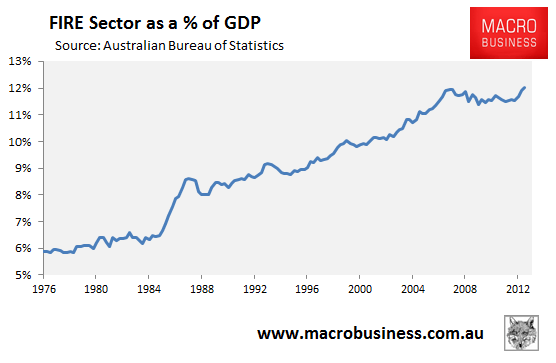
8. But Australia is actually on FIRE - Leith van Onselen at Macrobusiness points out the Financial Services, Insurance, Real Estate sectors are going gangbusters as Australia cuts its interest rates. Sigh. See numbers 1 to 4.
The chart below is a cracker.
Perhaps it is no coincidence that Australian house prices decoupled from rents at roughly the same time as the FIRE sectors’ growth decoupled from the rest of the economy, as the deregulation of the financial sector ignited credit growth, most of which has been channeled into housing.
9. You gotta laugh - Or scream. Fox reports Standard and Poor's is arguing it is being prosecuted for misleading investors because it downgraded America's credit rating. Sheesh. And these guys produce the ratings that our Reserve Bank relies on as a regulator.
10. Totally a music video from a 17 year old Aucklander (Lorde) that has just gone into the Top 10 on the Billboard Hot 100 in America. It's the first time this has happened since OMC's How Bizarre and Crowded House's various hits. I'm old and uninformed so this is news to me! Great news for Kiwi exports.
We welcome your comments below. If you are not already registered, please register to comment
Remember we welcome robust, respectful and insightful debate. We don't welcome abusive or defamatory comments and will de-register those repeatedly making such comments. Our current comment policy is here.