

Here's my Top 10 links from around the Internet at 2 pm today.
As always, we welcome your additions in the comments below or via email to bernard.hickey@interest.co.nz.
See all previous Top 10s here.

1. Where is New Zealand's Greek Yoghurt brand? - Fonterra has had its hands full lately just making sure it can process the latest wall of milk without using dirty pipes.
But it would be great if it could invent and sell some great new dairy brands.
It's always been a bit ambivalent about being a consumer dairy company.
At its heart it remains a processor of ingredients, and mostly one type of ingredient: milk powder.
That's a pity.
There's a big new trend in the world of dairy products. People oop North just love Greek yoghurt. It must be the only Greek growth story at the moment.
Here's the WSJ with a great piece on the Greek yoghurt boom.
These are dark days for fans of regular yogurt.
The creamy snack is being edged out on grocery store shelves by its thicker, tarter, higher-protein sibling, Greek yogurt.
Over a third of the yogurt in a typical grocery store is now Greek, in varieties from low-fat to fruit-on-the-bottom to tubes for kids. Because shelf space is limited, the Greek squeeze means consumers have had to say goodbye to some varieties of traditional-style yogurt and more obscure flavors. (R.I.P. Stonyfield Farm's Whole Milk White Chocolate Raspberry and Strawberry Acai flavors.) Pudding cups, margarine and other products with the misfortune of usually sitting near yogurt also are harder to find.
2. Fast food workers unite - Reuters reports on the growing move for fast food workers in America to unite into unions to push for higher pay.
Fast-food workers in more than 50 cities Thursday are striking for fair pay and the right to form a union — the biggest walkout to hit the industry. This latest round of labor unrest comes 50 years after hundreds of thousands of Americans, led by Martin Luther King Jr., joined the March on Washington for Jobs and Freedom, demanding not only civil rights, but also good jobs and economic equality.
One demand of the 1963 marchers was raising the federal minimum wage to $2 an hour. In today’s dollars, that’s roughly $15 an hour — what the striking fast-food workers are now calling for.
3. The rich feel fantastic - The poor not so much. Here's Bloomberg reporting on the widening gap in confidence between the rich and the poor.
4. Bank leverage - We at Interest.co.nz care a lot about leverage. Here's David Chaston's excellent table (and chart below) showing just how levered our banks are. They are better than they were, but arguably still too leveraged.
Here's Simon Johnson writing at Bloomberg about how bank leverage is the defining issue of our age.

5. A two tier workforce - Here's the Guardian with the latest on Britain's increasingly divided workforce structure.
6. Bad jobs - CEPR writes about the strange predominance of low wage jobs growing in America.
Why are we seeing so many bad jobs?
On the one hand we have the technology story which tells us the economy has changed. The jobs that used to provide a decent standard of living for the middle class are disappearing. In our brave new world of robots and computers the economy creates some number of very good jobs for the people with the right skills and it creates bad jobs for everyone else.
The other line of reasoning is that it is not technology that has changed, rather it is people's desperation that is forcing them to take bad jobs that they would not have considered otherwise. In this view the bad jobs were always there, but most people had better alternatives so they didn't take them. What's changed from the period when we didn't see so many bad jobs is that we have a much weaker labor market. The weakness of the labor market is the key factor in this story.
7. Cow tipping is not a real thing - Here's the proof.
To maintain its economic growth and provide for its massive population, China must reconcile two powerful, converging trends: energy demand and resource scarcity. One prime example of this tension is the country’s coal use and water supply.
According to a new WRI analysis, more than half of China’s proposed coal-fired power plants are slated to be built in areas of high or extremely high water stress. If these plants are built, they could further strain already-scarce resources, threatening water security for China’s farms, other industries, and communities.
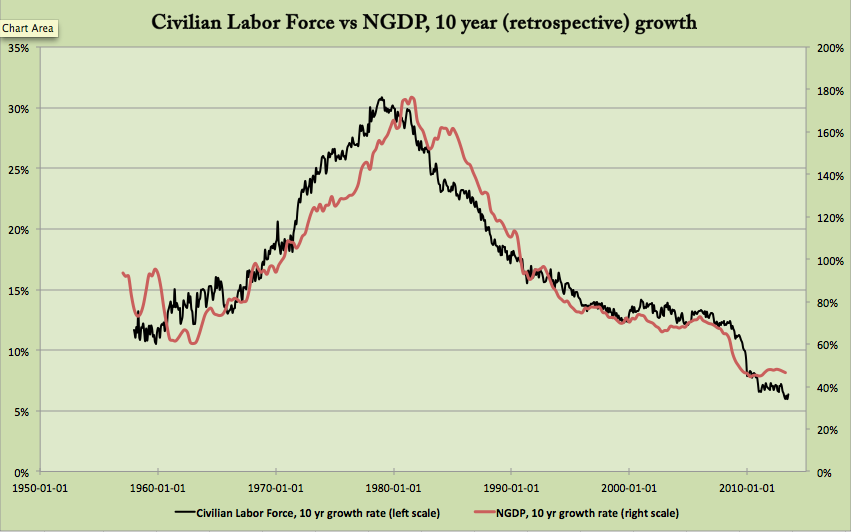
9. It's always, always about demographics - Interfluidity writes here that the arrival of the baby boomers into the workforce was partly responsible for the mad inflations of the 1970s. It's always their fault. ;)
The root cause of the high-misery-index 1970s was demographics, plain and simple. The deep capital stock of the economy — including fixed capital, organizational capital, and what Arnold Kling describes as “patterns of sustainable specialization and trade” — was simply unprepared for the firehose of new workers. The nation faced a simple choice: employ them, and accept a lower rate of production per worker, or insist on continued productivity growth and tolerate high unemployment. Wisely, I think, we prioritized employment.
But there was a bottleneck on the supply-side of the economy. Employed people expect to enjoy increased consumption for their labors, and so put pressure on demand in real terms. The result was high inflation, and would have been under any scenario that absorbed the men, and the women, of the baby boom in so short a period of time. Ultimately, the 1970s were a success story, albeit an uncomfortable success story. Going Volcker in 1973 would not have worked, except with intolerable rates of unemployment and undesirable discouragement of labor force entry. By the early 1980s, the goat was mostly through the snake, so a quick reset of expectations was effective.
We welcome your comments below. If you are not already registered, please register to comment
Remember we welcome robust, respectful and insightful debate. We don't welcome abusive or defamatory comments and will de-register those repeatedly making such comments. Our current comment policy is here.