

Here's my Top 10 items from around the Internet over the last week or so. As always, we welcome your additions in the comments below or via email to bernard.hickey@interest.co.nz.
See all previous Top 10s here.
My must read today is #1 from Ryan Avent on his grand theory of secular stagnation. Read it to make you think about why secular stagnation may be happening in the developed world, if not how to fix it.

1. A broader theory of troubles - Ryan Avent has written an excellent Free Exchange post at The Economist that brings together some thinking on secular stagnation, rising inequality, savings gluts, falling productivity, falling labour market participation and jobless recoveries.
It's an almighty puzzle for many of the world's central bankers and finance ministers and policy makers.
What's going wrong?
How is it we are still inventing amazing new technologies that should make most people better off, yet real household wages seem to stagnate.
Why is it central banks are pumping fuel into the engine and it's just not firing?
Here's Avent with a fascinating post on the counterintuitive idea that central banks should let inflation rise a bit:
The broader takeaway, however, is that apparent rapid progress in technological capabilities is not at all inconsistent with lacklustre productivity growth.
Distributional issues are key in this narrative. If we assume that purchasing power is allocated via market wages, then the task facing central banks immediately becomes impossible. If they try to maintain low and stable inflation, then competition for low-skill work will place downward pressure on the wages of low-skill workers, but wages will be too rigid to provide employment for all willing workers. The result is a stagnant real wage for all but those at the high end of the income spectrum and a growing number of frustrated workers pushed out of the labour force due to lack of work. Productivity growth will follow a middle path. It will be lower than it could be, because society will still be trying to employ everyone by reducing the real wage of less skilled workers until they are competitive at tasks machines could reasonably do. Indeed, efforts to employ everyone by reducing their real wage will retard cost declines in industries, like health care or education, that should be subject to rapid displacement of workers by capital, thereby leaving real wages for workers not immediately at risk of displacement lower than they could be. But productivity will be higher than it would be in a high inflation scenario.
But in general, the benefits of growth will flow to high-income workers and owners of capital. Since they have low propensities to spend, central banks will find it difficult to generate adequate demand, except by nurturing unsustainable borrowing by workers with stagnant incomes. Central banks cannot have adequate demand and low inflation.
On the other hand, if central banks are willing and able to raise inflation rates, then real wages will be more flexible, and firms will be more willing to use labour to do tasks that could reasonably, or even easily, be automated. In this scenario the central bank succeeds in generating adequate demand; because low real wages encourage less substitution of capital for labour, a higher share of income flows to labour, to workers with a high propensity to spend. But adequate demand is incompatible with a low rate of inflation. It may also be unsustainable, since many central banks will interpret the high inflation necessary to boost employment as evidence the economy is running at capacity.
It's enlightening and disappointing at the same time. That's because no-one in New Zealand public life is talking about this at all.
It's as if the world has passed us by.
First, the new technologies will bring good and bad. We can shape the good and manage the bad.
Second, education is not a magic wand. One reason is that we do not know what skills will be demanded three decades hence. Also, if Mr Frey and Prof Osborne are right, so many low- to middle-skilled jobs are at risk that it may already be too late for anybody much over 18 and many children. Finally, even if the demand for creative, entrepreneurial and high-level knowledge services were to grow on the required scale, which is highly unlikely, turning us all into the happy few is surely a fantasy.
Third, we must reconsider leisure. For a long time the wealthiest lived a life of leisure at the expense of the toiling masses. The rise of intelligent machines makes it possible for many more people to live such lives without exploiting others. Today’s triumphant puritanism finds such idleness abhorrent. Well, then, let people enjoy themselves busily. What else is the true goal of the vast increases in prosperity we have created?
Fourth, we will need to redistribute income and wealth. Such redistribution could take the form of a basic income for every adult, together with funding of education and training at any stage in a person’s life. In this way, the potential for a more enjoyable life might become a reality. The revenue could come from taxes on bads (pollution, for example) or on rents (including land and, above all, intellectual property). Property rights are a social creation. The idea that a small minority should overwhelming benefit from new technologies should be reconsidered. It would be possible, for example, for the state to obtain an automatic share in the income from the intellectual property it protects.
3. Frequency - This XKCD 'cartoon' on frequency made me smile. It's a gif so click through to see it in all its smiley glory.

4. We know which side of our bread is milk powdered - I see from David's 90 at 9 this morning that Australia seems to have missed out on a chance of a Free Trade Agreement with China this year because of its criticism of China's creation of an air defence zone over the Senkaku/Diaoyu Islands.
New Zealand has taken a much softer line on the Senkaku/Diaoyu Islands than Australia. Phew.
Ayson also makes the point our now historic nuclear free stance in the mid 1980s has probably helped us in our China connections. Oh the irony. A National party that once threatened the nuclear free policy with 'gone by lunchtime' now needs to emphasise its independence from America to support its largest trading relationship.
Here's some interesting background via Robert Ayson at Victoria University on the differences opening up between Australia and New Zealand in our China...ahem...diplomacy.
The gap in New Zealand and Australian views on China was evident in this week’s annual Leadership Forum between the two countries in Sydney. Several cabinet Ministers from both countries were active participants in this business-focused meeting. Prominent members of the Aussie contingent continually referred to New Zealand’s success in signing and implementing a Free Trade Agreement with Beijing. In typically understated fashion, the kiwis hinted that it had been useful to have a good political relationship with China and also to have an independent foreign policy. The second of these points is normally code for not getting too close to the US (a reputation which New Zealand’s nuclear disagreement with Washington since the mid-1980s had helped to maintain).

5. Forex crackdown - Global foreign exchange dealing rooms are abuzz with talk of mass sackings and clampdowns on trading as regulators target all sorts of LIBOR-style rigging.
Now it looks like the banks themselves have started to crack down on traders betting their own money on currencies.
The UK’s Financial Conduct Authority is probing the use of private accounts by forex traders, the Financial Times revealed in November.
This probe is ongoing and comes amid allegations that some traders might have used private accounts to place bets based on information gleaned by exchanging details about client orders with rivals, one person close to the situation said.
The queries are part of efforts by more than a dozen regulators across Europe, the US and Asia to investigate more than 15 banks over possible manipulation of the $5.3tn a day foreign exchange market.
6. Only God and Xi knows - What is really happening inside the bowels of the Chinese banking system and in shadows is a mystery to most. Even the experts can't make up their minds from the latest figures, FTAlphaville reports.
But we should all keep watching closely.
Here's UBS' Wang Tao:
This latest set of data shows that despite recent bouts of liquidity tightening (initiated by the central bank) and increasing market concerns about the sustainability of certain shadow banking products such as trusts, credit growth remains rapid. This may have been because the central bank allowed credit conditions to ease somewhat in January, especially via bank lending, as the government still wants to protect investment and GDP growth and wants only moderately slower credit growth.
In hindsight, the PBC’s tightening moves within the interbank market before the Chinese New Year were perhaps meant to prevent bank lending from growing at an even faster pace or from spiralling out of control, rather than to aggressively tighten as markets had feared at the time.
7. Our debt was just like Ireland's in 2007 - This startling accusation from London hedgie Stephen Jen this week that New Zealand was just like Ireland in 2007 was immediately rejected by Finance Minister Bill English.
Here's what the minister said to us yesterday: "Ireland had a banking crisis and they have got massive public debt. Ours is at reasonable levels. Where they are relevant is this talk about the fact that New Zealand has what appears to be a reasonably high exchange rate and that our households still have relatively high level of debt."
"I think both of those things are in my view correct, but New Zealand's in good shape to deal with the adjustments needed if the exchange rate comes down. There's elements of truth in what they say, that we have relatively high levels of household debt, our housing market is still more expensive than it needs to be, but New Zealand's households and businesses have shown that they are able to handle those pressures," he said.
The trouble is Ireland's public debt in 2007 was actually lower than New Zealand's pubic debt is now. Ireland's household debt in 2007 was a tad higher than ours is now, but not much more.
The reason Ireland got into so much trouble is it used that low public debt position in 2007 to bail out its banks in 2008.
Despite what the Government and the Reserve Bank say about imposing haircuts on depositers and 'Open Bank Resolution', we all know that the Government would use its strong balance sheet to rescue one or all of our big four banks if there was an enormous housing bust and they got into trouble.
No Prime Minister is going to stand up in the Beehive Theatrette and tell New Zealand savers that he is going to give their savings a haircut to save a bank.
The one big difference between Ireland and New Zealand is we have a floating currency and Ireland is stuck in the euro.
That flexibility in the New Zealand would cushion some of the blow of a foreign crisis triggering a domestic crisis, as it did in 2008 and 2009. But it would still put the banks under pressure because it would be much more difficult to roll over that hot foreign funding, which still funds about 20% of New Zealand's loans. But last time around the Reserve Bank came to the rescue and created a lending facility to tide them over until the markets unfroze.
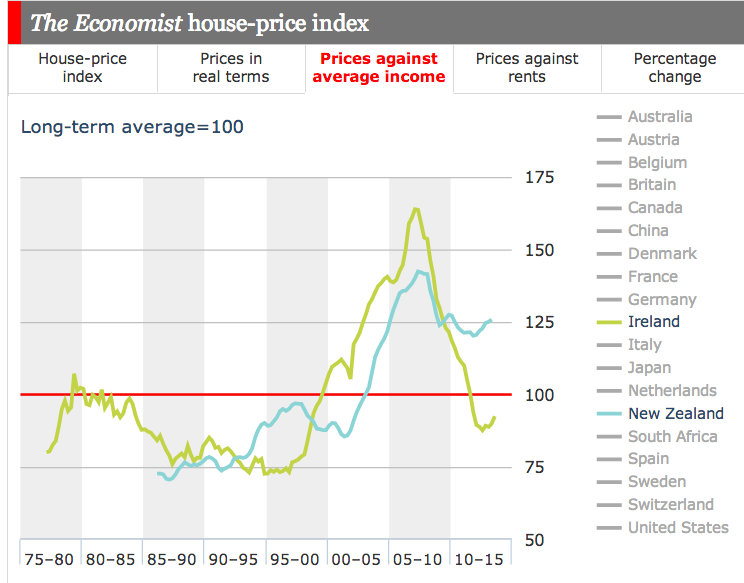
It all depends on your view on how over-valued New Zealand's housing market is relative to Ireland's. Back in 2007 Ireland's median house price was about six times household disposable income, while ours is just under five now. The Economist house price tool (see below) also shows that Ireland's house prices were almost double the long term average relative to incomes back in 2007, while ours are about 60% above the long term average.
So our house prices are not quite as over-valued as Ireland's were in 2007. So we're OK then? Hmmm.
Here's a bunch of juicy charts to chew over while you muse on comparison.



8. There will be a price to pay - Here's Michael Pettis explaining in more detail why he thinks a Chinese growth slowdown is inevitable. Well worth a read.
These reforms, and others – like attempts to protect the environment – will ensure that even as China’s real economic productivity improves, its GDP growth numbers will drop as the reforms are implemented. Most commentators argue that by increasing productivity, real reform will ensure a soft landing of GDP growth rates of 7-8 percent during the rest of President Xi Jinping’s administration. A growing minority worries, however, that rapidly rising debt will force China into a hard landing.

9. Flighty Capital - Here's John Lee at Business Spectator on the issue of capital flight out of China.
Another weekend and another couple of days filled with anecdotes about Chinese buyers snapping up residential homes in Sydney, Melbourne and Brisbane. What are Chinese private citizens up to? Why are they so eager to buy non-liquid foreign assets – such as residential real estate – in countries like Australia?
Much of this is driven by push factors arising out of China, rather than pull factors emanating from Australia. To be sure, Australia is seen as a stable, comfortable, environmentally clean and rule-of-law country that is inherently attractive to many Chinese compared to the dynamic but politically and economically uncertain environment that is China. It is why more than half of China’s millionaires, according to a recent Huron Report survey of 980 people worth over $US1.6 million ($1.8 million), are looking to leave China for a Western country.
10. How it's done - Lee explains how some of that capital flight happens.
Chinese citizens have become quite clever and skilled at ‘illegally’ transferring large amounts of money out of the country. This is done through schemes such as ‘over-invoicing’ of legitimate or false trading activity (i.e. effectively using a complicit trading company outside mainland China to exploit looser current account restrictions in order to take money out of the country), or else using financial services firms to set up complicated schemes to bypass capital account controls. For example, a 2012 report by Global Financial Integrity suggested that about $US3.79 trillion left China illegally through ‘over-invoicing’ of trade settlements alone.
Why are they buying such large assets as Australian residential property for themselves or their children, many of whom are students in Australian universities?
One is that over-paying for an Australian residential home will hardly register on the personal balance sheets of the Chinese ultra-rich. Another is that real deposit interest rates remain close to zero or negative in China, as the government remains stuck in a pattern of encouraging investment over consumption (despite what the official press is saying). Why not speculate on a home in Sydney’s Chatswood or Melbourne’s St Kilda when the few million dollars would be losing value in the domestic banking system? Besides, local Chinese citizens realise that the fundamentals of the Chinese residential housing market are even more precarious than so-called bubble housing markets in countries such as Australia. In Australia, there is at least a housing shortage in major urban residential areas. In China, there is a huge housing surplus following the construction boom from 2009 onwards.

We welcome your comments below. If you are not already registered, please register to comment
Remember we welcome robust, respectful and insightful debate. We don't welcome abusive or defamatory comments and will de-register those repeatedly making such comments. Our current comment policy is here.