

Today's Top 10 is a guest post from Eric Crampton, a Senior Lecturer in Economics at the University of Canterbury. He blogs at the ever-popular Offsetting Behaviour.
As always, we welcome your additions in the comments below or via email to david.chaston@interest.co.nz.
And if you're interested in contributing the occasional Top 10 yourself, contact gareth.vaughan@interest.co.nz.
See all previous Top 10s here.
1. Unbelievable opportunities
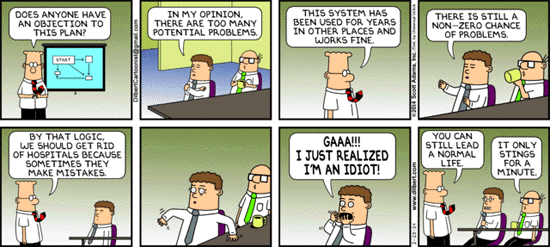
Twitter had a blast making fun of Maurice Williamson's discussion of the potentials, and policy challenges, of 3D printing.
It will never transmute lead into gold. But ChemPrinting is likely to allow home manufacturing of chemical compounds sometime in the next few decades.
The coming disintermediation, when individuals can go directly to the printer for drugs or pharmaceuticals without having to see either a doctor or a dealer, is exciting. I'm looking forward to someday being able to print pseudoephedrine when I have a cold to get around Peter Dunne's ban on the only useful cold medication.
And there will be policy challenges for those who don't like that kind of freedom, and even for those who do.
We already have pretty serious problems with over-prescription of antibiotics yielding drug resistance. What happens when anybody can print the most restricted and powerful antibiotics?
But I am, on the whole, more inclined to agree with Gareth Hughes: 3D printing will offer some exciting economic opportunities.

2. Rational response
Transport Minister Michael Woodhouse proposes making cars a lot more expensive. He didn't frame it that way, but how else should we interpret a regulation that will phase in mandatory electronic stability control on all vehicles by 2020?
There are always trade-offs in these kinds of regulations. Those new and used cars that continue to be imported will be of a slightly higher quality than otherwise. But, by knocking a lot of used Japanese cars out of the market, the regulation will also encourage Kiwis to keep older and even less safe cars on the road for longer.
It's not clear to me that this will improve safety, once we account for that people will keep running their 2000 Hondas for longer if they can't get a cheap 2010 model in 2020.

3. Judging bias
If you thought that the judging in a lot of the Winter Olympics events was plain nuts, you're right. It isn't just a coincidence that skaters from countries sending judges to the Olympics earn higher scores than skaters without that advantage.
Economist Eric Zitzewitz shows that the processes for picking the judges matter for outcomes. Bottom line: don't let national sporting federations pick the judges they send to the Olympics. But culture matters too.
4. Have you ever been told to check your privilege?
If not, you're lucky. The latest trend among left-wing activists on the web is "intersectionality".
Be grateful if you've never heard that term either. Julie Burchill explains the insanity. Isn't the highest form of privilege having nothing better to worry about than whether some columnist has paid sufficient attention to every possible intersection of race, culture, ability, gender and sexuality?

5. What if it's legal?
Russell Brown, in the NZ Drug Foundation's Matters of Substance magazine, cross-published with The Fix, looks at the legalisation of cannabis in Colorado, Washington and Uruguay. Given public ridicule of Don Brash's pro-legalisation musings a few years ago, I don't expect it will hit the New Zealand policy radar soon.

6. Productivity questions
If we did legalise cannabis, should we worry about the productivity costs if some people decided to work a bit less and spend a bit more time at home playing video games? How about if obese people, or smokers, earn less than others? Maybe. But if we worry about those, why shouldn't we worry about your decision to take 5 weeks' leave instead of 4? Or that you told your employer that you don't want to put in overtime while your kids are young?
I argued here that these kinds of productivity costs really shouldn't count as policy-relevant externalities. Mind the Stalin Gap.
And if we think regulations on fatty foods are justified because of the costs to the public health system, shouldn't we tax risky sex to avoid the social costs of sexually transmitted diseases?

7. While we're talking about obesity, is it really the case that it's just cheaper to buy fatty foods?
Richard Meadows goes mythbusting. While he's comparing a bit of home cooking to takeaways, it's pretty clear that the barrier to healthy eating isn't income poverty but either lack of time or simply not knowing how to prepare food. I'm not sure fat or sugar taxes would solve either of those problems.
8. Statistics NZ releases on alcohol availability are a bit of a Rorschach test.
If you're from Alcohol Healthwatch, you worry about the increase in the total volume of beverages containing alcohol that were available in 2013. If you're me, you notice that there has been zero change in the amount of pure alcohol available per person. And that "aggressive marketing" can hardly be held to blame for this zero increase.

9. Oh, Christchurch.
I don't agree with everything in Barnaby Bennett's take on the Christchurch Rebuild, but he's not far out. Many of the anchor projects seem misguided at best. Meanwhile, the discussion document for the government's review of the EQC legislation, promised for mid-2013, still hasn't been released.
Wellington is next in line for a big shake. The politicians and bureaucrats who could fix EQC will all wind up having to deal with EQC if they don't fix it. They haven't yet. And they may yet wind up like some of my neighbours.

10. Finally, Chris Dillow discusses the latest findings from Andrew Clark.
Clark finds that, despite rising income inequality, inequality in happiness has been dropping. Why?
Absolute poverty has been declining, and all the extra hours that the highest earners have to work come with some pretty serious costs.
If happiness is what fundamentally matters, maybe growth is the best equalising policy after all.
We welcome your comments below. If you are not already registered, please register to comment
Remember we welcome robust, respectful and insightful debate. We don't welcome abusive or defamatory comments and will de-register those repeatedly making such comments. Our current comment policy is here.