The following is the executive summary and conclusion from a New Zealand Institute of Economic Research (NZIER) public discussion paper by senior economist Kirdan Lees that was released this morning.
Entitled Big city life? Challenges and trade-offs for Auckland city, the full report is available here.
Key points
A surging Auckland provides opportunities and challenges
- Auckland has the opportunity to become a big, globally connected city from where New Zealand firms can grow generating and adapting new ideas and selling these ideas to the world. Auckland is set to grow fast.
- But the very growth that helps power the Auckland economy challenges how we live, through rising housing costs and longer commutes.
- Policymakers can use a suite of policies such as providing better transport infrastructure, improving construction productivity and lifting the supply of well-located land to improve outcomes – making Auckland a great place to live and lifting economic growth.
- Understanding how these policies affect economic and social outcomes needs a clear analytical framework. We present one framework, a monocentric model where all employment is located in the CBD, that focuses on the big picture trade-offs that arise from where families choose to locate.
Auckland’s geography intensifies demands on well-located land
- Auckland’s twin harbours – Manukau and the Waitemata – make Auckland very narrow relative to most cities including our Australian peers.
- Compared to other cities of the same population size that means Auckland will experience more intense demand for land close to the city centre.
- Narrow geography means Auckland cannot sustain a much larger population without sacrificing living standards under current policy settings.
- That heightens the need to get infrastructure and other urban policies right to provide outcomes comparable to other similar big cities.
Rising incomes and growing populations shape the city in different ways
- Auckland’s population growth and income growth will outpace the rest of New Zealand.
- Population growth is expected to push Auckland city to two million people by 2031. That increases demand for well-located land, pushing up the cost of housing. Expect smaller houses and density to intensify.
- Incomes are set to grow too – per capita real income hits $119,000 by 2031 – but this has a different impact. On its own, income growth incentivises families to use relatively cheaper land further out from the city to build bigger houses.
Better transport infrastructure reduces housing costs
- Commuting to work in the city imposes a cost on moving to the suburbs. Each kilometre away from the city centre increases the cost of the commute by a chunky $738 dollars a year according to our calculations.
- When transport infrastructure improves, all else equal, the supply of well located land increases and the price of land falls everywhere.
- Families can either move to the suburbs, taking advantage of bigger homes built with the additional well-located land, or stay put and benefit from cheaper rents since the price of land is now lower in the central city.
- Financing transport infrastructure improvements is costly. Over time, such changes transform land use promoting improved housing outcomes. The business case for new infrastructure needs to include this transformation.
Lifting building productivity improves outcomes – expect larger houses
- Building a house in New Zealand is more costly than building a similar size home in Australia. That suggests the possibility of unlocking productivity improvement.
- If housing productivity was 15 percent higher families would be 1.4 percent better off mostly through bigger or better located housing.
Extending the Metropolitan Urban Limit will lift welfare significantly
- We show the current Metropolitan Urban Limit (MUL) constrains the availability of well-located land and pushes up house prices.
- Moving the MUL out improves land supply and decreases housing costs. Families across the city benefit from reduced housing costs – even though commuting costs increase for some. The net impact on all families from expanding the MUL is always positive.
- The benefits can be material. Within our framework and set of assumptions on the cost of commuting and housing, extending the amount of land available by 22 percent makes each family a chunky $860 a year better off – including their transport costs.
Using many policy levers makes for better outcomes
- Policy settings need to adjust and respond to population growth and rising incomes that impact on the city shape in different ways.
- Some policies are easier to implement than others. We might expect to have picked the low-hanging fruit for efficient, low cost transport infrastructure projects. But a careful assessment of the trade-offs across policy options needs to account for interactions between housing and transport.
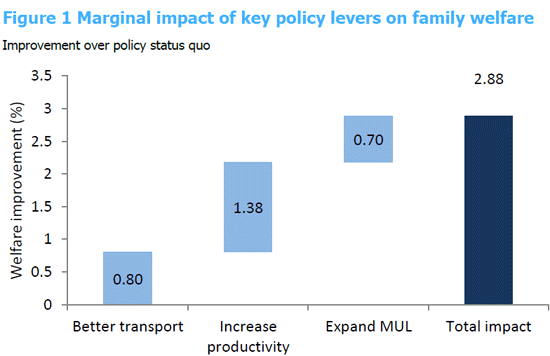
- Figure 1 shows the impact of three key policy changes:
1. a 2 percent improvement in transport infrastructure
2. a 15 percent increase in housing construction productivity
3. a 22 percent increase in land area within the MUL.
Some policy interventions may prove less costly than other interventions.
- Adjustment along many dimensions, including transport infrastructure, produces better outcomes rather than just using a single policy lever.
Policy adjustment is needed to get Auckland humming
- A thriving Auckland needs to provide people with well-located land that allows people the opportunity to work within or close to the city centre that drives Auckland’s growth.
- Policymakers have generally identified the right set of levers – extending the urban boundary, reducing urban planning restrictions and improving productivity in the housing sector. Continuing to look closely at the costs of imposing height restrictions will also help.
- But the facilitating role of transport infrastructure – both public and private – means there appear to be opportunities to make housing cheaper.
- Auckland’s rapid population growth and challenging geography suggest coordinated adjustments across a number of policies are needed to deliver a world-class city to live and to work.
A role for further research
- Our work uses a single spatial framework that helps isolates the trade-offs across a range of policies. Extending the range of policies to include the impact of height restrictions would be a useful exercise.
- Testing the implications of these policies in extensions to the model would make policy advice more robust.
- Our analysis suggests extending the model to accommodate a polycentric city where employment occurs at many locations within the city looks like a prime candidate for enriching our framework.
- Auckland’s strong migration inflows are dependent on Auckland’s high desirability as a place to live and work. Allowing for populations to choose across cities with better employment opportunities, cheaper houses and better commuting flows would be a useful extension to our work.
Conclusions and next steps
At the heart of what can make or break Auckland as a liveable city is its narrow geography. We show how the twin harbours restrict the availability of well-located land close to the city. That means Auckland experiences big city outcomes in terms of housing that is more expensive and commuting costs relative to its peers across the Tasman.
As geographic constraints bind tighter than elsewhere, that raises the premium on getting our transport infrastructure, urban planning and the efficiency of housing construction right.
Both population and income growth will start to change the shape of the city in the coming decades but in different ways. Income growth incentivises a push to the suburbs to build larger houses while population growth increases density, the price of land and housing costs.
Policymakers have options to help improve the quality of housing, reduce costs and improve outcomes for city residents. We looked at three: transport infrastructure, increasing productivity in housing construction and extending the Metropolitan Urban Limit. One of our key findings is leaving all the adjustment to a single policy lever means heroic assumptions about the magnitude of adjustments a single policy lever might be expected to deliver.
Our work is intentionally broad brush. We work with a simple model so that we can understand at the expense of integrating detailed real world features that nuance where policymakers should lend their attention.
For example, less than 20 percent of Auckland families work in the CBD. Understanding the robustness of our policy conclusions in a model that allows for multi-centric work locations and population flows that respond to the quality of transport infrastructure and cost of housing is desirable, although these models can be very complex. Exploring the impact of relaxing height restrictions through Auckland would also be a useful model extension provided the policy in the model can closely mimic policies that might be implemented (rather than a generic height restriction in the inner city area only).
But putting aside these concerns our work highlights the role transport infrastructure can play in improving outcomes not just for commuting but for housing outcomes within a city. We show that by increasing the supply of well-located land, housing costs fall, making families better off while encouraging development in the fringes of the city.
Our work also shows the outcomes we expect from improvements in housing construction. More effective construction – whether from local government regulation or private sector efficiencies – lowers the price of a unit of housing, incentivising families to build larger houses in the suburbs.
Perhaps our most contentious finding relates to relaxing the Metropolitan Urban Limit. Within our stark model, we show that by 2031, shifting out the Metropolitan Urban Limit and making 22 percent more land available effectively makes each family better off by $860 a year by lowering housing costs. This illustrates that there can be material benefits to shifting out the Metropolitan Urban Limit.
Above all, our work shows simple economic models can help broaden the understanding of some of the trade-offs across policy choices. Understanding the sometimes unintended consequences of policies that change how land is used can make for better policy advice.
31 Comments
A surging Auckland provides opportunities and challenges
....
A population Ponzi Scheme
.
2.3 Changing policy expectations
While useful, models do not capture all the effects policymakers expect from immigration.
When New Zealand moved to increase the numbers and skills of immigrants in the 1980s
and 1990s, policymakers appear to have considered that these changes had the potential
to have major beneficial impacts on the New Zealand economy, reinforcing the gains from
22
the other liberalising and deregulating economic reforms undertaken during that period.
At that time, it was considered that skills-focused inward migration could: improve growth
by bringing in better quality human capital and addressing skills shortages; improve
international connections and boost trade; help mitigate the effects of population ageing;
and have beneficial effects on fiscal balance. As well as “replacing” departing
New Zealanders and providing particular help with staffing public services (for example,
medical professionals), it was believed that migration flows could be managed so as to
avoid possible detrimental effects (such as congestion or poorer economic prospects) for
existing New Zealanders.Since then, New Zealand has had substantial gross and net immigration, which has been
relatively skill-focused by international standards. However, New Zealand’s economic
performance has not been transformed. Growth in GDP per capita has been relatively
lacklustre, with no progress in closing income gaps with the rest of the advanced world,
and productivity performance has been poor. It may be that initial expectations about the
potential positive net benefits of immigration were too high.Based on a large body of new research evidence and practical experience, the consensus
among policymakers now is that other factors are more important for per capita growth
23
and productivity than migration and population growth. CGE modelling exercises for
Australia and New Zealand have been influential in reshaping expectations.
Migration and Macroeconomic Performance in New Zealand: Theory and Evidence Julie Fry New Zealand Treasury Working Paper 14/10 . ACKNOWLEDGEMENTS This paper has benefited greatly from discussions and comments, many of which have been substantive. My thanks to Rienk Asscher, Anne-Marie Brook, David Brown, Nick Carroll, Enzo Cassino, Linda Cameron, Andrew Coleman, Paul Dalziel, Graeme Davis, Shamubeel Eaqub, Matthew Gilbert, Michael Hampl, Christine Hyndman, Natalie Jackson, Tracey Lee, Geoff Lewis, Geoff Mason, Mario di Maio, Dave Maré, Vinayak Nagaraj, Ganesh Nana, Jacques Poot, Roger Procter, Michael Reddell, Paul Rodway, Mark Smith, Steven Stillman and Phil Veal for helpful suggestions. I am also grateful to Hannah Benbow, Rietta Barnard and Bradley Rose for assistance with accessing documents, Frédérique Bertrand for help with data queries, and Kelly Shen for formatting the paper. All remaining errors are my own.
Some time ago I researched the relationship between population, population growth rate and the ecconomic per capita across about 180 nations. Briefly the findings were:-
1 There was no corrolation between the population size and the GNP/per capita growth rate.
2 There was a mildly negative corrolation between the population growth rate and the GNP/capita growth rate. That is the faster the population grows the ecconomic well being growth suffers
3 The countries with negative population growth were predominantly established first world countries who enjoyed a significantly higher GNP /capita growth rate. (22.2% cf 15.8%)
Accordingly I could find no evidence to support the proposition for population growth rate for NZ by immigration or otherwise. It is good to see that at last others are now starting to seriously question it. All the analysis aside, on the bassis of common sense we are a small nation that largely relies on exporting aggricultural products. The number of people in this sector is small compared to the total population. Increasing the population just means the farming sector has more people to support. As noted below you cannot spend your way to prosperity, you must either export or develop home grown industry. We seem to be going backward in this later sector so-
Your sub heading a population ponzi hits the nail on the head. The population growth creates a lot of demands and ecconomic acivity which has the appearance of prosperity but in reality it is chewing up foreign capital that we cannot afford. At the end of the day the extra people need real jobs that are sustainable. What happens when and if this stupid game of musical chairs stops.
Finally it is obvious that the population of the earth is placing greater stress on our planet than it can sustain. We have to get a hell of a lot smarter about the way we do things and we have to address the issue of stopping and reversing population growth. If we do not nature will have the last word, and it will very likely be catestrophic.
well put. When are MM going to stop and ask......do the people (the owners) of Auckland want this growth? How about this site runs a poll along those lines eh?
A poll, that would be great. The people that follow this web site may be a bit skewed however.
One of the other big questions for Auckland is when and how are they going to address the gross overexpenditure. You may remember a NZ Herald headline a while ago that stated that Auckland City council has over spent it''s income by $835 million for each of the last three years. Just a number, the significance of which probably went over most peoples heads. I tried to get some perspective. The best that I could do was a few years out of date but at that time their annual budget was just over $3 billion. This means that 25-30% of the councils expenditure is borrowed. How long can this keep going?
A financial device was set up in the last few years where by all the councils join together in their borrowing so that they can get attractive loan rates. In this world you don't get something for nothing and I would almost bet that the other hapless local bodies are underwritting the profligacy of Auckland and a few others. If I was a councilor I would be looking for ways to get of this arrangement and take responsibility for only those things that I control.
......and of course the more 'growth' that occurs, the more new infrastructure is required and upgrade of. This applies to roads, stormwater, parks, librarys, pools, schools, hospitals,local environment and so on. The ability to ignore these by merely referring to the cost of an indivdual new home grossly underestimates the extra cost that growth will impose on Aucklanders.
- "Commuting to work in the city imposes a cost on moving to the suburbs. Each kilometre away from the city centre increases the cost of the commute by a chunky $738 dollars a year according to our calculations."
Solution is very simple.
1.Identify bottle necks or narrow areas due to geography.
2.Do not use these narrow areas to build more housing/industry. Use them primarily for transport. Multi lane, decent (high speed?) train services running regularly through these narrow areas.
As soon as this is done, massive amounts of land that was considered poorly located, suddenly becomes well located.
20km away from cbd wellington the waterloo interchange with regular trains into the city (15 min on train V 40 min in a car in peak traffic), is equivalent to many areas in auckland that are currently 'poorly' located, but chuck a decent train to them and they become very well located at 15min commute during peak times.
Massive amounts of land for setting up satelite suburbs within 20km radius of city center.
Run 3 train lines through each bottle neck, a main central train station centered at 20km point away from CBD with large park and ride's so an extra 5km radius around these main stations are within easy driving distance to train station. Then 15min trip to work while you read the morning news on your ipad.
...youre in cuckoo land. Just who is going to pay for this? Not to mention every suburb is another deduction from agriculture...thems that pays the bills. Quit while we are ahead. End this constant growth nonsense and be happy with what we have.
3 train lines and double track? 20 x 20million x 3 = $1200Million. How many of these do you say you want?
Just who would pay that bill?
regards
I think you're missing the point.
Those people are already travelling, (albeit very slowly and expensively).
Who pays? better long term planning. What shape do you want your city with 25% more people? 50%? 300%? 1500%? With the "population can grow forever and so can profits" crowd such population numbers are only the start.
I think Simple Simon was saying identify the trouble spots, plan _around_ your infrastructure, as much as possible. Don't build like some 12 century peasant town, where everything has to be in walking distance, and then cram stuff around it to make it work.
Unless they're going to start capping the size of cities, they will grow indefinately. the sooner they start making allowances for the infrastructure upgrades, the easier and cheaper the migration will be each time. So don't build a suburb at pinch points, deliberately move it, and put the infrastructure in place to make the new suburb work.
I don't think we need to go as far as the Chinese making instant population-free cities for future expansion plans, but just allowing forethought for planning and zoning is a good start.
Freeing up for sprawl to save a few dollars is all good and fine...and kicks the can a few more years, but it won't solve the problem
Well no it isnt simple. The Q is, who pays for the expansion of the roads, and (public) transport? Light train services are something like $20million per km of double track.
So a 20km line will set you back 400million...and that is just one line....How many lines would you need? 5? goodbye $2000Million.
Not much if you say it quick.
regards
How did/does wellington manage it?
Trains going only 2 ways; up west coast and up the hutt valley over to masterton?
Wellington is more geographically constrained than auckland. Obviously knew they had to bite the bullet and spend the money . Maybe it's time Auckland did too.
Trains in welly are always packed, and if I recall, at the 20km distance from wellington, was paying something like $5 each way. Cheaper than petrol + parking. Unlike roads where people complain about tolling, no one seems to mine paying these sort of fairs for the train.
No on lots of counts, if this is the std of your concuslions, no wonder you think such things are "simple"
My line is empty most of the day, its nuts to run a 22toone? train with three staff for maybe 6 passengers. I pay $5 for 11k, and that is 50~60% subsidized.
Yes its cheaper than a car, hence its well subscribed in the peak times.
Yes ppl do mind....Im there to listen to them. On top of that lots of ppl now have 10 trip passes and not monthly suggesting financial limits.
regards
Read yez Railwayz History, Simon. The two lines, one private (W&MR Company), other the Gubmint Fell-engine bottleneck over the Rimutakas, didn't link up (via Manawatu Gorge) until the early 20th century. And the WMR line was done specifically because the Gubmint ran out of OPM during the depression of the early 1880's....so much for ' bite the bullet and spend the money'
History never repeats but it rhymes....
So welly has been lucky enough to get rail by historical mistakes?
$3k grants for aucklanders that want to move to welly to enjoy our rail network that you will always be too poor to replicate?
The for Wellington lines are already layed so no capital costs.
The west coast is I think all twin line to Waikanae, all twin to Upper Hutt which are the commuter limits. Any further and they are single lines and 2 or so heavy trains a day.
Too late for Auckland IMHO. Too late for Wellington to expand either, it makes no economic sense.
regards
Wellington did it in the 1930s by a Labour government that invested in transport and affordable housing (State housing). Sorry my copy and paste function has stopped working but google 'Chris Harris Lost City' to see how this worked for Wellington but not Auckland or Christchurch.
Policymakers have options to help improve the quality of housing, reduce costs and improve outcomes for city residents..
....
A highrise for a neighbour. This isn't for Aucklanders it is for the people servicing sector (Property Council, etc,etc).
http://www.wired.com/2013/08/unbelievable-photographs-of-hong-kongs-crazy-high-rises/
$738 per year PER km from cbd.
So if you move to a suburb 15k away, you are paying $11k extra a year compared to living in an apartment in walking distance to work.
$11k savings, $212 a week.
They must be including a cost for time wasted during commuting as fares alone don't add to this (unless considering family all needing to comute to cbd).
Sorry have to do one more calc for ya..
A) couple considering buying at 550k in suburb 15k from cbd Versus B) buying a 2 bedroom apartment in CBD with carpark for 300k. A flatmate used to help pay mortgage for each option, and 20% dep paid for each option.
A) Suburb house:
$110k paid up front for dep. $440k mortgage remaining. Ave 6.5% interest rate.
$28,600 per year for interest cost. Plus $3k for rates and insurance. Plus $3k for general maintenance, lawns, etc. Plus $11,070 for transportation costs to cbd for work using 738/km figure.
= $45,670 per year costs (NOT including any principle paid). $878 per week.
Less income from boarder @ 150/week = $7800
= $728/week net cost due to purchase.
B) The apartment:
$60k paid up front for dep. $240k mortgage remaining. Ave 6.5% interest rate.
$15,600 per year for interest cost. Plus $1k for rates. Plus $4k for BC's covering all maintenance and insurance needs.
= $20,600 per year costs (NOT including any principle paid). $396 per week.
Less income from boarder @200/week = $10,400
= $196/week net cost due to purchase
The NZIER "simple model" probably excludes the possibilty of anyone living in anything other than a free standing house. Hugh P claimed that 1km of infrastructure/roading servicing apartments/terraces is more expensive to build and maintain than 10km's of infrastructure servicing freestanding houses.
Young people dont get ahead in life and complain about the cost of living and need WFF even though they earn decent salaries because FHB's can't do simple math. And or make decisions based on emotional irrationality.
My brother in law in London has a friend who purchased a house in Notting hill 12 years ago for 4 million pounds, he just sold it for 36 million.
When are houses just too expensive?
NZ is more than just AKL which accounts for only 1% of total export earnings. Ppl will argue that it accounts for such such % of GDP, but remember that a national cannot spend to prosperity.
I also doubt any innovative ideas generated from AKL can be capitalized on the world stage by a Kiwi company. The most likely outcome would be the idea got sold to a multinaitonal Ltd, and that NZer keeps all the $, and enjoy rest of his life somewhere, or become a columnist for interest.co.nz.
Since NZ is not going to change its economic structural in next 100 years, why not just focus on increasing the milksolids per capita while keeping the pollutant per capita down?
Xingmowang......that's what Auckland is counting on....the poor old cow......
"- Building a house in New Zealand is more costly than building a similar size home in Australia. That suggests the possibility of unlocking productivity improvement."
The costly nature of New Zealand housing was a deliberate government manipulation.
It was thought tha too many people were jumping on the property bandwagon, and this competition was forcing prices up, as people could buy a property cheaply and sell it quickly for an excellent untaxed capital gain (+ depreciation and other writeoffs). The resulting yield made other investments (stock exchange, term deposits, SUPERANNUATION) look bad and NZers were putting money into property instead of the more governmentally desireable investments which made them look bad.
Wait, you say that doesn't make sense!
well according to the governments figures the economy was going beserk and dollar was rising to prove it. This was because the number of building consents had gone up....
Also the governments of the day were promoting "the information age". We were all going to get rich by being more educated and upskilling NZ. This enable a complete overhaul of the old apprentices system (which didn't pay fees to government or schools) and most mostly in the hands of industry diehards.
The proof of this was of course, the corellation between education and wages/salaries for employees.
Thus if we put all the electricians and plumbers and painters and plasterers through massively expensive and life long training and upskilling programs and make them renew frequently, it would create an entirely NEW industry, pump massive amounts of funding into the flagging education sector. We'd have the cleverest trades people with the mostest education, and therefore we'd have better quality houses.
Plumbers were complained, were just told to pass costs on to the customers with margin, and to be happy as they'd all be rich. What really happened is the plumbers, builders etc, could no longer afford to have low skill staff and the costs skyrocketed.
By that was the idea. theoretically the skyrocketing costs would reduce the explosive inflation (caused from high building consent rates) [* note that extra compliance and paperwork/inspection steps were also introduced to reduce the speed of completion to also keep the consent rates down, as well as time limits on consent process ].
And wealth would be redistributed to the working class, in a trickle down manner.
this means fewer FHB could afford to bid up prices. Few mid-income people would pour "dead equity" into fiddling about with their houses and would invest in sharemarket, and even better the cost would reduce the competitiveness of property as an investment.
Several of these "old guard" are clearly still advising the government.
But with 20/20 hindsight would people love to point out where and why they got it *so* wrong? and with disection, point out why it has contributed to today's woes.
There is propaganda and then there is gullible !! Even with the benefit of hindsight some people can't see or interpret the events of the past.......
Only 2 weeks ago NZIER economist Mr Equab was stating that there's "no shortage of actual houses, physical houses" in Auckland with "prices potentially even falling" and prices only being driven up by speculation.
So how come if there's "no shortage of actual houses, physical houses" NZIER have now decided that more sprawl supply is needed?
Our clients build sprawl housing on the fringes of Auckland. It's never for affordable housing though, they want big houses on small sites to appeal to multigenerational immigrant families from China/India. They don't mind commuting because traffic is negligible compared to home and owning cars is quite the status symbol.
I assume their "simple economic models" ignore externalities like pollution and energy waste as usual.
" 22% more land would make each family $860 better off annually by cutting housing costs;"
for how long?
and then what?
We welcome your comments below. If you are not already registered, please register to comment
Remember we welcome robust, respectful and insightful debate. We don't welcome abusive or defamatory comments and will de-register those repeatedly making such comments. Our current comment policy is here.