

Here's my Top 10 items from around the Internet over the last week or so. As always, we welcome your additions in the comments below or via email to bernard.hickey@interest.co.nz.
See all previous Top 10s here.
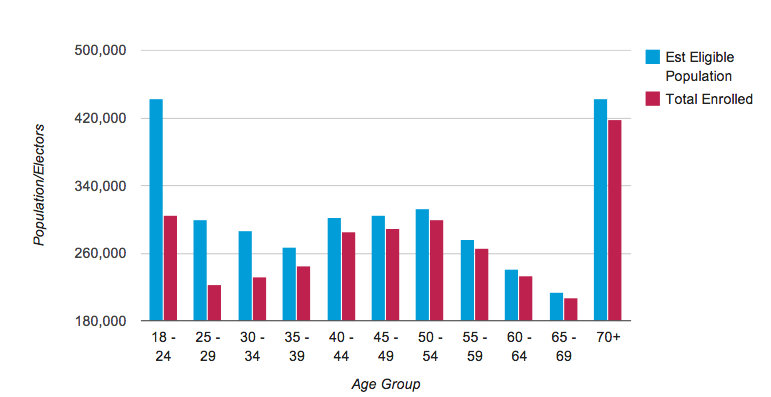
My must-peruse is the chart from the Electoral Commission on enrollment rates by age group. Click through to their site to be able to dig down by electorate. A fascinating, scary, hopeful and sobering insight into the youth of today, the political opportunities for one side and the threat for the other. And read #5 if you do one thing today.

1. 'So long. Be on your polluting way' - Gareth Morgan, Geoff Simmons & Susan Guthrie have written a pretty strong send-off for Fed Farmers CEO Conor English, focused on his approach to water, in particular.
There has been a change of leadership broadly at Federated Farmers in the last couple of years that seems to be dragging it more towards the centre of politics and thinking on environmental issues.
The difference between former Fed Farmers President (and now ACT candidate) Don Nicolson and the just-retired Bruce Wills was like night and day.
Wills had a much more nuanced approach on issues such as climate change and water than Nicolson. English was CEO when Nicolson was President. We'll see how the new team of William Rolleston as President and former ESR CEO Bruce Smith as CEO do.
Morgan is none too happy to see English go.
Conor English’s valedictory article in the Dominion Post the other week provides ample evidence for why we won’t be sad to see the back of the former Federated Farmers CEO. His consistent advocacy for dirty economic growth has not only unfairly put farming in a bad light, undermining the considerable effort being made to clean farm practices up, but perpetuates the myth that New Zealanders must choose between economic prosperity and environmental protection, we cannot have both.
Conor’s worst stand was his objection to the Horizons One Plan, which aimed to help the people of Horowhenua and Manawatu limit the impact of farming on their waterways. Thankfully he lost that battle and the Plan is in place. His swansong last week was to predict that now the people of Hawkes Bay will be heading to the “third world” if they don’t construct the Ruataniwha dam across the Tukituki river and enable irrigated intensification of dairying in that region.
Arguably his most memorable line will be “we waste so much…[water], it just flows out to sea.”
It is difficult to know how to respond to such an unenlightened view of the role of waterways and their role in sustaining life on the planet.

2. The Double Irish Dutch Sandwich - Here's 'Conversable Economist' Timothy Taylor explaining how the likes of Google use the international tax system to ensure they don't pay much tax anywhere, citing this excellent IMF graphic below. Remember, Google paid NZ$227,074 in tax last year, despite receiving more than NZ$200 million from New Zealand companies buying services (GST-free).
There is an ongoing cat-and-mouse game in corporate tax avoidance, in which government tax agencies write regulations, well-paid corporate tax attorneys construct arrangements to pay lower taxes within the rules, the government tax agencies write more regulations, and so on--in a spiraling descent into ever-greater complexity and confusion. As with many pointless and destructive games, the answer is to define the rules for a different game.
President Obama has proposed one corporate tax reform, and other proposals are floating around. When the economic incentives to shift profits are powerful, the corporate tax attorneys will find ways to make it happen. Thus, one goal of such reform should be to reduce the underlying incentives for this sort of profit-shifting

3. The youth of today - The chart below from the Electoral Commission tells the story of just how many young people are not enrolled to vote. The total of unenrolled but eligible 18-34 voters is 268,896. That's more than enough to change an election result, if they enrolled and voted.
4. Gareth Morgan's Brazilian dairy farms - Gareth Morgan has been campaigning on nitrate leaching from dairy conversions, so it's only natural he would get some push-back from dairy farmers who queried Morgan's involvement with dairy farms in Brazil's rainforest.
Morgan has published a commentary from one of the directors about how the farms manage nitrogen and leaching.
It's a useful insight into the science and the practicalities, albeit in another ecosystem with different soils etc.
Using a highly efficient nitrogen absorbing pasture with a deep root structure, a farm layout with grazed areas located well away from waterways, operating the farm with conservative nitrogen applications based on good science, and using a low overall stocking rate on the property, Fazenda Leite Verde believes that its nitrogen management is as good as any pasture-based dairy farm in the world.
Of course every country has to develop its own approach to nitrogen loss that accords with climate and soils of that location so there are few direct lessons from farming in the tropics in Brazil to the temperate farming here.

The bolding is mine. He says some remarkable things out loud for someone in his position.
It is not difficult to see why the recovery has been anemic. Excessive private-debt creation before the crisis and subsequent attempts at deleveraging have weakened demand considerably.
While fiscal deficits can help to offset deficient demand, they also result in rising public debt. Leverage has not gone away; it has simply shifted to the public sector – creating a debt overhang that may last for many years, or even decades. Eliminating it will likely require significant debt write-offs or permanent monetization.
The same pattern is unfolding in many emerging economies – most notably, China. With credit growth far outpacing nominal GDP growth, leverage is increasing. And it seems that the rising credit intensity of GDP growth (the amount of new credit required to generate a unit of output) is needed to ensure that economic performance remains in line with potential.
This implies a serious dilemma: while rising leverage is apparently essential, it inevitably leads to crisis and recession. Against this background, policymakers must consider whether rapid credit growth is really necessary, and whether there are any alternatives – a question that modern economics has so far largely ignored.
In fact, much credit growth is not critical to economic growth, because it does not play a direct role in financing consumption or investment. Economics textbooks often describe how households deposit money in banks, which lend to businesses to finance capital investment. But, in advanced economies – and increasingly in emerging economies – this story is largely fictional, because such lending accounts for only a small share of the total.
Instead, a large part of bank lending finances the purchase of existing assets, particularly commercial or residential real estate, the prices of which primarily reflect the value of the underlying land. Such existing-asset finance does not directly stimulate investment or consumption. But it does drive up asset prices, causing lenders and borrowers to believe that even more credit growth is both safe and desirable.
6. Lots of false heroes - The stock market rallies since 2009 due to all the cheap money Turner referred to have made a lot of fund managers look very good. But are they that good.
This New York Times article refers to a new analysis showing that just two funds out of 2,862 actually consistently out-performed the market.
What should investors make of these findings? There is one clear implication, said Keith Loggie, senior director of global research and design at S.&P. Dow Jones Indices.
“It is very difficult for active fund managers to consistently outperform their peers and remain in the top quartile of performance over long periods of time,” he said. “There is no evidence that a fund that outperforms in one period, or even over several consecutive periods, has any greater likelihood than other funds of outperforming in the future.”
This seems to bolster the case for index-fund investing. After all, if a fund manager with a great year can’t be counted on to outperform other fund managers later, it’s reasonable to ask: Why bother trying to beat the market at all?
7. Young, skint and self-employed - BBC Newsnight's economics editor Paul Mason writes a good piece here about the problems of young, self-employed and lowly paid workers in Britain.
He visits a workshop in London where 400 young people work in a low-rent industrial space in East London.
Now multiply that until you get 400,000 – the number of self-employed jobs added to the British workforce in the past year. Add tens of thousands of low-paid regular jobs and you get the headline the government does not want to talk about: a five-year collapse in real wages, especially among the young.
The Institute for Fiscal Studies calculates that, after inflation, the real hourly pay of workers under the age of 30 has collapsed by 11% since the financial crisis of 2008; their household incomes are down 15% as large numbers live in shared housing, and even shared rooms.
These figures are not hard to summarise: we're creating jobs hand over fist by allowing the young to work for peanuts. Conventional economic models say: "Don't worry, all the slaving, starving and powerlessness you're going through now will end at some point as wages rise." However, conventional models might be wrong. They are based on a world in which there are national labour markets and wage-bargaining power – either because of unions or a shortage of professional skills. But the post-crash British economy is creating the kind of jobs where the labour market is international and bargaining power weak.

8. 'Moaning moguls' - James Surowiecki has written an excellent piece at the New Yorker on the billionaires complaining in the United States about all the complaints about their wealth. He's not sympathetic, or hopeful.
If today’s corporate kvetchers are more concerned with the state of their egos than with the state of the nation, it’s in part because their own fortunes aren’t tied to those of the nation the way they once were. In the postwar years, American companies depended largely on American consumers. Globalization has changed that—foreign sales account for almost half the revenue of the S&P 500—as has the rise of financial services (where the most important clients are the wealthy and other corporations). The well-being of the American middle class just doesn’t matter as much to companies’ bottom lines. And there’s another change.
Early in the past century, there was a true socialist movement in the United States, and in the postwar years the Soviet Union seemed to offer the possibility of a meaningful alternative to capitalism. Small wonder that the tycoons of those days were so eager to channel populist agitation into reform. Today, by contrast, corporate chieftains have little to fear, other than mildly higher taxes and the complaints of people who have read Thomas Piketty. Moguls complain about their feelings because that’s all anyone can really threaten.
9. 'You could not invent a better gravy train' - Alan Kohler argues in this Business Spectator piece that Australia's gold plated pension system, which delivers massive profits for mostly-bank fund managers, needs to be changed. He makes some good points.
Since 2009 the average super fund has increased in size from $1.5 billion to $3.5bn, while the average fee has fallen from 1.3 to 1.2 per cent. That means the average fees received by each fund have doubled from $20 million a year to $40m.
What better business can there be? Contributions are mandated by law so that about $100bn a year pours in; there are few variable costs (costs are mostly fixed); and there is no regulation of prices, so they are determined by competition alone.
And as the Murray inquiry observed, the fees they charge for this are among the highest in the world because “competition between funds for members has largely been conducted on a non-fee basis, which has led to feature-rich and more costly superannuation products”.
10. Totally John Oliver on America's amazing prison system. Some astonishing numbers. America has more prisoners than China.
We welcome your comments below. If you are not already registered, please register to comment
Remember we welcome robust, respectful and insightful debate. We don't welcome abusive or defamatory comments and will de-register those repeatedly making such comments. Our current comment policy is here.