

Here's my Top 10 items from around the Internet over the last week or so. As always, we welcome your additions in the comments below or via email to bernard.hickey@interest.co.nz.
See all previous Top 10s here.
My must read is number 7 on whether low interest rates are fuelling asset bubbles, or whether they are just a leading indicator of secular stagnation.

1, The problem in America with jobs - This week we'll hear more on the state of America's jobs market.
On the face of it (see the first chart below), jobs growth is picking up and long term unemployment is falling.
But the chart below that shows most of the jobs are in low paid fast food and health care industries.
That's important because the doves in the US Federal Reserve are apparently linking any decision about tightening monetary policy to a pickup in wage growth as well as jobs growth.
A delayed or tepid pickup in wage growth could delay any tightening until well into next year, rather than the first quarter that some of the hawks suggest.
That in turn gives little relief for our currency.
Here's Rabobank's view of the Fed's decision on Thursday morning our time. It sees rates on hold until late 2015.
The doves in the FOMC want to make sure that there are no remaining weaknesses in the economy before the central bank unleashes its hiking cycle. However, they may be asking a little too much from this recovery. The economy came out of recession in the summer of 2009, but the recovery has been uneven and disappointing on average. Therefore, we remain skeptical of the linear recovery that is implicit in the FOMC’s projections.
What’s more, the Committee also wants 200Kplus nonfarm payroll growth, falling wider measures of unemployment (such as U6 which includes marginally attached and involuntary part-time workers), stronger wage growth, and a sustained housing market recovery. Most likely, not all of the Committee’s projections and criteria will be met by mid-2015, so for now we stick to our forecast of a 2015Q4 start of the hiking cycle. Keep in mind that the Fed has been too optimistic about the recovery and premature in signaling its next policy steps several times before.

But not in the higher wage jobs.

2. Cool - I want one. The US army is developing pocket-sized camera drones for its troops.
Just imagine the applications in all sorts of industries and activities, including farming, retailing and the media.
Paparazzi drones are just a matter of time.

3. Higher wages cost jobs? - Really? This is an eternal debate, but particularly relevant now Labour and the Greens are proposing quite big increases in the minimum wage if elected. Labour has promised to increase it by 14% to NZ$16.25 an hour by April next year, which National said would cost 6,000 jobs, according to MBIE research.
However, the jury is still very much out on this subject in America.
Here's Planet Money with a look at the research, which was ambivalent at best.
Figuring out the effect of raising the minimum wage is tough. Ideally you'd like to compare one universe where the minimum was raised against an alternate universe where it remained fixed.
Economist David Card found the next best thing. In 1992, New Jersey was about to raise its minimum wage. Right next door, there was a parallel universe: Pennsylvania, which was not raising its minimum wage.
Card and a colleague decided to study what had happened to jobs at fast-food restaurants in both states. They surveyed restaurants and found that the number of jobs actually went up in New Jersey, which increased its minimum wage, compared to the number of jobs in Pennsylvania, which didn't.
4. Thundermaps for dairy farmers - Thundermaps CEO Clint Van Marrewijk has written a piece at Gareth Morgan's site about how farmers and others can use his Thundermaps service to track pollution reports.
It is in the interest of any farmer to know if an environmental report has been made that affects their business:
If cattle break through a fence into a nearby creek, the faster the farmer or their neighbor hears about it, the better. The incident can now be resolved more quickly, with less resulting environmental damage. A report of major slip damage for example, is something a nearby farmer could give a hand to clear as well.
There are significant advantages to more open and transparent communication of environmental incident reports.
The public (but moderated) nature of the My River pollution alerts gives an additional incentive for any incidents to be resolved quickly and efficiently.
5. Here's a cartoon below that touches on this issue of water quality and the stoush this week between Nick Smith and a couple of environmental groups.

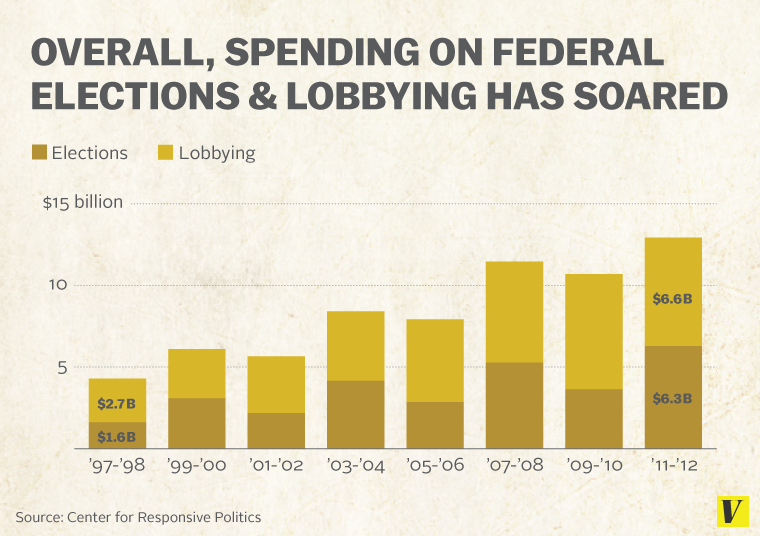
6. The real story behind House of Cards - This Vox piece has 40 charts explaining how lobbyists and big money runs US politics. I'm really enjoying House of Cards, as much for the minutiae on how American politics seems to work.
7.Maybe there is no bubble - The FT's Robin Harding has an interesting piece suggesting the very low interest rates in the developed world are actually not building up asset bubbles because they simply reflect a secular stagnation.
Those who think there is a bubble believe that central banks have kept interest rates unjustifiably low. By buying bonds in the name of quantitative easing, they have created a false boom in asset prices. Rising inflation will soon expose this miscalculation, and rates will rise.
But that is actually the cheery scenario. It suggests that generating enough demand to keep economic resources fully employed will not be as hard as central banks expect – and thus they have already gone a bit too far with their stimulus.
In that case, we can expect interest rates to rise and asset prices to fall. The economy would suffer in the short term, and it would be painful for investors. But, since the private sector is no longer burdened with unmanageable quantities of debt, the fallout should look more like the bursting of the internet bubble in 2000 than the financial crisis of 2008.
The gloomier alternative is that interest rates are low for good reason, and likely to stay that way. In that case, high asset prices make sense, because demand for new investment is miserable and unlikely to accelerate. Investors will not suffer upfront losses on their portfolios, but returns will stay low for a long time. If this is what is going on, mistaking the situation for a bubble would lead to bad policy.

8. Luckily productivity growth was so weak - Really? Economists and central bankers usually love lots of productivity growth, but in Britain it has helped unemployment a lot that productivity growth there has been so weak.
Here's Simon Wren Lewis with a blog post and a juicy chart. It's too early to know if this is one of the reasons jobs growth in New Zealand has been relatively strong.
Imagine that productivity (defined as GDP divided by total employment) since the general election had grown by 2.3% per year - its average from 1977 to 2007 - and that output had followed the course it actually has*. If this had happened, employment would now be 2.48 million lower. If half of this number were counted as officially unemployed, there'd be over 3.4 million registered as unemployed. And unemployment would have topped 3.5 million last year. That would be a post-war record.
9. Productivity and coffee - Maybe New Zealanders need to drink more coffee. Or less tea. Or maybe more Red Bull. This chart below courtesy of Freakonometrics (HT Eric Crampton) shows the connection between coffee consumption and GDP per hour worked.
But there does seem to be a law of diminishing returns at work. The Finns apparently drink 12 cups a day and their GDP/hour worked is lower. They must all be so shaky they don't get any work done, or maybe they're all slacking around in cafes.


We welcome your comments below. If you are not already registered, please register to comment
Remember we welcome robust, respectful and insightful debate. We don't welcome abusive or defamatory comments and will de-register those repeatedly making such comments. Our current comment policy is here.