
Today's Top 10 is a guest post from Shamubeel Eaqub who is the Principal Economist at NZIER, occasional blogger at www.tvhe.co.nz and an author.
As always, we welcome your additions in the comments below or via email to david.chaston@interest.co.nz. And if you're interested in contributing the occasional Top 10 yourself, contact gareth.vaughan@interest.co.nz.
See all previous Top 10s here.

1. Ending corporate welfare
Sam Morgan created a mini-storm by attacking government grants for tech companies.
Tech investors love free subsidies, so nobody tells the government that the grant programmes are stupid.
— Sam Morgan (@samfromwgtn) October 2, 2014
Aditya Chakraborrty writes in The Guardian that the extent and effectiveness of corporate welfare is unknown. I wonder if anyone has done that work in New Zealand?
The bill for corporate welfare is huge – and largely hidden. We know a lot about the people who claim social welfare: we know how much each benefit costs the public, the government sets strict rules for eligibility – and we even have detailed estimates for how much cheating goes on. Between them, Whitehall, academia and NGOs have churned out enough surveys on social welfare claimants to fill a wing of the Bodleian library. But corporate welfare? The government has itself acknowledged: “There is no definitive source of data about spending on subsidies to businesses in the UK.” The numbers are scattered across government publications and there is not even any agreement on what counts as a corporate handout.
2. The Vol strikes back
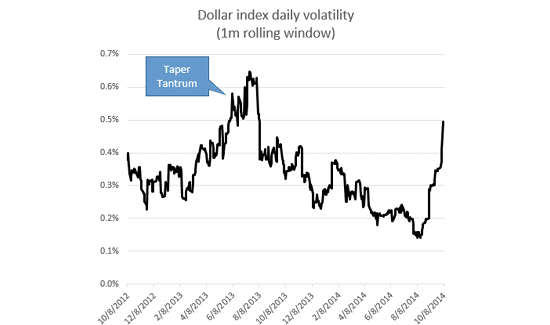
Sober Look writes about a return of volatility in currency markets.
While a lot of NAZI commentary was around the BENZ’s intervention, a rise in volatility and risk aversion is likely to be the main cause of NZD weakness.
The RBNZ’s intervention capacity is a mere drop in the NZD trading ocean.
Questions about the ECB's programs' effectiveness have introduced increased uncertainty into the euro's trajectory, causing volatility to rise.
Similarly the uncertainty is increasing around the Fed's liftoff as well. Expectations of timing vary dramatically between as early as Q1 of next year and as late as a year from now. With rate uncertainty comes increased currency volatility.
3. Lower currency = higher exports?
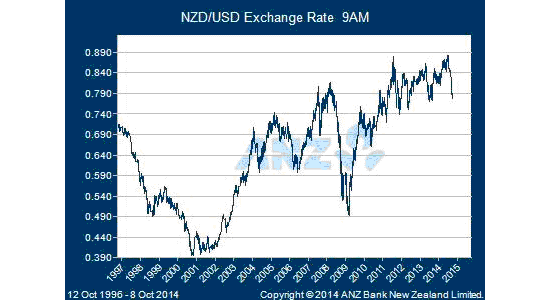
The NZD has fallen sharply (see chart from ANZ below) in recent weeks, although the level is historically high. Will a lower NZD spur exports?
Historically that has certainly been the case. But the recent Japanese experience suggests caution.
The parallel with New Zealand is that our exports have become less diversified over time. Its unclear if the decline in exports has led to permanent closure of some firms or sapped the capacity for product development.
The Economist writes:
The most worrying explanation of all is that Japanese products appear to have lost competitiveness, claiming an ever-dwindling share of rich-country exports since 1986. That is partly due to the sheer energy of rising stars like China and the Asian tigers. But it is also down to poor product development, especially in consumer electronics, along with cars, the driver of Japan’s earlier export miracle.
4. Milk pain
Dairy prices have fallen sharply in recent months. Unless prices lift soon the dairy payout will be south of $5.
NZ isn’t the only country affected by this - farmers in the UK are in an uproar.
A good clip from the BBC shows the impact of excess supply on farmers. The BBC reports that UK dairy farming is no longer profitability:
The average cost of production of a litre of milk is just over 30p. The typical price paid is now around 28p, down from around 35p in April.

5. Economic reforms and ‘Proclamationitis’
The GFC was painful for Europe and particularly countries like Italy. Italy’s problems are well known – high sovereign debt, bankruptcies and high unemployment.
There is talk about fiscal stimulus, but without fundamental reform, the hardened arteries of the economy cannot function. The new president started off with a hiss and a roar, but already his 100 day plan is at least a 1000 day plan, if not more.
The recovery in Europe wont be sustainable until fundamental reforms make their economies more nimble and agile. That won't happen in a hurry.
The Der Spiegel article on Italy is informative and it ends on how slow making change is:
The Italians are used to it: About 250 bylaws of the Mario Monti government (November 2011 to April 2013) still haven't come into effect. But Renzi wanted to do everything differently, quickly and immediately. That's why he replaced his lame predecessor and fellow party member, Letta.
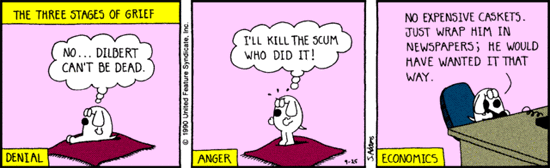
But he has begun talking about needing "one thousand days" for his work. The majority of Italians still support him, but his approval rating is rapidly crumbling from 69 percent in June to 54 in September. The philosopher and former mayor of Venice, Massimo Cacciari, is already talking about a disease that has afflicted Renzi: "Proclamationitis."
6. Preventing the next GFC
Paul Krugman’s review of Martin Wolf’s book “The Shifts and the Shocks: What We’ve Learned - and Have Still to Learn - from the Financial Crisis” is worth a read.
Krugman makes three key points:
1. The experts didn’t really see the GFC coming
2. The GFC was caused by excessive debt; no one couldn’t be sure how it would play out, but debt busts tend to be long and painful
3. Orthodox economics didn’t have politically palatable solutions – the void was filled by woolly and wrong policies:
It’s true that conventional economic analysis fell short in the face of crisis. But when policymakers rejected orthodox economics, what they did by and large was to reject it in favor of doctrines like “expansionary austerity”—the unsupported claim that slashing government spending actually creates jobs—that made the situation worse rather than better.
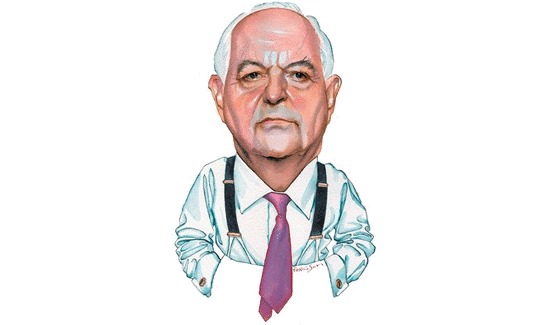
Martin Wolf
7. Economists have transformed the world
Economics and economists are "often unnoticed or scorned by the public, are actually the plumbers of modern society."
The Economist’s review of "Trillion Dollar Economists: How Economists and Their Ideas have Transformed Business" by Robert Litan is now on my reading list:
Mr Litan’s book is perfect for those who are puzzled about why economics is still so in vogue, despite the field’s anni horribiles following the financial crisis. He demonstrates how every aspect of modern society has been touched by economic thought. Those with no training in economics will benefit from a work that not only introduces abstract economic theories but also shows where they came from. Even the geeks could learn a thing or two from it.
8. Fancy modelling vs common sense
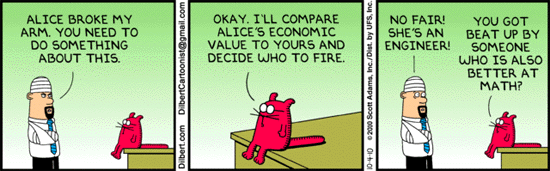
Better computers and sophisticated software mean that financial and predictive models are becoming more complex. But are they any better? Not really.
The HBR blogs about the use of complex models in predicting if a retail customer will make a repeat purchase. Complex models are at best a little better.
In complex situations, common sense may in fact be better:
Financial markets are rife with uncertainty and correlation — and the correlations are strongest when the uncertainty is greatest (think of the parallel downward trajectories of lots of different asset classes during the financial crisis of 2008). Sure enough, while sophisticated financial models performed poorly during the recent financial crisis, simple market heuristics (buying stocks with low price-to-book-value ratios, for example) have withstood the test of time.

9. Will robots take your job?
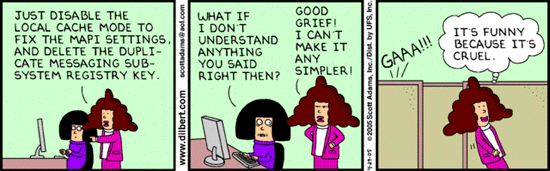
The inexorable rise of technology is rendering some industries, occupations and skills obsolete.
The ravages are clear in the hollowing out of manufacturing in NZ.
The new stars, like software programming, typically employ fewer people but with high incomes. This creates an urgency for swift economic reforms.
Yet although governments can mitigate the problem, they cannot solve it. As technology progresses and disrupts more jobs, more workers will be employable only at lower wages. The modest earnings of the generation that technology leaves behind will need to be topped up with tax credits or wage subsidies. That need not mean imposing higher tax rates on the affluent, but it does mean closing the loopholes and cutting the giveaways from which they benefit.
10. Repay or repent
The world hasn’t really deleveraged since the GFC, according a fascinating new report by CEPR. While parts of world repaid debt, others took it on. The risk from excessive borrowing has been a game of musical chairs, without a fundamental fix.
The authors suggest that:
…the policy path to less volatile debt dynamics is a narrow one, and it is already clear that developed economies at least must expect prolonged low growth or another crisis along the way.
They propose low interest rates for longer alongside fundamental reforms:
…successful exit from a leverage trap also includes appropriate fiscal and macro-prudential policies, together with the restructuring of private-sector (bank, household, corporate) debt and sovereign debt where required.
12 Comments
"The bill for corporate welfare is huge – and largely hidden.............But corporate welfare? The government has itself acknowledged: “There is no definitive source of data about spending on subsidies to businesses in the UK.” The numbers are scattered across government publications and there is not even any agreement on what counts as a corporate handout."
If we don't know how much it is, and can't even agree on what counts as a 'corporate handout', how does he manage to confidently state the bill is 'huge'?
#1 Corporate Welfare
I heard the Movie people talking on BBC about how good they were for the British economy. They make Dr Who in Britain as they make the Hobit in NZ.
By moving out of California and into Britain, NZ, Australia and elsewhere they are now in a prime position to play those contries off against each other. Who will give the the best Corporate welfare gets to make the movie.
Best we turn our backs on the movie industry.
#4 dairy prices:
FOAF went to a Lincoln Uni Model Farm presser the other day: I have the handout.
2013/14 figures for their 610 coos-in-milk operation:
Soil types:
Free-draining shallow stony soils (Eyre soils) 5%
Deep sandy soils (Paparua & Templeton soils) 45%
Imperfectly drained soils (Wakanui soils) 30%
Heavy, poorly-drained soils (Temuka soils) 20% Irrigated ha 161KgMS: 276K
Payout/KgMS: $8.50
Supplement KgDM/coo 507
Est pasture consumed tDM/ha 14.9
Days in milk 259
Wintered off-farm - whole herd, 11.4 weeks
FWE/KgMS $4.28
As FWE is awfully close to the new season's payout once interest, drawings etc are added in, it's gonna be an Interesting season......strict attention to that oldest of forecasts - CashFlow - will suddenly be back en vogue....
#8 is basically the very well know problem of overfitting, if you make you model too specifically tailored to the ideosyncracies of the data it is built on, it becomes worse at general prediction. There are established methods for dealing with this, but I have no idea how widely they are used in economics. That said there is a lot of misuse of numbers out there, I was reading this good blog post on A/B testing recently.
http://blog.sumall.com/journal/optimizely-got-me-fired.html
Technology brings change not necessarily unemployment. I have a great grandfather who a hundred odd years ago did an apprenticeship in coach (horse) building -bad adaptive choice. But on the other side of the family a grandfather became the Dunedin secretary of the AA -good adaptive choice.
I believe technological and societial change were more rapid a hundred years ago than it is today.
A thought provoking list of articles. The currency/exports/economists generally/preventing the next GFC/corporate welfare articles prompted me to reread some of L Randall Wray's views in what he calls Modern Monetary Theory.
Relatively detailed principles of MMT
A more simple look at the role of money, deficits and saving.
The fallacy of composition and its relevance to budget deficits.
I find Wray's logic compellingly simple, if at times a little counter intuitive, mostly because of the paradigms we've all grown up with, and partly because we try and extrapolate our personal circumstances onto a national economy, in a "if only the government ran the economy like I run my household" kind of way, when actually at an aggregate national level an economy works quite differently to a single household.
If you have a spare half an hour, they are worth a read.
I will have a go Stephen, although I don't have time to give the matter more than a cursory look. Likely it will ferment and I will come up with more later. Actually I will do this in more than one bite as i just said something to someone else that is pertinent. In relation to this keep in mind that bonds are issued at interest, which is a future claim on production.
Now keep in mind that there won't yet be a catastrophic collapse of society, that will happen slowly at first. What will probably have to happen though is a reset on the money supply. The financial system needs growth or it fails, so right now there is a divergence between the slowing rate of growth in real wealth (or production) and the financial claims on future growth that are still increasing in rate. Sooner or later that has to be reconciled and it doesn't take shrinking growth to necessarily be the catalyst. Simply not growing fast enough will do the trick.
Stephen those links make sense on the face of it. If you think back to posts I have made in the past thought that growth, or what we think of as wealth creation, is essentially the consumption of resources. If the private sector are not doing it then the government can pick up the slack. This can be done by spending on healthcare, education or other essential services, which in turn spend into the private sector with their wages. Or it can be done more directly with infrustrature projects where the consumption of resources is more assured.
But there is also a third aspect in play. By issuing more bonds than the private sector requires then what is occuring? Well what is likely happening if the issuance is not being matched by the consumption of resources then you have paper wealth. Like all virtual wealth it is a promise for the future to pay, and a promise on future resources. Where is this current wealth from bond issuance being accumulated? I don't think Joe public isn't buying them, it is probably going to the banks and big retirement funds. I mean bonds are a sure bet right? You know that more can simply be issued to cover the interest and eventual capital return. Isn't that a ponzi scheme?
Interest is always the killler. Possibly you will find that the treasury issuance before the Fed did not have the interest component.
One of the more important points contained in the second link is that anybody can issue money, the only problem is getting people to accept it.
That leads to the shadow banking world. Although shadow banking has no ability to issue money my belief is that this system operates by creating financial instruments that are money like. Derivatives, and thereof, of money if you like. This works because they can trade these instruments or use them as collateral with other non bank financial institutions. As long as everybody plays the game and accepts each others paper wealth it works very well. Problem happens when there is a loss of faith.
I think that the aggregate national level economy is rather similar to a single household - if that household is properly and tightly run. Or do you think countries can actually get rich by constantly spending more than they earn/own...
cowboy,
At a national NZ Inc level I agree totally with you, and that is why at one point I talked of supporting a CAMELOT party if there was one (or the Current Account Matters a Lot). Randall Wray points out a truism of economics 101 that assuming a current account exactly in balance, then a government deficit equals private saving, and vice versa. So again, CA in balance, if we want our government to be fiscally conservative and in surplus, the private economy must go further in debt. You can argue the cause and effect, but the inverse correlation is exact. The fiscal deficit is not too important if the current account is being managed.
We of course do not have a current account in balance or surplus, and haven't for forty plus years. So by running a fiscal and often a private deficit, we are adding to the wealth and savings of foreigners, and depending slightly on how that deficit is spent, spending our future wealth with gay abandon. This is entirely manageable by monetary policy, when you extend out Randall Wray's logic. There just isn't the political will, as it would mean less spending power through a currency depreciation in the short term. It would not though mean the government would have to spend less money. They have unlimited amounts up to the point where inflation kicks beyond whatever limit is deemed ideal, when mixed with other targets the country wants.
Labour were very close with their proposed amendment to the Reserve Bank Act to factor the current account as a target; and that was the single reason I supported them strongly. The Reserve Bank have the tools, or at least can easily have, and have enough independence to look past election cycles. So we have had a lost opportunity, and I doubt English and Key can go against either their populist or conservative natures to consider a change, even if some of their rhetoric post election has been promising.
A family's finance's shouldn't be in balance (ie living hand to mouth) nor should it be without debt (as I expect every PI and business owner on this board will agree regarding leverage). The issue of family debt is what you spend it on.
Now if the government had unlimited amounts of money, then we wouldn't need taxation, let alone multiple types of taxation to balance the books. To say the government has unlimited funds (up to inflation) is like saying Mum and Dad have full access to the ATM because that's where money comes from.
Inflation is often -caused- by taxation. and Taxation is often used by government to "remove excess funds from circulation". This is because the funds to pay the taxes are on top of all other business costs (including the business of the sale of labour) and irreducible. Therefore they must be recovered on top of all other expenses and passed on to the customer. The more supply chain, the more people and expenses and other supplies who need their taxes paid too.
Since access to money is through banks, and few other places, interest also operates as a fiscal tax. "Opportunity cost" confirms that model.
Also Mum and Dad and the kids can also work more. Just like the government they can increase their paid hours or they can develop passive tranches. So their income is also "unlimited" just like a governments. But it costs in lifehours, how much life is a person willing to give up to recover the ability to pay $100? or $10,000. At a certain point I find myself working 15, 18, 20 hours a day, to achieve what? shelter? car? Do I really need the MacMansion? that is your family inflation. That and flatscreens in every room...(etc)
Realising that linear programming points out that taxation isn't a single line, at certain points other real world influences trim off parts of the graph. In a family, that is the absurdity of working 20+ hrs a day. Once a family or government starts operating in that part of the graph then they are causing the very issues they think they're combatting. This is due to misinterpretating the underlying principles - easy to do in a government that thinks it's got unlimited funds...just like my ex-wife who used to get staff loans from her bank.
Re no4. You gotta laugh at the effect the hypercritical US inspired sanctions against Russia are having on the UK and the EU. Polish apples, Greek and Spanish food crops and now Uk milk all down the toilet so that the UK and the Eu can suck up to the USA and pretend to take the high ground over Ukraine crsis. To summarise this crisis. The USA puts $4billion in to destabilize a democratically elected government installs its puppets and when Russia realises the threat presented, arranges a referendum in Crimea that votes overwhelmingly to join Russia. The west characterises this as an invasion and imposes sanctions.
Thank goodness NZ doesn't blindly follow the US into ill advised trade agreements or ridiculous military adventures....Oh wait a minute?
We welcome your comments below. If you are not already registered, please register to comment
Remember we welcome robust, respectful and insightful debate. We don't welcome abusive or defamatory comments and will de-register those repeatedly making such comments. Our current comment policy is here.